Click a point to jump to its film.
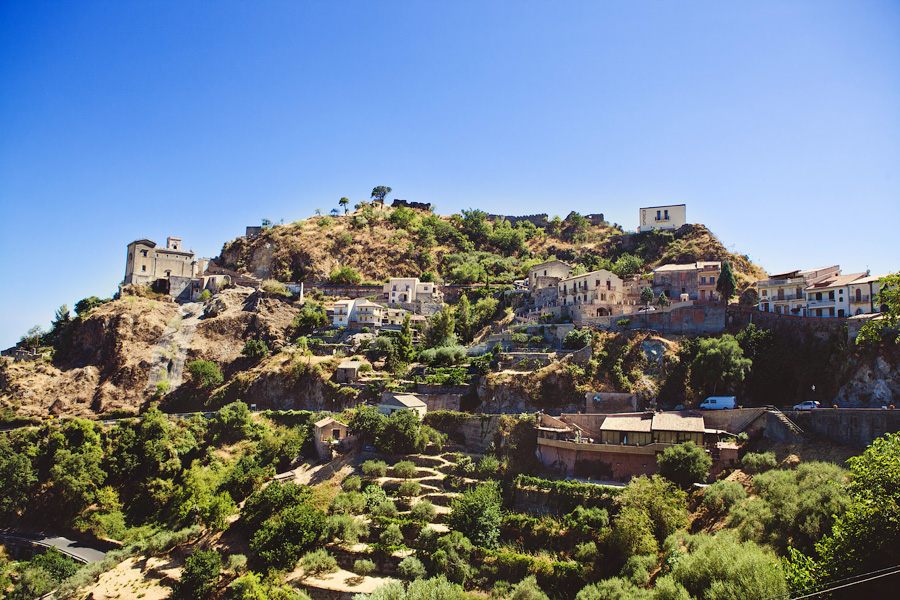
For six hundred years Savoca ran the valley below it. From the twelfth century it was the chief town of the Valle d'Agrò, holding the courts, the prison and the district offices. It lost the district seat in 1855, emigration emptied it, and in 1929 the fascist government abolished the comune and attached what was left to Santa Teresa di Riva on the coast. Savoca got its own council back in 1948.
Losing things is the long story here. Until 1492 the town had a Jewish community of two hundred and fifty to three hundred people in fifty or sixty families, weavers and dyers mostly, named in papers of 1409 and 1470.
Their synagogue stood in the middle of the town on its best ground, next to the church of San Michele and the palace where the courts sat. That is why it was taken. In 1470 the Viceroy of Sicily ordered it confiscated for standing in a Christian quarter beside the churches and the seat of justice, and directed that a synagogue be built elsewhere. Twenty-two years later the Jews were expelled from Sicily. The building was a house for centuries and a stable in the twentieth, and since the roof fell in it has been an open ruin.
The record of filming here since 1971 is thin. The Italian article on The Godfather Part II puts part of its Sicilian shooting here, where the English one names only Forza d'Agrò. A Rai film, La vita rubata, about the murder of Graziella Campagna, a laundry worker of seventeen killed for what she saw, was shot in Letojanni and Savoca, and nothing says which scenes went where. In April 2014 a beer commercial was made in Bar Vitelli, the only shoot inside that room we found recorded since Coppola's.
The village fills once a year. On the second Sunday in August, the December feast day being cold and damp here, a girl of Savoca in a white dress is carried on a man's shoulders as Saint Lucy, holding a silver palm. A rope runs from her waist to two oxen, hauled by men dressed as Roman soldiers, and the devil walks in red in a sixteenth-century wooden mask. She goes round the village three times, standing still through the temptations. Then the devil and the soldiers scatter into the alleys with the loosed oxen after them.