Click a point to jump to its film.
Sit through the end of The Godfather Part III and the acknowledgements name a commune of under a thousand people. The AFI Catalog's transcription of that list has it: Il Comune di Fiumefreddo; Il Comune di Forza d'Agrò. Coppola had first brought a camera up this hill eighteen years earlier.
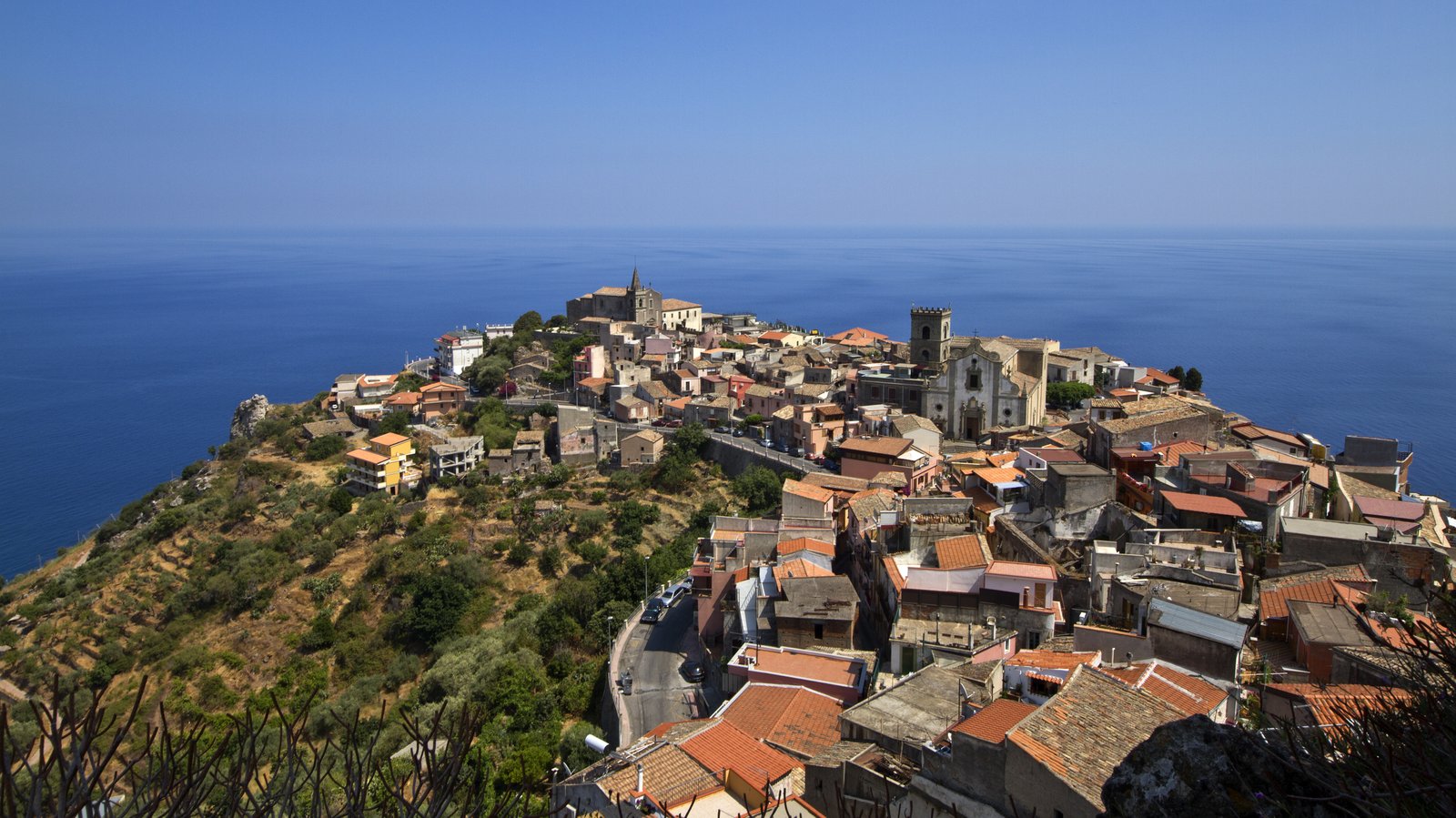
By then the village had been living on that for a while. Italian Wikipedia sets out its modern history without a footnote: over the later twentieth century Forza d'Agrò found it had tourist potential, was picked as a set by several successful films, had hotels and restaurants built, and became one of the best known destinations in Sicily. Films first, hotels after, in a place of about 924 people 420 metres above the Ionian sea.
Part III has an address for everything, if the street-by-street account in Italian Wikipedia holds: Corleone's church is the Santissima Annunziata, its main square Piazza della Santissima Trinità, and Via Belvedere is where Kay parks the car. The footnote under all of it is a New York Times feature that would not open for us.
Part II will not settle. The Independent, in 2003, put the scene where the boy Vito escapes towards America with Don Ciccio's men behind him against a church here, and both Wikipedias name the village. But AFI quotes the film's own pressbook, and the pressbook says the company was based in Taormina and shot the Corleone scenes at Sparagogna, between Catania and Enna, with the station sequence at Sparagogna's station. Nobody else names Sparagogna at all. The pressbook is the studio's own paper and the only first-hand document in the argument, which is why it is open. One level down, The Independent calls the church Sant'Agostino where the Italian sources call it the mother church, Santissima Annunziata.
Before the Corleones there was Jessica, in 1962, and it is the one film here where the village is not pretending: Jean Negulesco shot it almost entirely in the commune, with Angie Dickinson as an American midwife who upsets a farming village. Three Italian pictures of the 1970s used the place and said little about it, and none of the four has a production source behind it. The commune keeps a website, with pages for the castle, the churches and the quarters, and access rules on each. There is not a word about cinema on any of it.