Robert Roy MacGregor ran cattle on the banks of Loch Lomond and lies buried at Balquhidder, 29 km apart in the southern Highlands. The film put his house 107 km north-west of the grave, on a pebble beach at the end of a dead-end road, and gave him a different loch to look at. The film also went 210 km south-east of that beach, to a ruined castle outside Edinburgh.
11
places on the route
About 210 km from west to east — switch with the buttons above. Click a point to jump to its entry.
The film was shot entirely on location and there was no studio work. Much of the ground the crew worked on lay in parts of the Highlands that had to be reached by helicopter.
filmed herewhere it really happened
Lochaber and the west Highlands
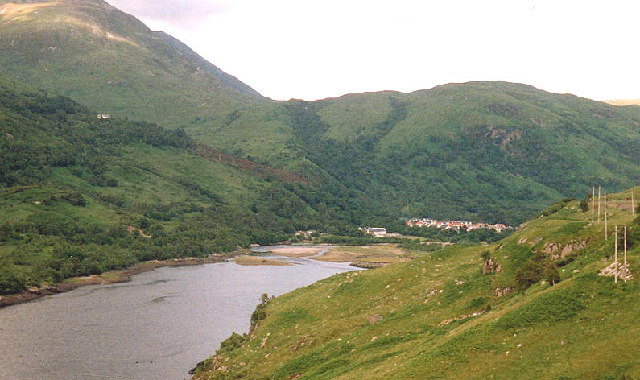
Loch Leven and Kinlochleven
The head of Loch Leven, with Kinlochleven on the flats at the far end
The opening has Rob and his men above the water at the eastern end of this sea loch.
The village at the head of it is younger than almost anything else the camera points at. Kinlochleven was laid out in 1909 as a company village for an aluminium smelter. Power from the works was free, and the village was one of the first places in Britain with electric street lights. The smelter closed in 2000. The Ice Factor climbing centre took one of its buildings and the Blackwater Bunkhouse another, and a brewery moved into the old carbon plant where the electrodes were made. It is the third brewing company in that building since the works shut.
The West Highland Way comes into the village along the military road that Major William Caulfeild drove across Rannoch Moor in 1752, and that road followed an older drove road. Cattle really were walked through here.
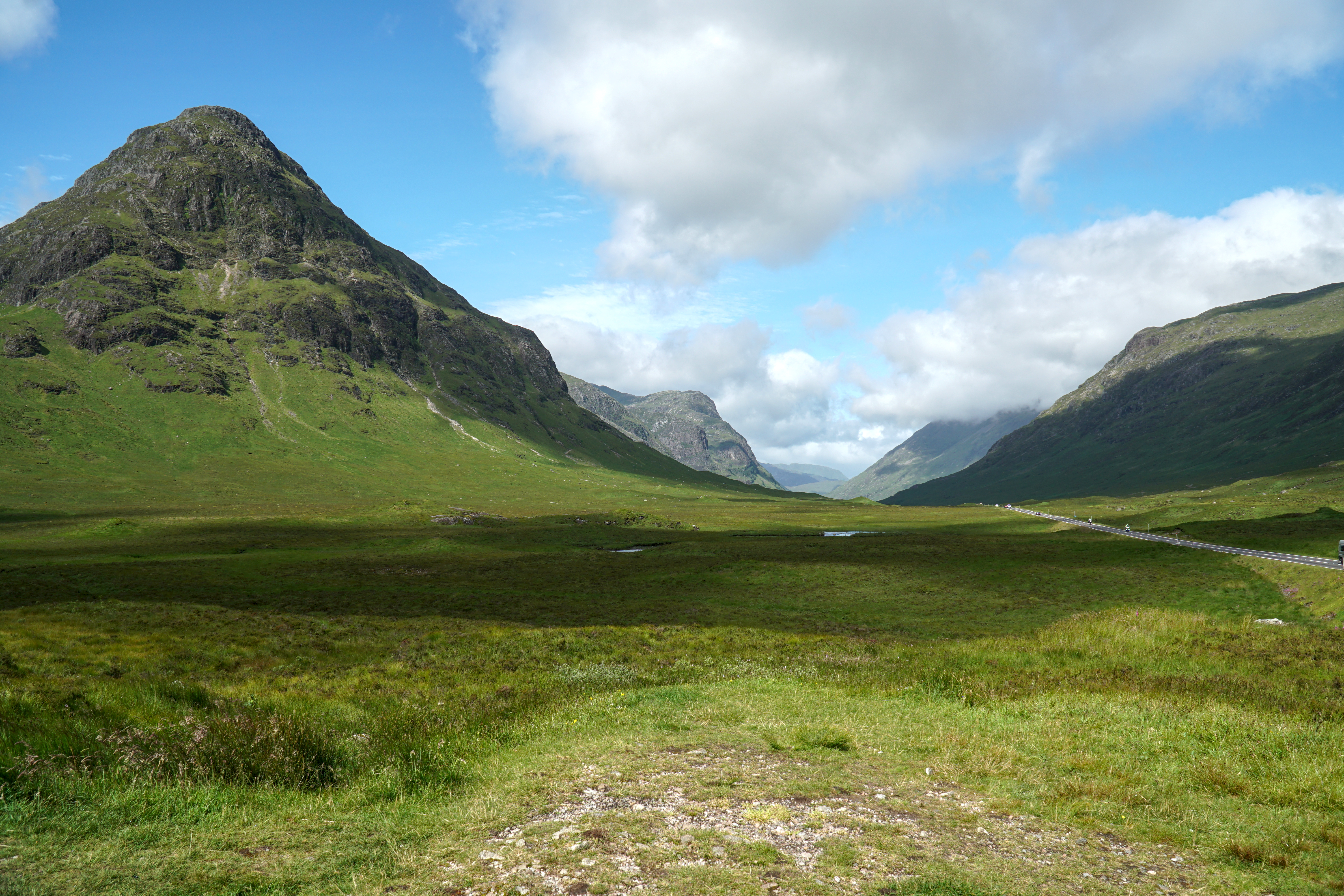
Glen Coe
Glen Coe from the north end, with the A82 running down the far side of the glen
Most of the open country in the film is this glen. It is a National Nature Reserve, and the National Trust for Scotland owns it.
It has kept working. In Skyfall, Bond and M take the DB5 up the A82 under Buachaille Etive Mor, and the house at the end of that drive was filmed in England. Outlaw King and Mary Queen of Scots both used the glen in 2018. Hagrid's hut for the Harry Potter films was built in Clachaig Gully, five minutes' walk from the Clachaig Inn.
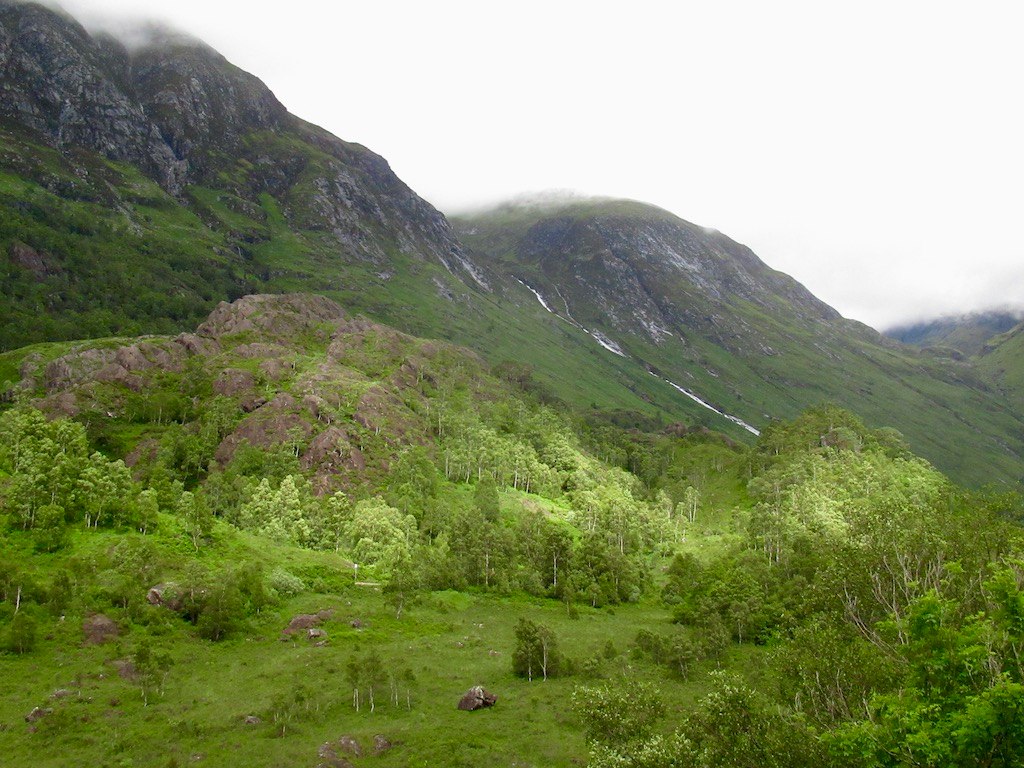
Glen Nevis
Birch woods on the floor of Glen Nevis under low cloud
The glen under Britain's highest mountain, inside the Ben Nevis and Glen Coe National Scenic Area. The Nevis Gorge and Steall Falls are at the top of it.
Braveheart worked all over this glen, and it is where Wallace runs the ten peaks of the Mamores above Loch Leven. Forestry and Land Scotland calls the car park at the mouth of the glen Braveheart. Steall Falls come back in the Triwizard Tournament in Harry Potter and the Goblet of Fire, and the glen stands behind the Quidditch matches. Two films of 1995 used the same glen and only one of them got a car park.
The ride between Rob Roy and the Duke of Argyll. Most of the film was shot in Glen Coe.
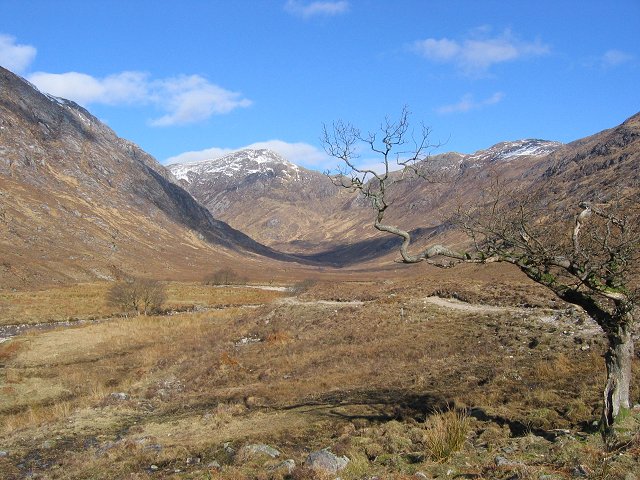
Coire an Iubhair, Glen Tarbert
Coire an Iubhair under Garbh Bheinn, where a set was put up
Richard Webb photographed this corrie in Ardgour in March 2006 and wrote under the picture that a set for this film had stood in it. The road through the glen is the A861, and Glen Coe is 24 km east. Garbh Bheinn stands over the corrie. The floor is bog and the walls are bare rock. There is no village in the glen and nothing built along it but the road.
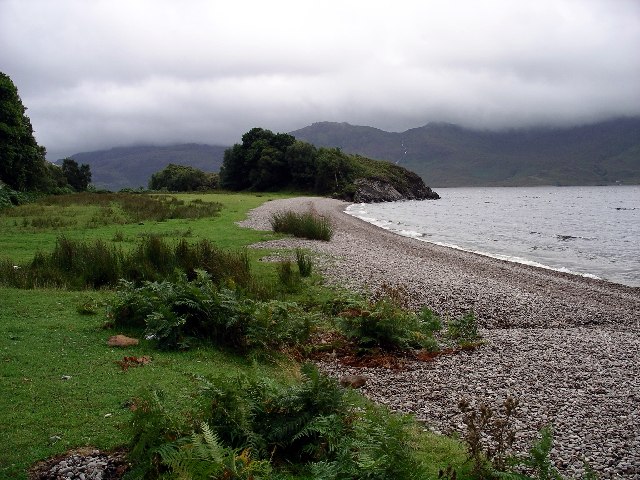
Loch Morar, north shore
The pebble beach and promontory at the end of the Loch Morar road
The MacGregor house and the settlement round it were built on a pebble beach at the end of the single-track road along the north shore, near Bracorina, and cleared away afterwards.
In the film this water is Loch Lomond, 113 km to the south-east. Loch Morar is 18 km long and 310 m deep, the deepest loch in Britain, and its bed is the lowest point in the United Kingdom. The road along the north side stops at the shore with nothing beyond it but a footpath.
The beach and the little wooded promontory beside it are still there, at the end of a road that goes nowhere else.
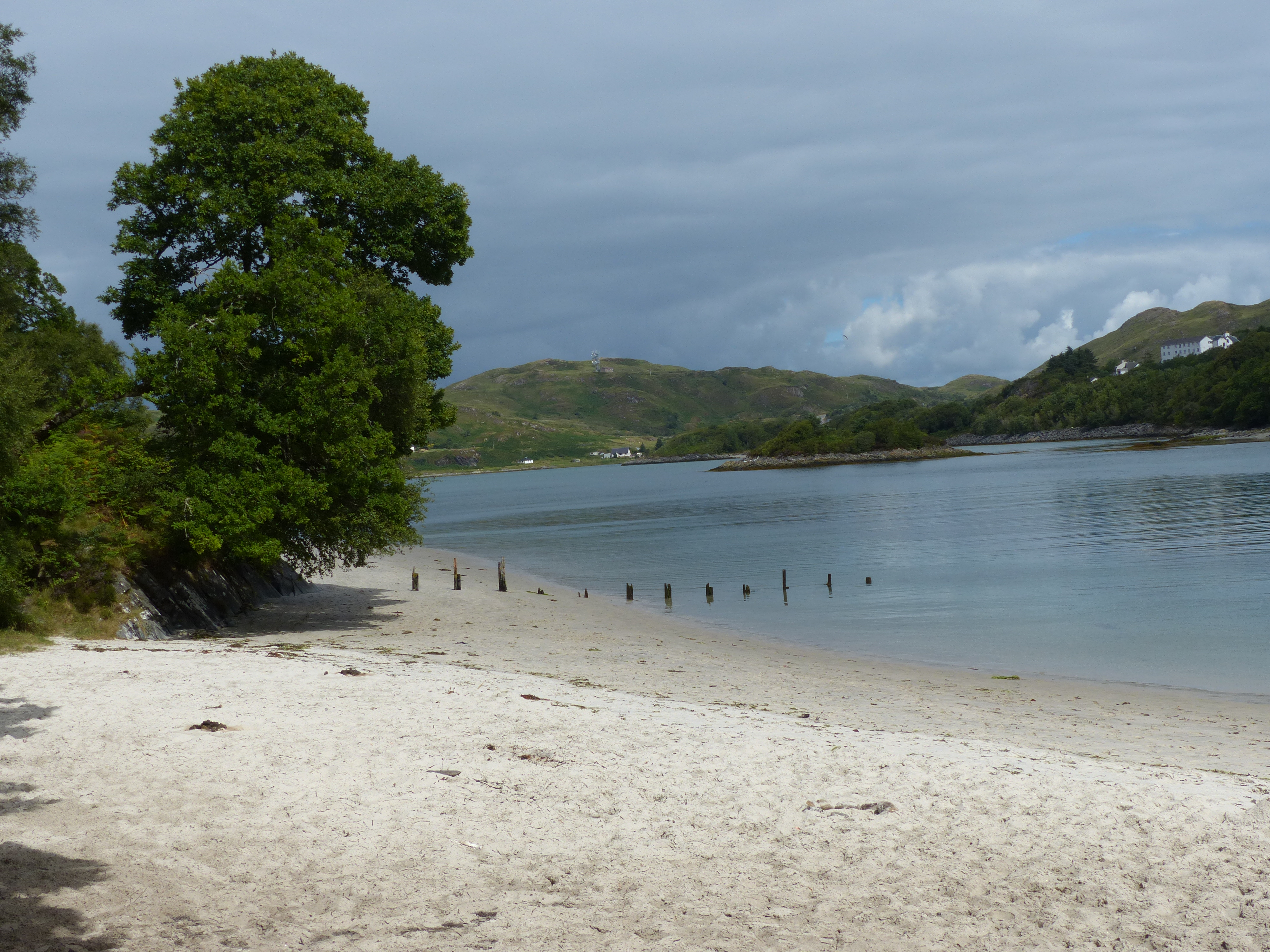
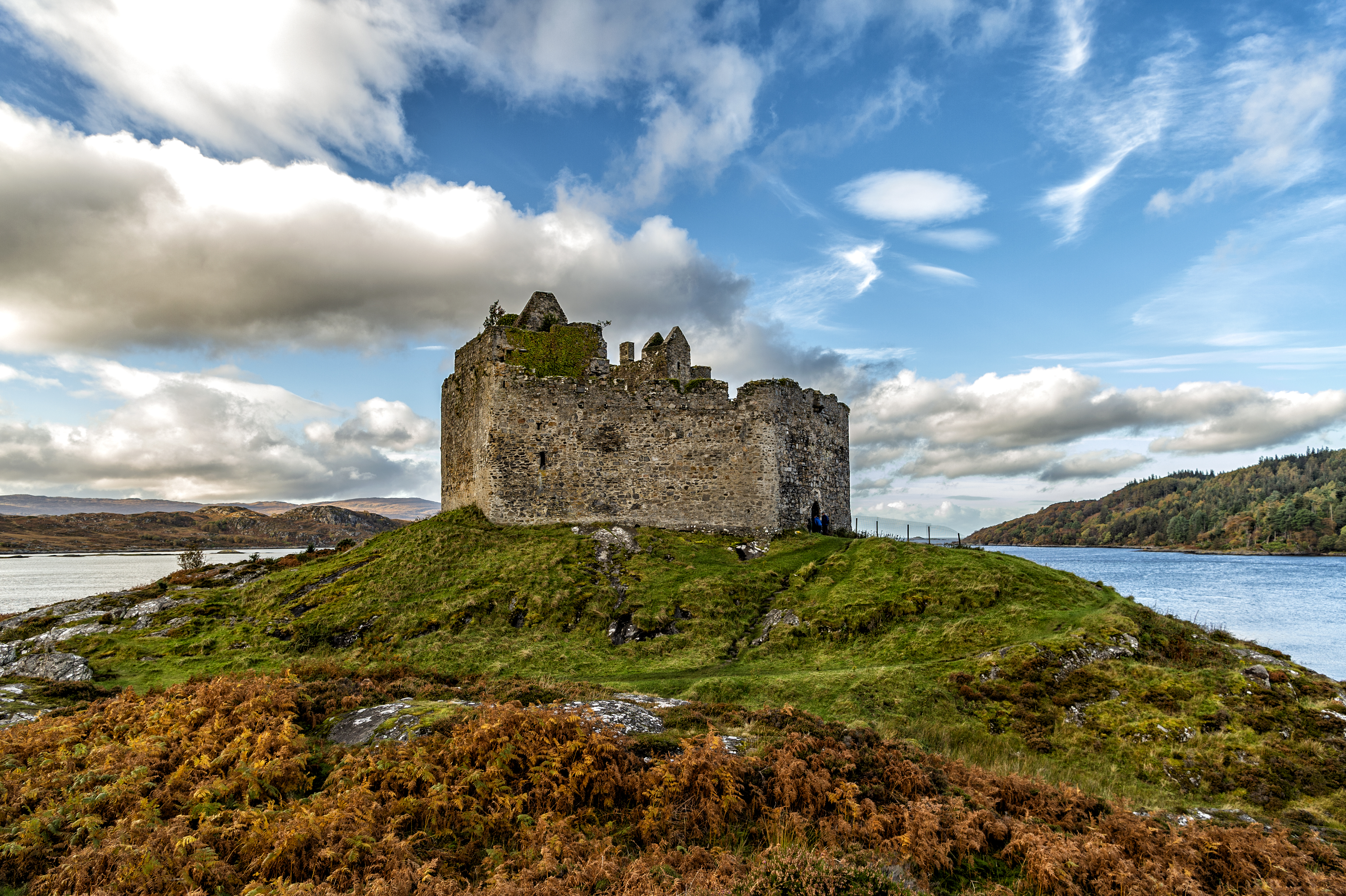
The Duke of Argyll's estate in the film, 21 km south of the Morar beach, on a tidal island in the mouth of Loch Moidart.
The castle is the old seat of Clan Macdonald of Clanranald. In the rising of 1715 a garrison of fourteen government soldiers held it, and Allan of Moidart, the 14th Chief, took it back and is said to have set fire to it himself so that nobody could use it again. He went on to Sheriffmuir and was killed there. The castle has been a ruin since. Anta Estates bought it in 1997 and proposed to rebuild. Highland Council granted planning consent, Historic Scotland refused scheduled monument consent, and a public inquiry upheld the refusal.
You can walk out across the causeway when the tide is down. There is no way into the interior, because masonry falls.
Perthshire
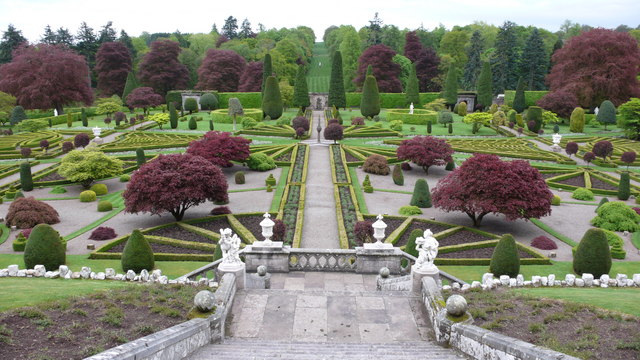
Drummond Castle Gardens, Muthill
The parterre from the top terrace, the view the film uses
The gardens of the Marquess of Montrose, the man who ruins MacGregor over a debt of a thousand pounds.
The castle went up on a rock outcrop around 1490 for John, 1st Lord Drummond. The 2nd Earl remade the gardens between 1630 and 1636 and set the sundial that still stands where the arms of the parterre's St Andrew's cross meet. The terraces were rebuilt in the 19th century and the planting renewed in the 1950s. There are eleven miles of box hedging in the parterre, ancient yews, and a copper beech Queen Victoria planted when she came in 1842. She planted two of them; one is left.
The gardens open from 1 May to 31 October. The castle does not open at all, though the gardens look straight up at it.
The same parterre plays the gardens of Versailles in the second season of Outlander. The Bruce was here in 1996 and Man to Man in 2005.
Megginch Castle, Errol
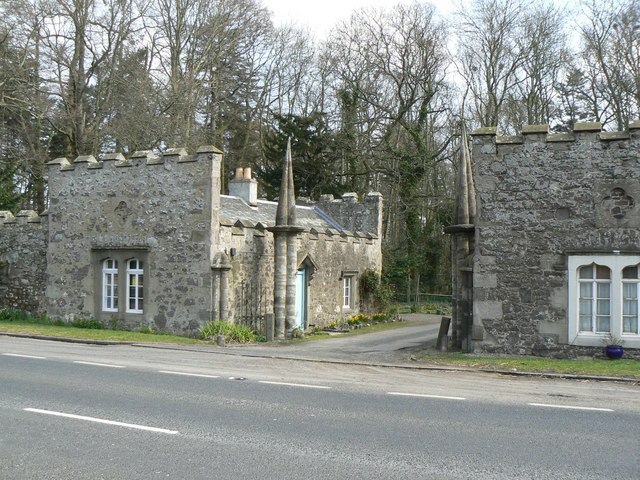
The castellated gatehouse on the road at Megginch
Photo: James Allan · CC BY-SA 2.0 · Wikimedia Commons · From this image at geograph.org.uk; transferred by User:Kurpfalzbilder.de using geograph_org2commons.
Forty kilometres east of Drummond, the village scenes were shot in the courtyard here in 1994, with two-legged and four-legged extras off the estate.
A tower and fortalice were standing at Megginch by 1460, and the first document that names the place is from 1560. John and Jean Drummond bought it in 1661 and moved their household from Lennoch near Crieff by ox cart; their descendants are still in the house. Four heavy clumps of yew are said to mark the corners of a monastic garden that was here before the tower. The beech avenue was planted as a memorial to the dead of Culloden. The gardens first opened to the public in 1855, to raise money for a school in Errol.
It is a family home and now a wedding venue, so there is no general admission. What faces the road is the north gate: two crenellated gothic lodges of 1794 with a carriage entrance between them.
Midlothian
Crichton Castle
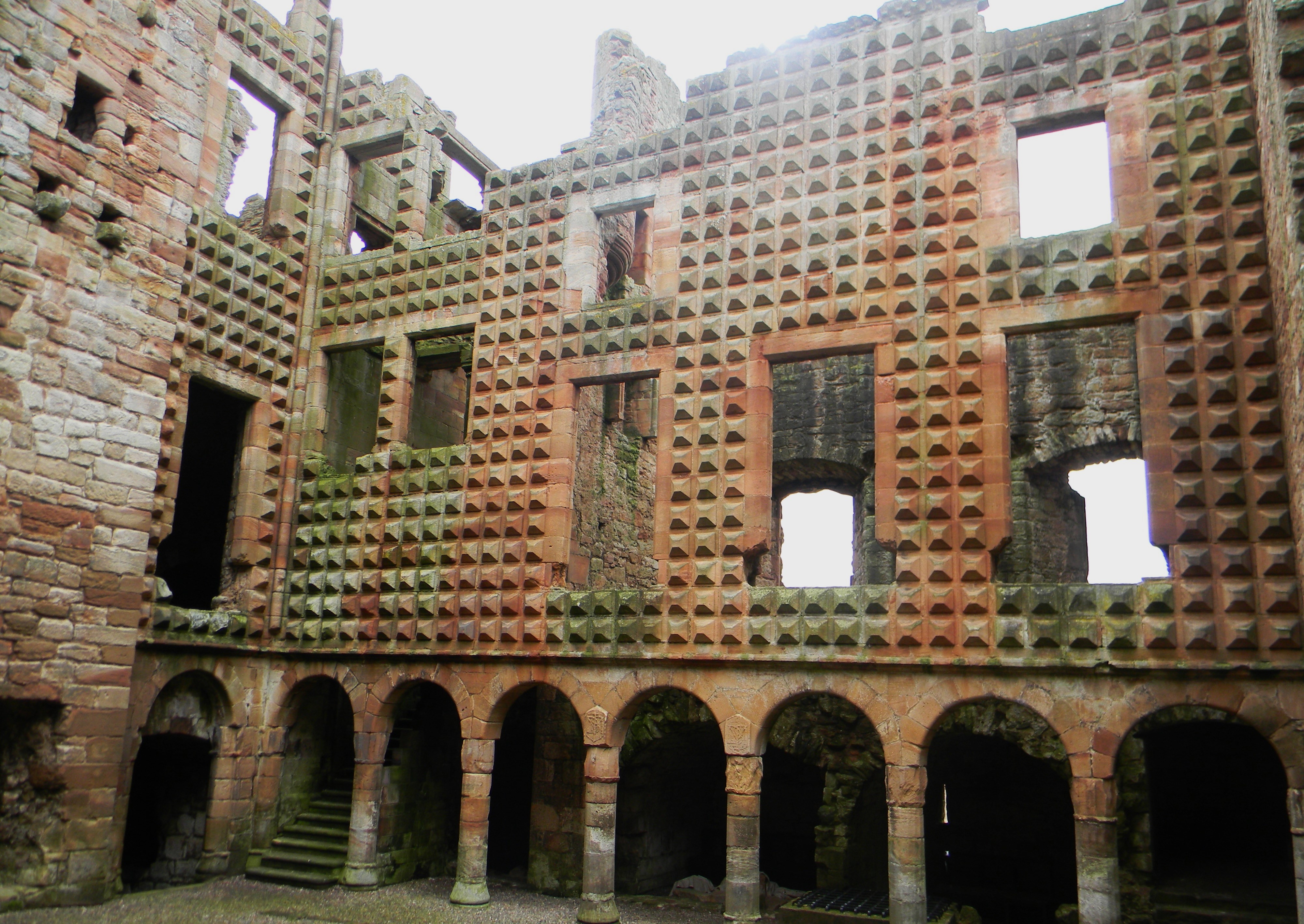
The courtyard, with the diamond-faceted north lodging of about 1580
A long way from the Highlands, 154 km from Glen Coe, on a terrace above the River Tyne. The castle is in the film in a landscape shot. Several location guides put the final duel in this courtyard. None of them names a source.
John de Crichton built the tower at the east end. His son William was made Chancellor of Scotland in 1439 and added a great hall and a kitchen around a new courtyard. In 1488 the castle passed to the Hepburns, earls of Bothwell; Mary Queen of Scots came in 1562 for the wedding of Bothwell's sister Janet. Around 1580 Francis Stewart, the 5th Earl, built the north lodging, and faced the courtyard side of it in diamond-cut stone. He also put up a stables block with an overlight cut in the shape of a horseshoe. Bats from the valley roost in those stables.
The castle is closed and fenced for conservation work. The grounds around it stay open, and the walk to them is a quiet one.
The duel
Reviewing the film in April 1995, Roger Ebert wrote that the sword fighting sequence, staged by William Hobbs, was the best of its sort ever done, and that it was one of the great action sequences in movie history. What he pointed at was what the scene leaves out. Cunningham takes a rapier, MacGregor a broadsword. The rapier keeps finding MacGregor, and the heavy sword wears him out. Long stretches of the fight are silent except for the breathing.
Hobbs co-founded the Society of British Fight Directors and had narrowly missed selection for the fencing at the 1956 Olympics in Melbourne. He said a fight had to grow out of character rather than spectacle, and that having been an actor was his advantage. The fight director Tony Wolf, writing after Hobbs died in 2018, called this duel probably the most famous of his career and described the method behind it: fighters shown as fallible people, scrambling to recover from mistakes, exhausted or enraged, slipping in the mud.
The American rating card gives three reasons for the film's R certificate. The sword fight is the first of them.
Balquhidder, where he is buried
Rob Roy MacGregor died in 1734 and was buried beside the old kirk at Balquhidder with his wife and two of his sons. No filming happened here. It is 51 km south-east of Glen Coe and 107 km from the beach where the production built his house.
The kirk was put up in 1631 by David Murray, Lord Scone, and rebuilt in 1774. It has stood roofless since the parish moved into a new church next door in 1855. The chiefs of Clan MacLaren are buried here as well, and a MacLaren trust stabilised the ruin in 1997.
The markers lie under the yews inside a low rail. The plaque on the rail makes him seventy when he died; he was sixty-three. A stone put up in 1981 reads MacGregor Despite Them.