Click a point to jump to its film.
Four men and a driver called Santiago drove 20,000 kilometres and stopped in more than 1,600 Spanish towns, photographing and sketching. They were not collecting masterpieces; they were assembling one ideal village out of fragments of the rest. The Canary Islands are missing from it because the budget would not pay for the trip.
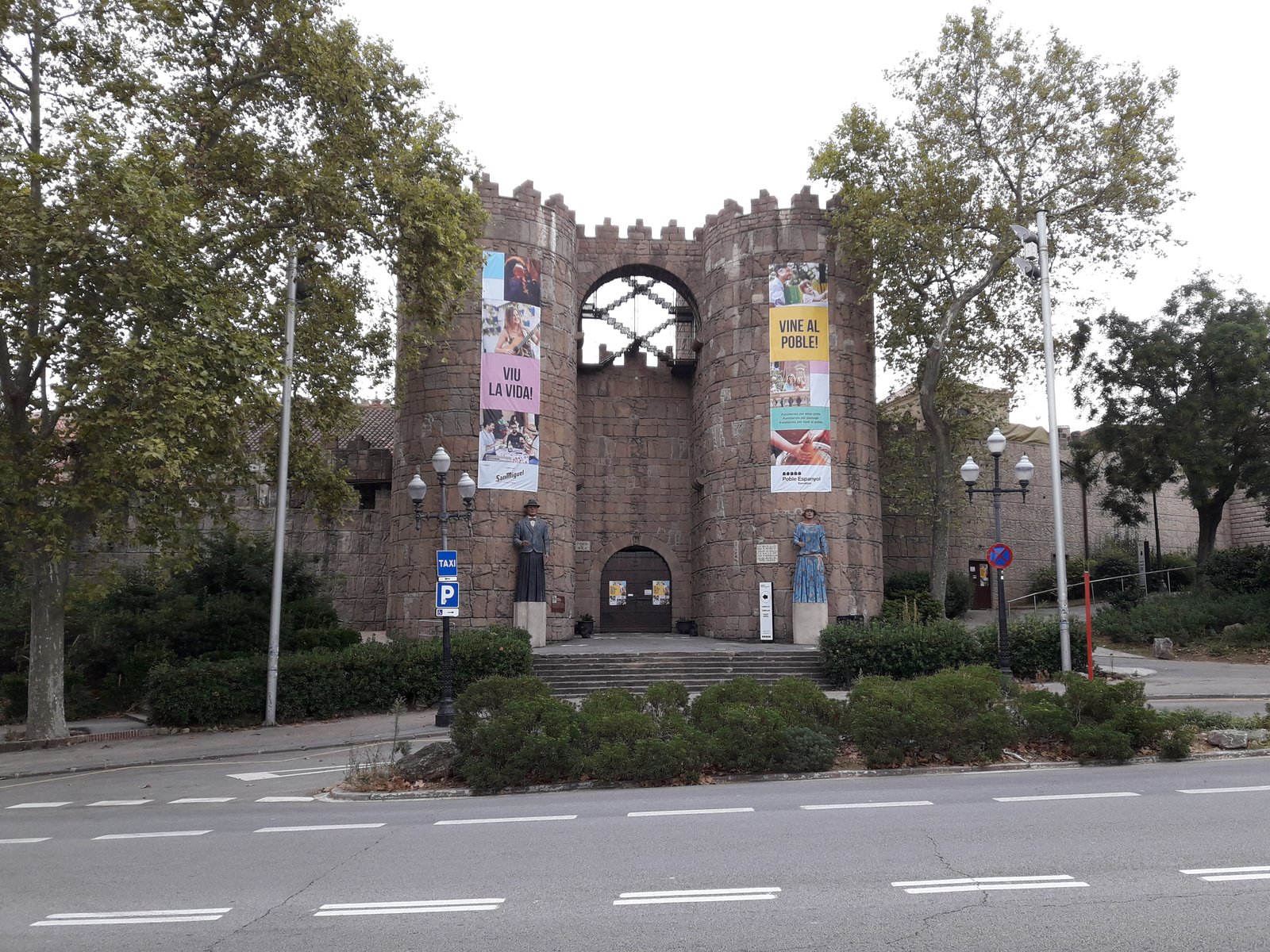
What they built on Montjuïc is 117 full-scale copies with a wall around them, a single gate and a main square taken from Riaza in Segovia. Only the parts on show are finished. Anything that does not carry the atmosphere was built plain and functional, and the ground was never levelled: the streets follow the slope of the quarry that was here first.
It was meant to last six months, the length of the 1929 exposition. It was nearly called Iberona, until Primo de Rivera's dictatorship named it the Spanish Village. During the Civil War it held prisoners as an internment camp, which the operator states in one sentence, without dates and without saying whose prisoners.
Perfume spent a week on the main square for the execution scene, longer than the production got anywhere else in Catalonia.
The list of spaces for hire runs through the monastery, the town hall and the square, and ends with the whole enclosure. The village can be rented entire.