The production designer asked Barcelona for a week to turn one street of the Gothic Quarter into eighteenth-century Paris. The city said no: tourists. What it offered instead was a single night — in on Saturday evening, shoot at first light on Sunday, strike immediately, and by Monday morning nothing left to show it had happened. Uli Hanisch says he heard himself agree to that, and that at around half past five in the morning he thought the crew would fall over.
14
places on the route
The Gothic Quarter holds most of it within 600 m; the rest runs north to the French border — switch with the buttons above. Click a point to jump to its entry.
That street was what the whole production had been waiting for. Hanisch says the hardest thing on the film was finding the place where an audience first walks into Paris; once it was found, the rest could be arranged around it. He reckons the search ran more than a year, through Croatia, France and the Czech Republic. The real Paris was discussed and dropped: the city is completely different today, says Frank Griebe, who shot the film. Croatia came next and lost out on distance. The price there was right, but the places they liked were at least two hours apart from one another, and Barcelona, dearer, kept its locations close together.
Tykwer describes the story as a road movie: orphanage, tannery, a master perfumer's workshop, the mountains, a cave, then Grasse. All of that road but one room was packed into Catalonia. Paris became the Barri Gòtic of Barcelona, Grasse the old quarter of Girona and then Barcelona again, and the tannery, the gates of Paris and the prison cell all went inside one fortress at Figueres, 118 km north-east of the Gothic Quarter. France got into the picture once: a three-day unit went to Provence at the end of June 2005 for the lavender fields, the only ones in Europe, Griebe says.
The one room the story turns on never left Germany. Baldini's workshop was built on the largest stage at Bavaria Studios in Munich, where shooting started on 12 July 2005 and stayed for fifteen days. Dustin Hoffman appears only in scenes shot there. He never travelled to Barcelona.
The Paris market
Carrer de Ferran
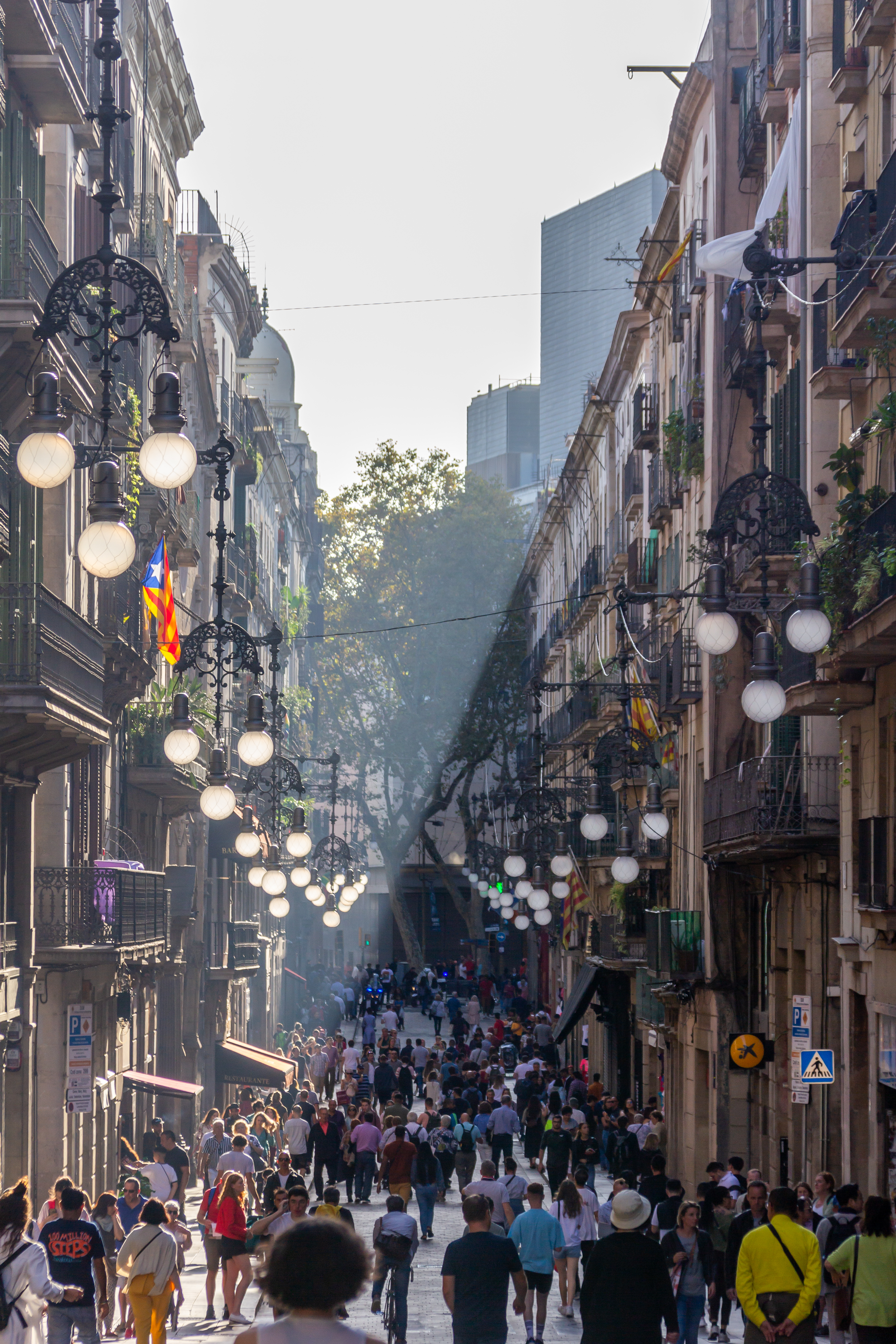
Carrer de Ferran, Barcelona, looking east from La Rambla on an ordinary afternoon.
Grenouille is born under a fish stall on the hottest day of the year, and his mother tries to hide him among the entrails beneath her gutting table. At a press conference in Barcelona in August 2005, with the shoot still running, Tykwer named the street the market was built on: Carrer de Ferran, worked over hard enough to strip its good looks off it and leave somewhere dirty, stinking and packed with extras.
Ferran runs about 350 metres straight from La Rambla to Plaça de Sant Jaume, cast-iron lamp standards down both sides, and it is one of the busiest walking routes in the old city. It is also younger than the century it was playing. The street was cut through the medieval quarter to join the Rambla to the citadel: the first stretch opened in 1826 with its façades drawn as a single composition by the city architect Josep Mas i Vila, and the full length was not finished until 1848. It is named after Ferdinand VII.
The market days ran on a hard clock. The crew fouled up entire stretches of road and could shoot on them only from 8 until noon; a dirt unit of about sixty young helpers laid the filth with buckets and hoses and had to take all of it away again the same day, without a trace. Extras were in the chair at one in the morning, wigs and bad teeth and the rest of it, because the job took more than six hours. Some of them were tradespeople doing on camera what they did for a living, fishmongers among them; the rest had been taught the trade they were playing. Anything too modern went under sheets of latex stretched over the houses — cables, window frames. Bernd Eichinger, who produced the film, said afterwards that some streets had to be filled with mud and mire for two weeks, and that not one resident ever complained.
Two squares in the old city
Plaça de la Mercè
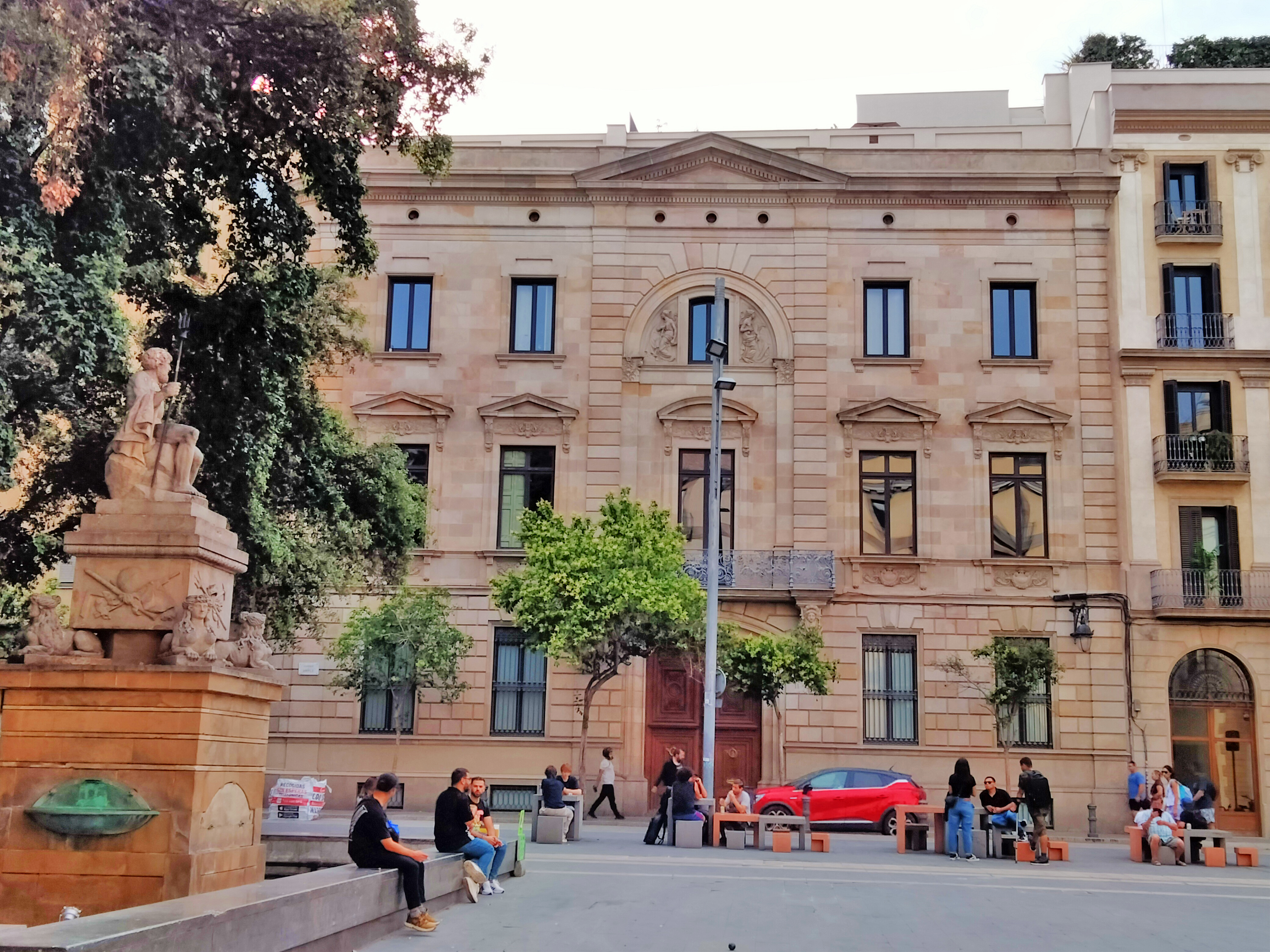
The Neptune fountain end of Placa de la Merce, with the former Credit Mercantil building behind.
Two and a half tons of fish and one ton of meat went down on the paving of a restored Barcelona square, the production notes say, and the smell carried for miles. Tykwer looked back on those days fondly. The notes call the place a beautifully restored city square and never say which one, and no other account of the shoot fills the gap.
La Mercè is one of the squares the production dressed as period France: a wide open space 400 metres down from Ferran and two minutes from the harbour front, the baroque façade of the basilica on one side, nineteenth-century ashlar across from it, a Neptune fountain and benches at the far end.
Plaça de Sant Felip Neri
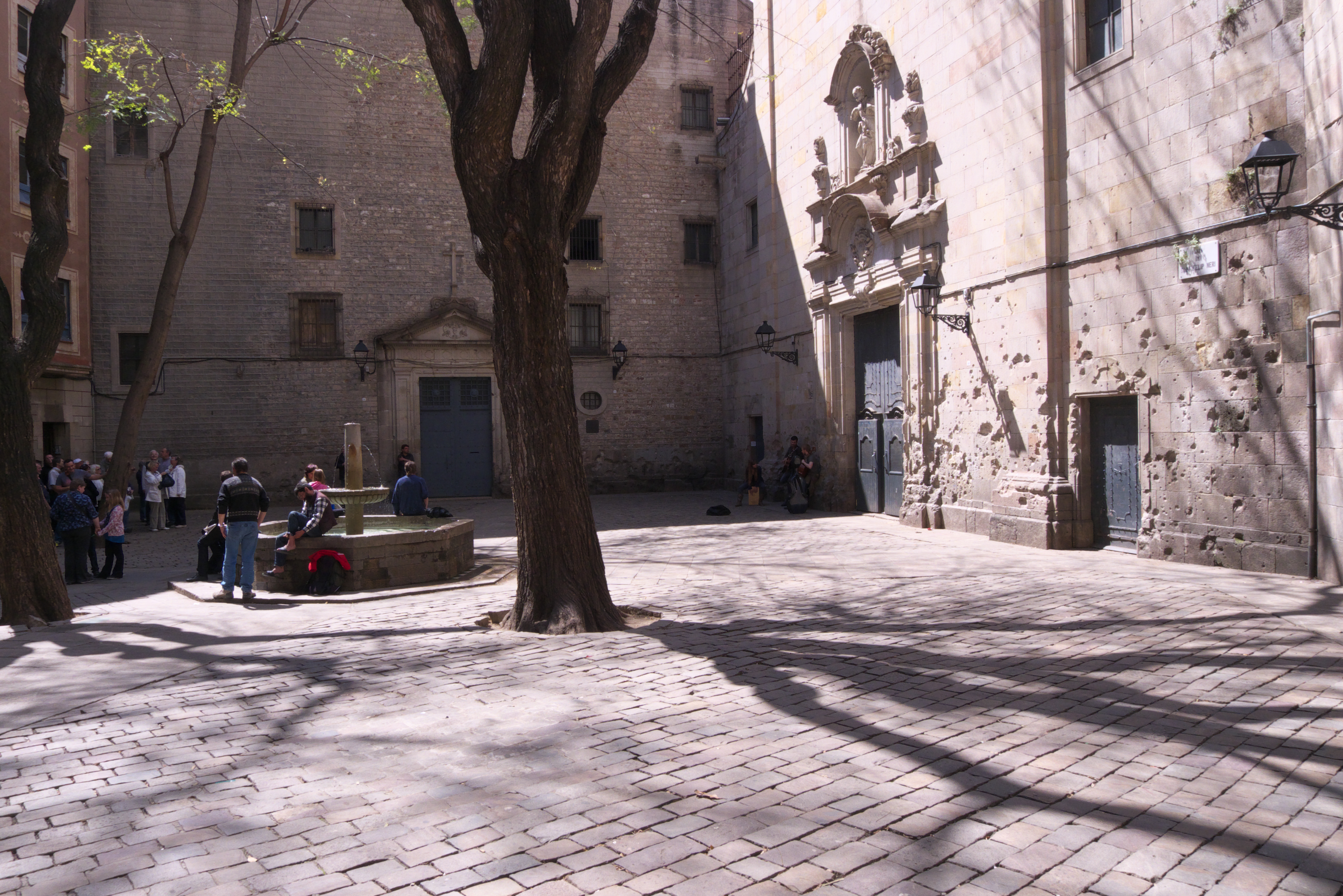
Placa de Sant Felip Neri, Barcelona: the fountain, the plane trees and the shrapnel-scarred wall of the church.
The production dressed this square too. It is the opposite kind of space to Plaça de la Mercè, enclosed and quiet, two hundred metres north of Ferran and reached by two narrow lanes off Carrer del Bisbe: an octagonal fountain in the middle, two big plane trees over it, a school along one side that uses the square as its playground. The stone at the foot of the church is chewed and cratered. A Nationalist bomb fell here on 30 January 1938 and killed forty-two people, most of them children who had gone down into the church basement to shelter; a second bomb caught the people digging survivors out. Two of the Renaissance fronts on the square are not native to it either. They were taken down stone by stone elsewhere in the city, where new avenues were being driven through, and rebuilt here afterwards.
The back lot at Figueres
Castell de Sant Ferran
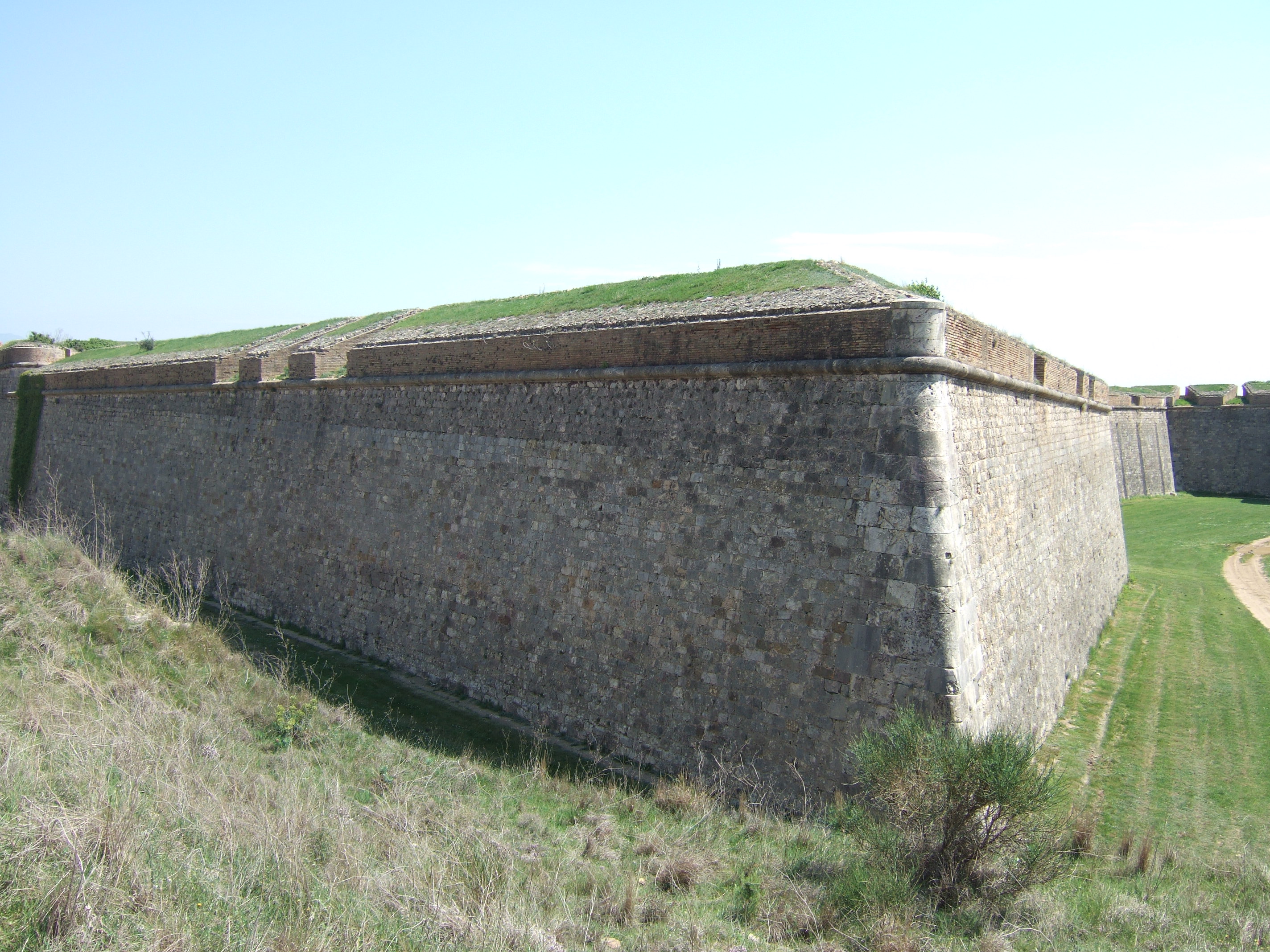
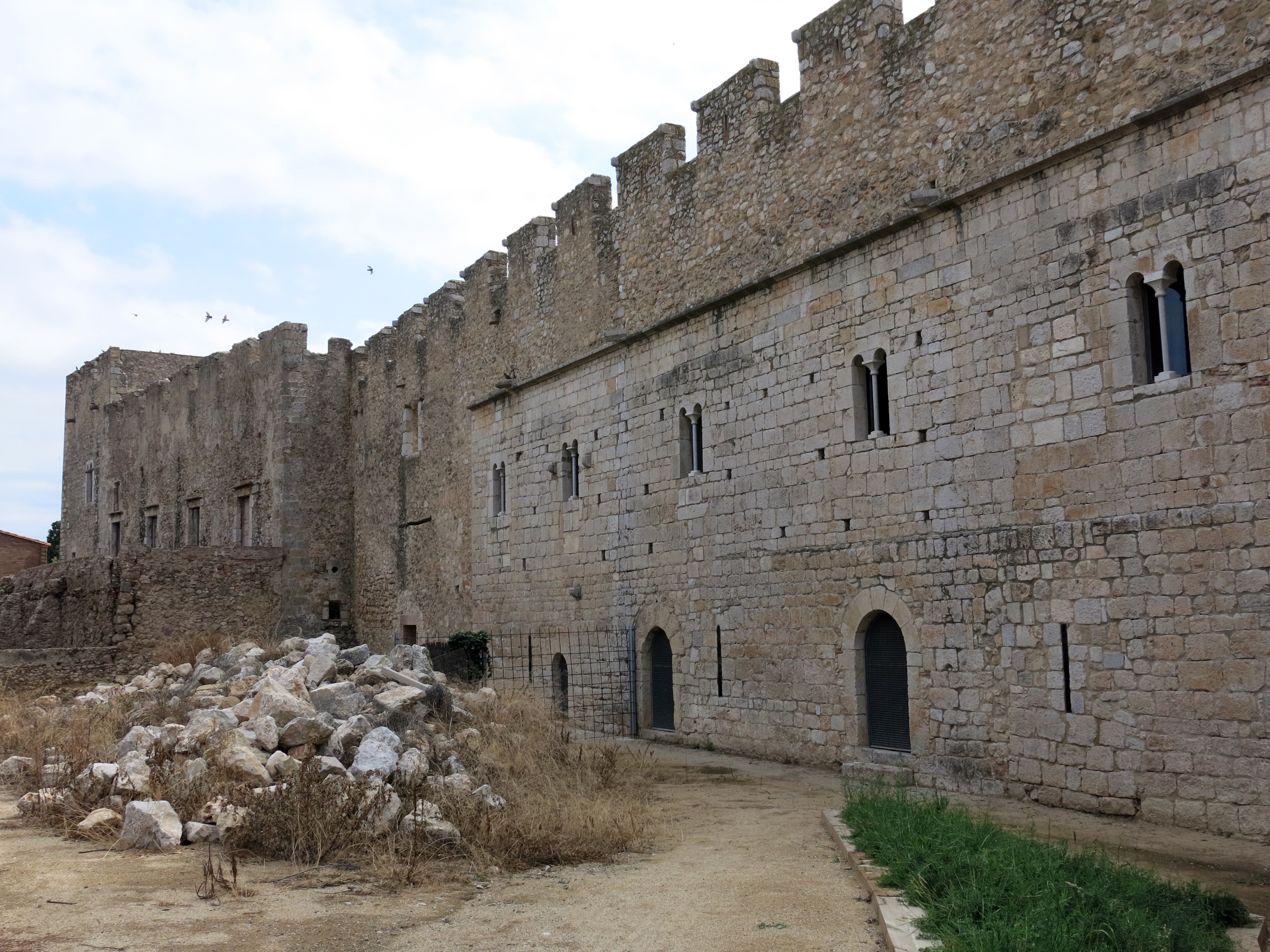
A bastion and the moat of the Castell de Sant Ferran, Figueres.
Grimal's tannery, where the boy is put to work as an apprentice. The gates of Paris. The cell where Grenouille is held after his arrest, which is the fortress's own prison doing the job it was built for. Fifteen days of the schedule went to Figueres, Dalí's town, and the fortress was what Griebe called the back lot — the tannery, the dungeon and anything else that came up. The cave in the Massif Central, where Grenouille lies in the dark and works out that he has no smell of his own, was built in Figueres too.
The fortress is the same age as the story. The first stone went down on 13 December 1753, and it is the largest monument in Catalonia: about 3.1 km round the covered way, walls 15 m thick, a moat of some ten hectares, eighty-nine casemates, eight cisterns. At the bottom of the moat on the east front stands a double-vaulted hall built to stable three squadrons of cavalry, 450 horses.
The prison outlasted everything else. On 1 February 1939 the last prime minister of the Republic called the Cortes together inside the walls for their final meeting on Spanish soil; a week later, with Franco's army coming up, the retreating republicans blew up the arms stored there and took part of the fortress with them. The new regime then held thousands of returning republicans in it before moving them on to other camps, and the army kept it as a military prison for most of the rest of the century.
Grasse is Girona
Pujada de Sant Domènec and the steps to Sant Martí
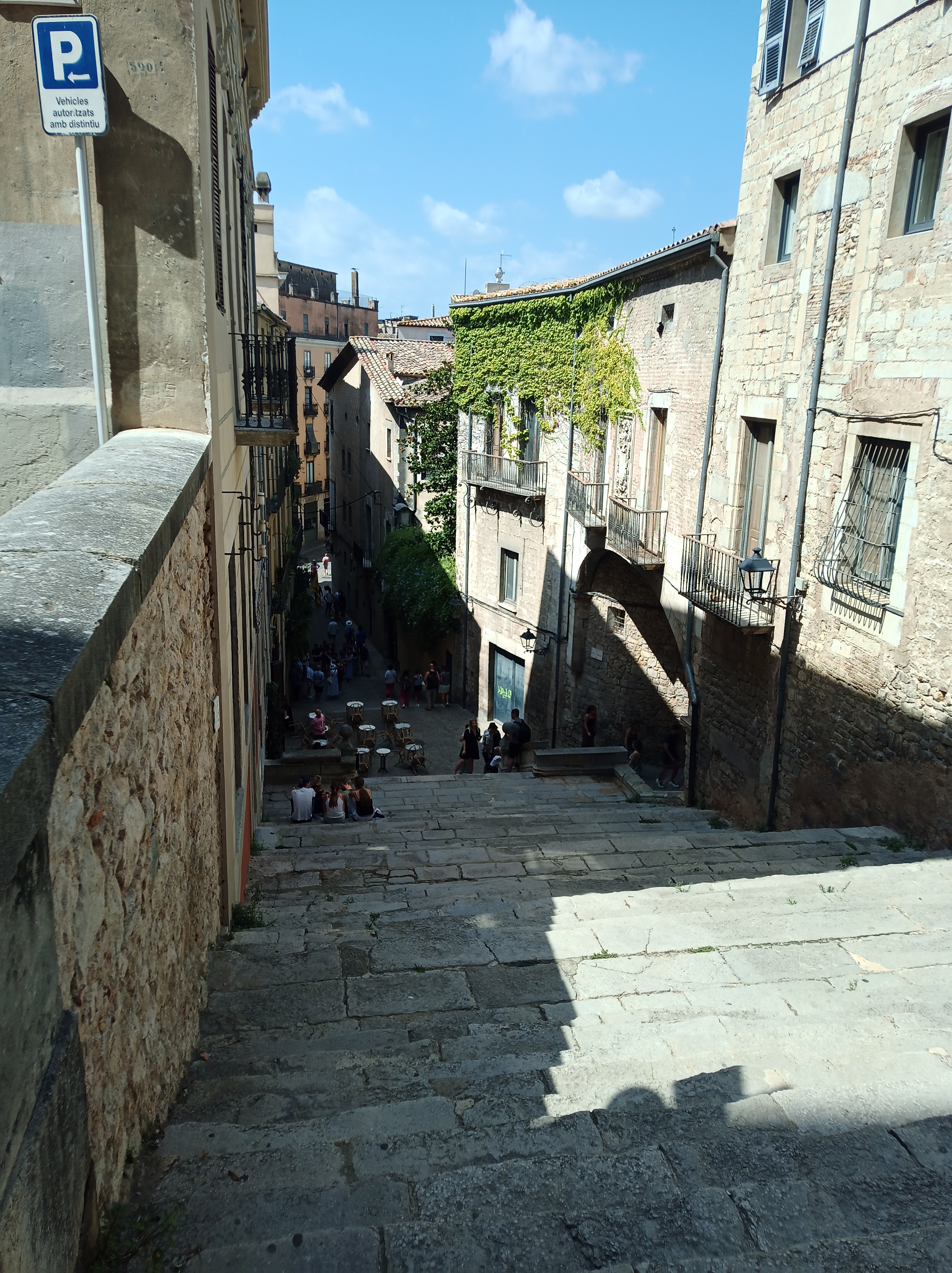
Pujada de Sant Domenec, Girona: the stepped street of the Barri Vell seen from the top.
The crew had eight days in Girona. Traffic was cut from the 19th to the 24th of September 2005, and the town came apart before it could be dressed: road signs, street lighting, drainage channels and street furniture all lifted out. The façades of some of the buildings were made up with earth and other organic matter, to be washed off when the shoot was over. About two hundred people from the town were taken on as extras, and they dressed and had their faces done in the Sant Domènec theatre. Tykwer had said three weeks earlier, in Barcelona, that Girona was chosen because it looked like Grasse. Edmon Roch, one of the film's producers, is from Girona himself.
Two stairways come together at the bottom of the same slope, thirty-six metres apart: one climbs to the old Dominican convent that gives the street its name, the other to the church of Sant Martí Sacosta. On the Sant Martí flight, Grenouille kidnaps a red-haired prostitute. The arch of the Casa Agullana crosses the lower steps, and there are café tables at the foot of them.
Other crews have worked the same stone. Arya Stark's escape in the sixth season of Game of Thrones was filmed on this street in September 2015. David Trueba shot Soldiers of Salamina from inside Le Bistrot, the restaurant on the right-hand side of the steps, with Ariadna Gil in the chair where the writer Javier Cercas had heard the story behind it. A minute away, on the cathedral stairway, Jaime Lannister rode up on horseback; between 20 July and 3 August 2026 Disney's live-action Tangled used that stairway, these steps and stretches of the city wall.
Jardins de la Francesa
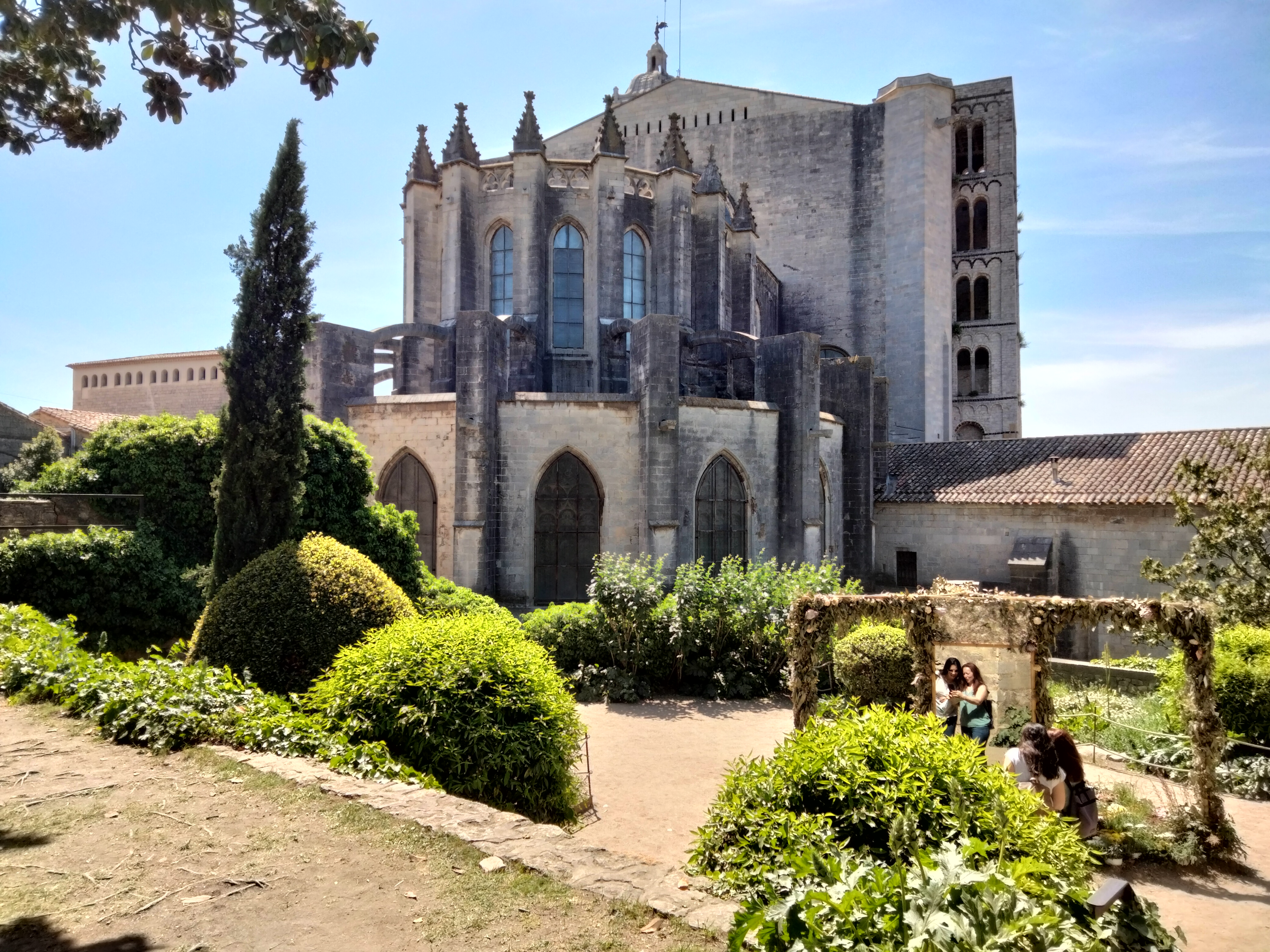
Jardins de la Francesa, Girona, under the apse of the cathedral.
A strip of terraces and box hedge inside the medieval wall, directly under the east end of the cathedral, on the walk that runs along the ramparts. The steps of Sant Domènec are 280 metres away. This garden is part of the Grasse that was built in Girona.
Girona also provided the house and workshop of Madame Arnulfi, where Grenouille learns enfleurage, the extraction of essential oil from flowers. Several mountain and forest scenes were shot in the country around the town.
Grasse is also Barcelona
Parc del Laberint d'Horta
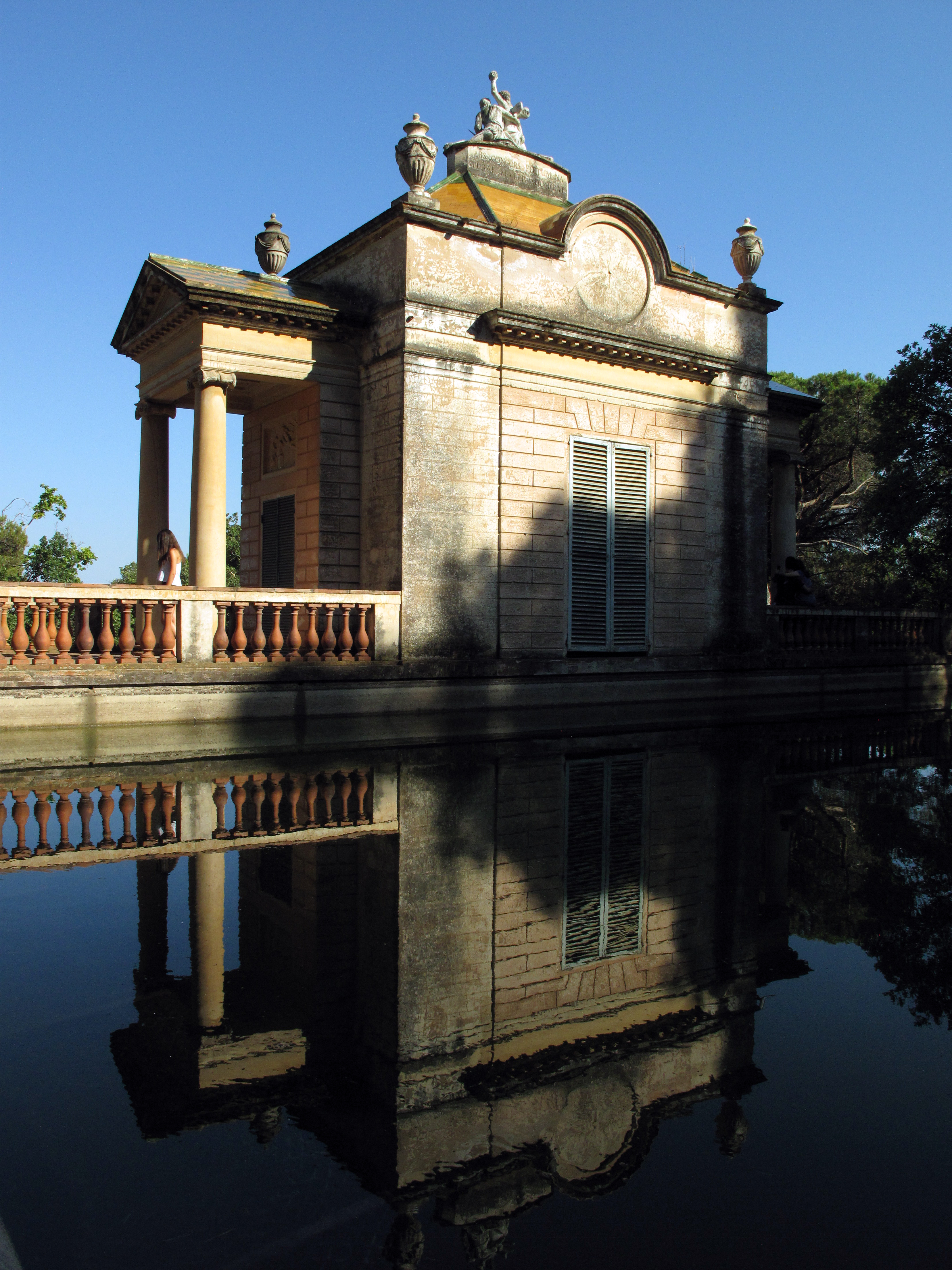
The neoclassical pavilion and the still water tank in the Parc del Laberint d'Horta.
Barcelona had 29 days and a crew of 350, and it did double duty: besides the streets and alleys of Paris it gave the film Pelissier's perfume shop, where Grenouille first smells scent out of a bottle, the cathedral of Grasse, Richis's villa and the town square of the execution.
Alan Rickman described the house his character lived in as a derelict place in the middle of Barcelona where the crew shifted a foot of rubbish off the floors and found marble underneath, painted the walls, moved in antique furniture, and got a terrace for the birthday scene and a maze for his daughter to get lost in.
Garden scenes were shot in this park, seven kilometres up the hill from the Gothic Quarter. It has a maze of its own: 750 metres of clipped cypress on the lowest terrace, a marble relief of Ariadne and Theseus at the entrance to it and a statue of Eros in the middle. Above the hedges a balustraded double stair climbs the hillside to the pavilion. The garden was laid out from 1791 for the Desvalls family in neoclassical taste, extended a century later in romantic taste, and handed to the city in 1967; it is municipal and ticketed. Filming in it is not allowed at weekends or on public holidays.
Elsewhere in Catalonia
Castell de Requesens
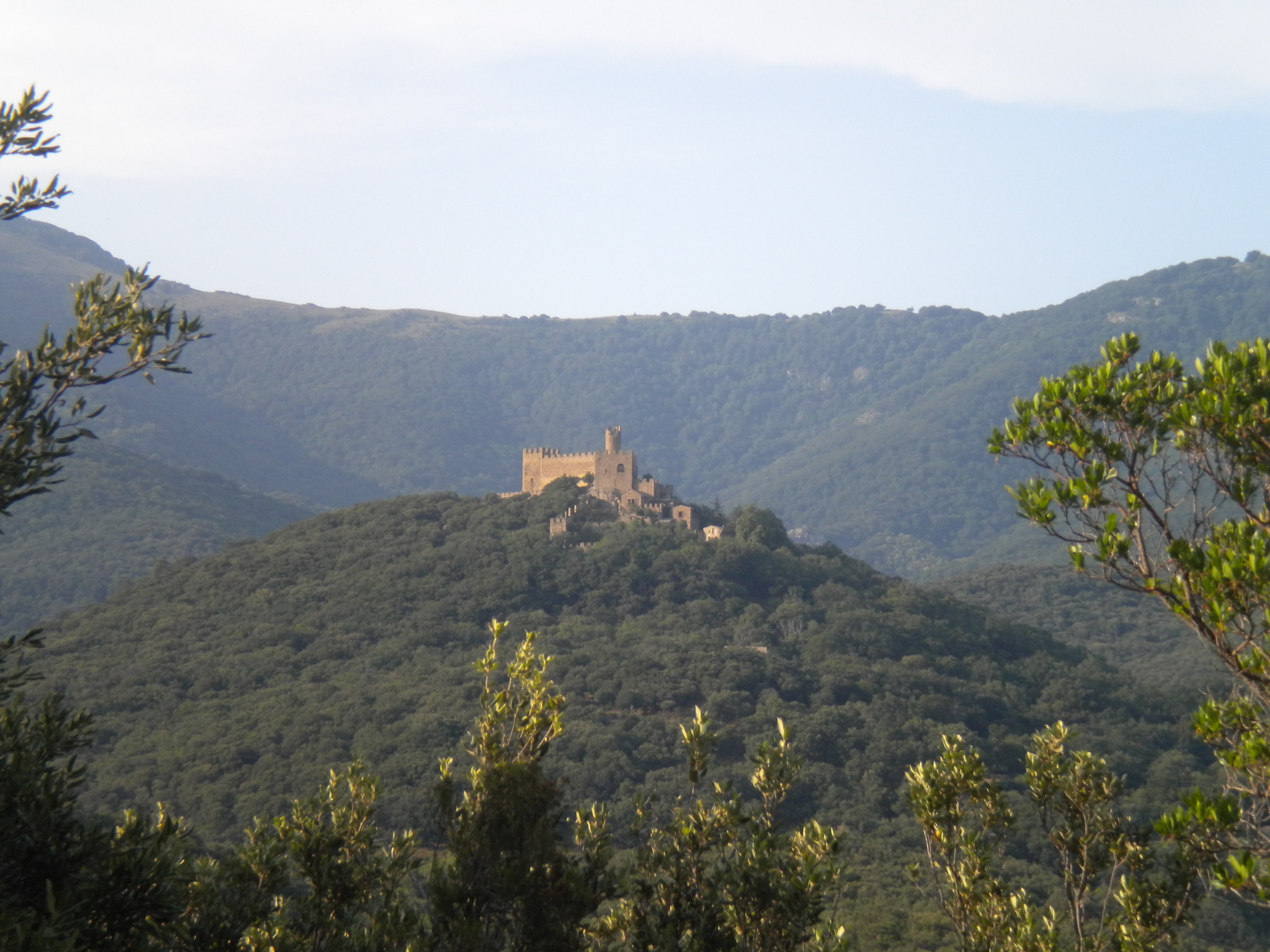
The Castell de Requesens on its wooded hill in the Albera range.
Scenes were filmed at this castle, 19 km due north of the fortress at Figueres and seven kilometres up a forest track from the hamlet of Requesens, on a wooded summit in the Albera range. What stands there now is largely a nineteenth-century rebuild for the Counts of Perelada: the master builder Alexandre Comalat put it back on the medieval footprint in granite from the same mountain, and the join is hard to find. Fernando Colomo's El caballero del dragón was shot partly here as well.
Canònica de Santa Maria de Vilabertran
The east side of the canonry of Santa Maria de Vilabertran.
Scenes from the film were shot in this canonry, 2.8 km east of the fortress: an Augustinian house whose church was consecrated on 11 November 1100 by the bishop of Girona, with bell tower, cloister and abbot's palace still standing around it. It kept a hospital for pilgrims heading for the Holy Land, and lost its archive and its library when French troops sacked it in 1794. It belongs to the Generalitat and is run by the Catalan heritage agency.
A convent of 1583 on the cliff at Punta de Santa Anna, above the sea, 61 km up the coast from Barcelona, now a private events venue with more than five thousand square metres of garden. The venue says the film shot here, and dates it to 2004; principal photography ran from 12 July to 16 October 2005. Kenny Ortega ended Cheetah Girls 2 here, with a wedding the film sets in Barcelona.
Some of the film was shot at Empúries, the Greek and Roman city on the shore at L'Escala, 21 km south-east of Figueres, run as a site of the Catalan archaeology museum.
The production worked in Besalú as well, a town of about 2,400 people in La Garrotxa, 26 km north-west of Girona. What people come for is the eleventh-century fortified bridge over the Fluvià, with its gate tower standing in mid-river.
The old harbour of Barcelona had the production in it too. Port Vell was rebuilt for the 1992 Olympics with a marina, an aquarium and a shopping deck out on the water; nothing of the eighteenth-century port stands above the surface.
The execution
Poble Espanyol
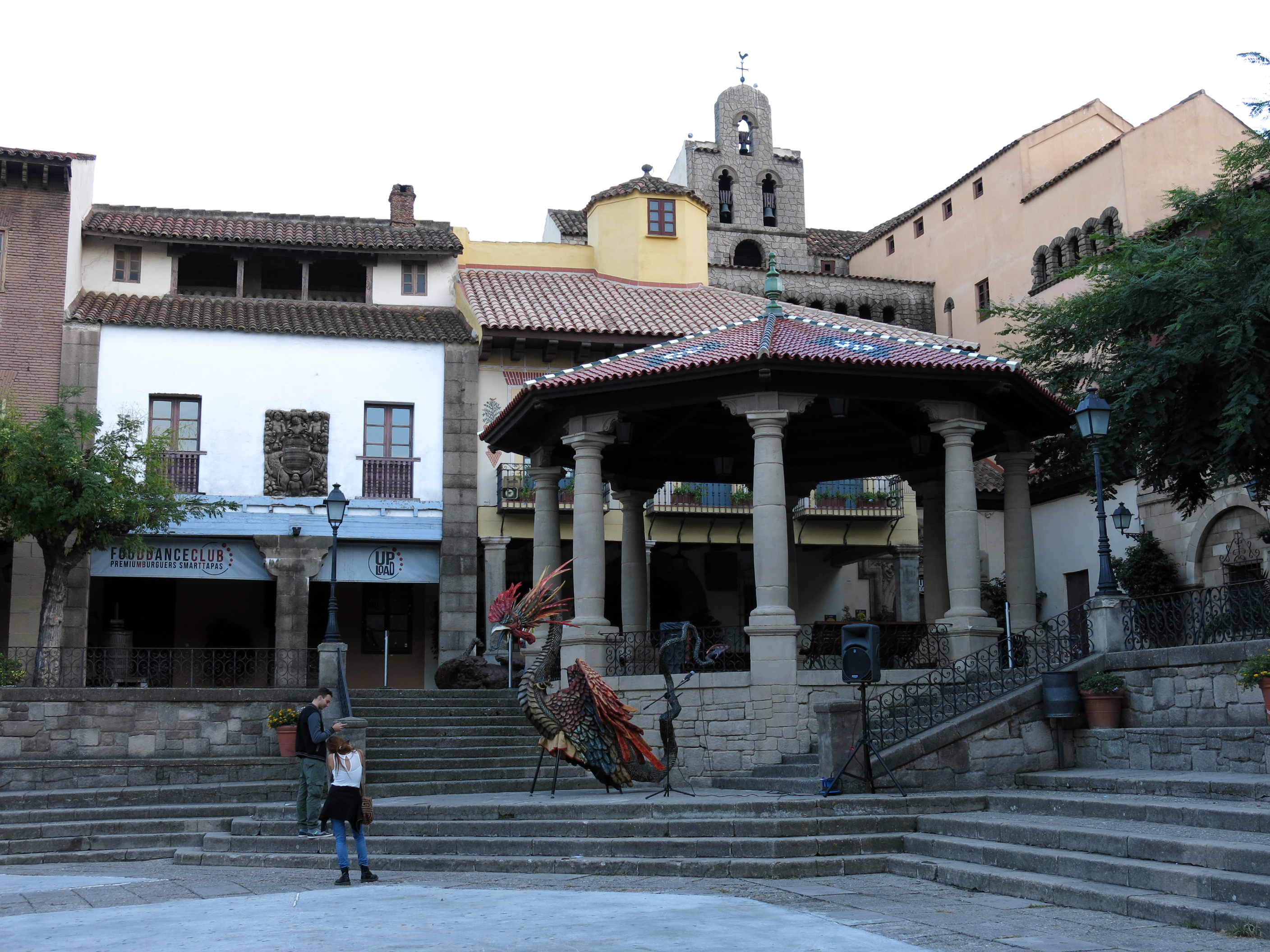
The Placa Major of the Poble Espanyol, Barcelona, from the south.
Grenouille is brought out to be killed in front of a town that has come to watch, and the town does something else instead. A whole week went on that one sequence. Tykwer had always pictured it as choreography, closer to a dance piece than to a crowd scene, and he had admired the Barcelona company La Fura dels Baus for years, so he rang them on the spot. Their people built the crowd outward from a core of their own performers and drilled it in detail; getting the eighteenth-century clothes off one another took practice on its own, so that it would not look complicated on camera.
The town is the Poble Espanyol, on the flank of Montjuïc, 2.8 km west of Carrer de Ferran, and it is not a town at all. The place was built for the 1929 International Exposition as a walk-through anthology of Spanish village architecture, streets and squares and all. Its Plaça Major is a copy of the Castilian square at Riaza in Segovia, arcaded on all four sides, with a replica of the town hall of Vall-de-roures filling the eastern wing.
The street in the Gothic Quarter had to be handed back by Monday morning; that was the deal. On Montjuïc nothing had to be handed back. The Poble Espanyol was a set from the day it opened, and its Plaça Major still has the arcades and the borrowed town hall, because no town has ever lived in it.