Click a point to jump to its film.
The horn at Marshall Point does not run on a schedule. A boat coming into Port Clyde in poor visibility turns its radio to channel 83A, keys the microphone five times, and gets an hour of blasts, ten seconds apart. Then it goes quiet.
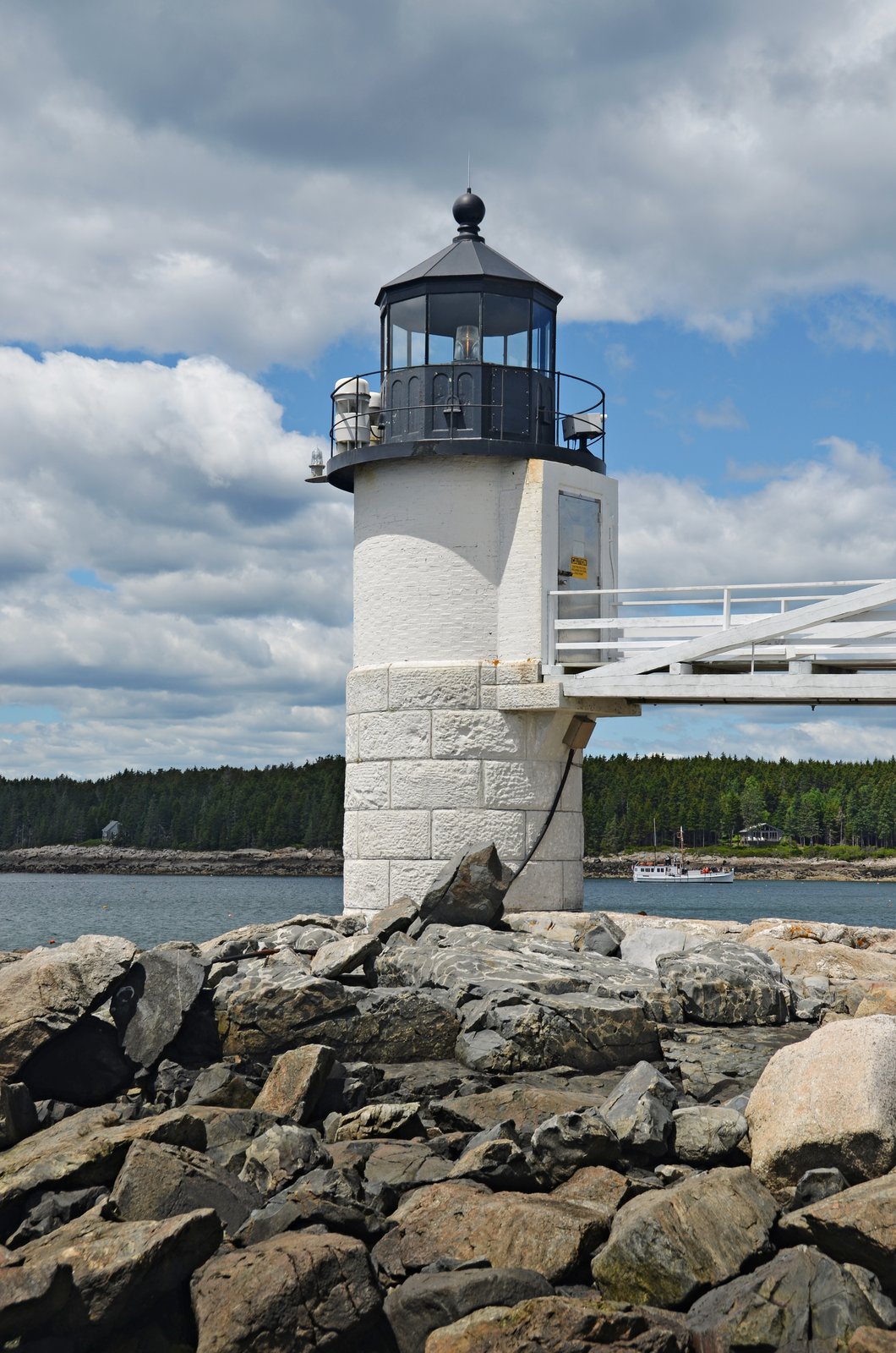
The tower stands off the mainland on a rock outcropping, granite at the bottom and brick above. A wooden walkway of four spans on three granite piers crosses the gap.
Charles Clement Skinner kept the light from 1874 to 1919, the longest anyone served at one light in Lighthouse Service history. Lightning burned the keeper's house down on his watch. Two of his daughters were born here: Eula Kelley in the old house in 1891, and Marion Dalrymple, the first child born in the one that replaced it, in 1895. Both came to the reopening of the restored house in 1990.
The Coast Guard boarded that house up in 1980; the town of St. George has owned the station since 1998. The museum inside is less about lighthouses than the peninsula: quarrying, lobstering, shipbuilding. Outside, a black granite tablet counts eleven local fishermen lost at sea since 1941. Grounds open dawn to dusk, all year.
Forrest Gump reaches the Atlantic at the end of that walkway in 1993 and turns back. The light is still a working aid to navigation: fixed white, thirteen nautical miles, lit around the clock. That one nobody has to ask for.