In the film's 2019, a cinema on South Broadway is advertising a bandleader called Mazacote, a group called Los Mimilocos and a Mexican melodrama about a boy who crosses the Rio Grande to find his father. All three were really booked on that marquee, in 1981, and the film left the sign alone. The future in that shot is downtown Los Angeles, photographed as it stood.
6
places on the route
The downtown core sits within a kilometre; a house above Los Feliz stands apart. Click a point to jump to its entry.
That shot is the exception. What year is Blade Runner set in? November 2019, and the place is Los Angeles — the 1982 release puts both on a title card at the start. Almost all of that city was manufactured: a studio street in Burbank under dozens of rented neon signs, a skyline of plastic and brass, a rooftop built thirty feet up on a backlot. The parts that were already standing are mostly downtown: one intersection, Broadway at Third, with a road tunnel ten minutes' walk north-west of it and a railway terminal fifteen minutes east. Then a house on a hill above Los Feliz, eight kilometres out. Most of these places are playing something they are not.
The Blade Runner city
The novel the film came from is set in San Francisco. The film moved it south, and then built its Los Angeles on a lot in Burbank.
Blade Runner filming began on 9 March 1981 and ran about four months, most of it indoors. The street everyone means, the wet, crowded, over-signed one, is New York Street on the Warner Bros. lot: a standing backlot street put up in 1930, already used for 42nd Street in 1933 and used again for The Dark Knight in 2008. Lawrence Paull handed Syd Mead photographs of the facades that were already standing there, and Mead drew pipes, ductwork and signs over the top of them. Scott and his crew shot on stages 4, 24 and 25.
The light came from neon: dozens of signs, a number of them rented from One from the Heart. The ones in shot were often run on dimmers, set just above the level where they start to flicker; the ones out of frame were left at their brightest and did the lighting wherever that was possible. At one point seven people on this production were doing nothing but looking after neon.
When Zhora runs through a shop window, that shop was built on the same backlot street. The art director dressed it once and Scott hated the result; the dressing came out, and the interpretation that came back a week later he hated too. His own fix was to pull the neon signs off the street outside and stand them in the shop windows.
The buildings above the street are models. The two Tyrell pyramids were clear plastic shells sprayed opaque, and John Vidor spent weeks scraping the paint back off with a chisel cutter and a knife to open thousands of windows, all of them lit from inside by a single bare 10K bulb on a smoke stage. The opening push over the burning refineries is rows of acid-etched brass cut-outs standing on lit tables in forced perspective, with seven miles of fibre optics threaded underneath. Those cut-outs were drawn over reference photographs of the refinery at El Segundo, so the shape of that skyline is real, even though the film never shot there.
The rest of the model city came out of whatever the shop had. One building in it has the outline of the Millennium Falcon, taken from Bill George's five-foot replica; another is Jon Roennau's four-foot model of the ship from Dark Star.
Broadway at Third Street
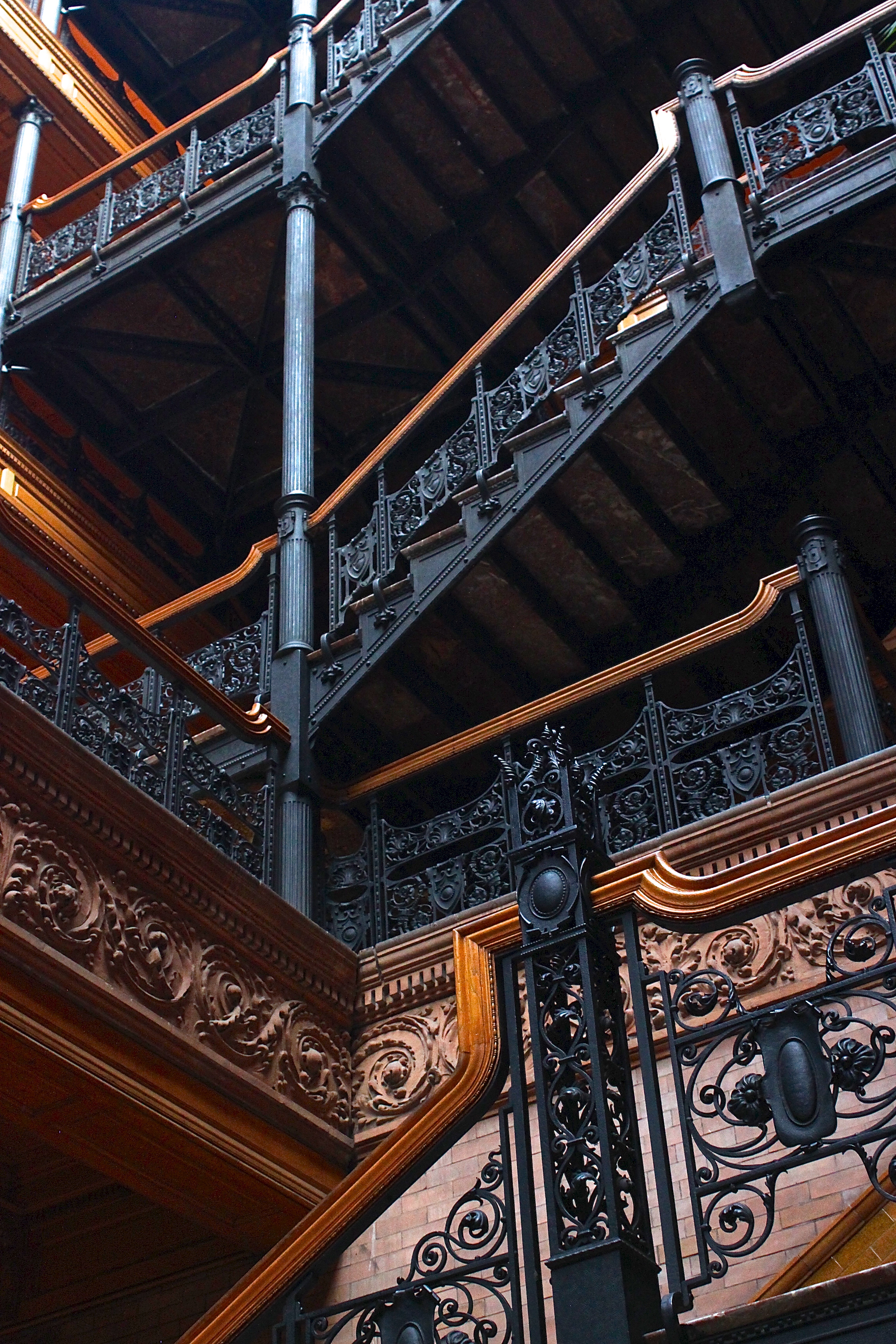
Bradbury Building
The Bradbury Building atrium. The open cage lifts, iron stairs and skylight are the interior J. F. Sebastian lives in.
The last fight in the film goes up these stairs. The Bradbury Building in Blade Runner is the home of the genetic designer J. F. Sebastian and the place he brings Pris back to, and the inside of it does the whole job: five storeys of open court under a glass roof, open-cage lifts, wrought iron rails, pink brick, and daylight coming down the full height.
The roof is the other reason people come, and the roof is not here. The closing rooftop sequence was planned for real downtown roofs and dropped as impractical. The crew built two movable rooftop units about thirty feet high on the Warner backlot instead, and spent over two weeks up there, turning them to get new backgrounds behind the actors. Anyone standing in the court looking for the place where the film ends is in the wrong building.
It opened in 1893. Sumner Hunt turned in the design and George Wyman supervised the construction, and which of the two men the building belongs to has been argued over ever since. It is a National Historic Landmark, open daily, and still a working office building: casual visitors get the ground floor and the first landing, and no further up the stairs.
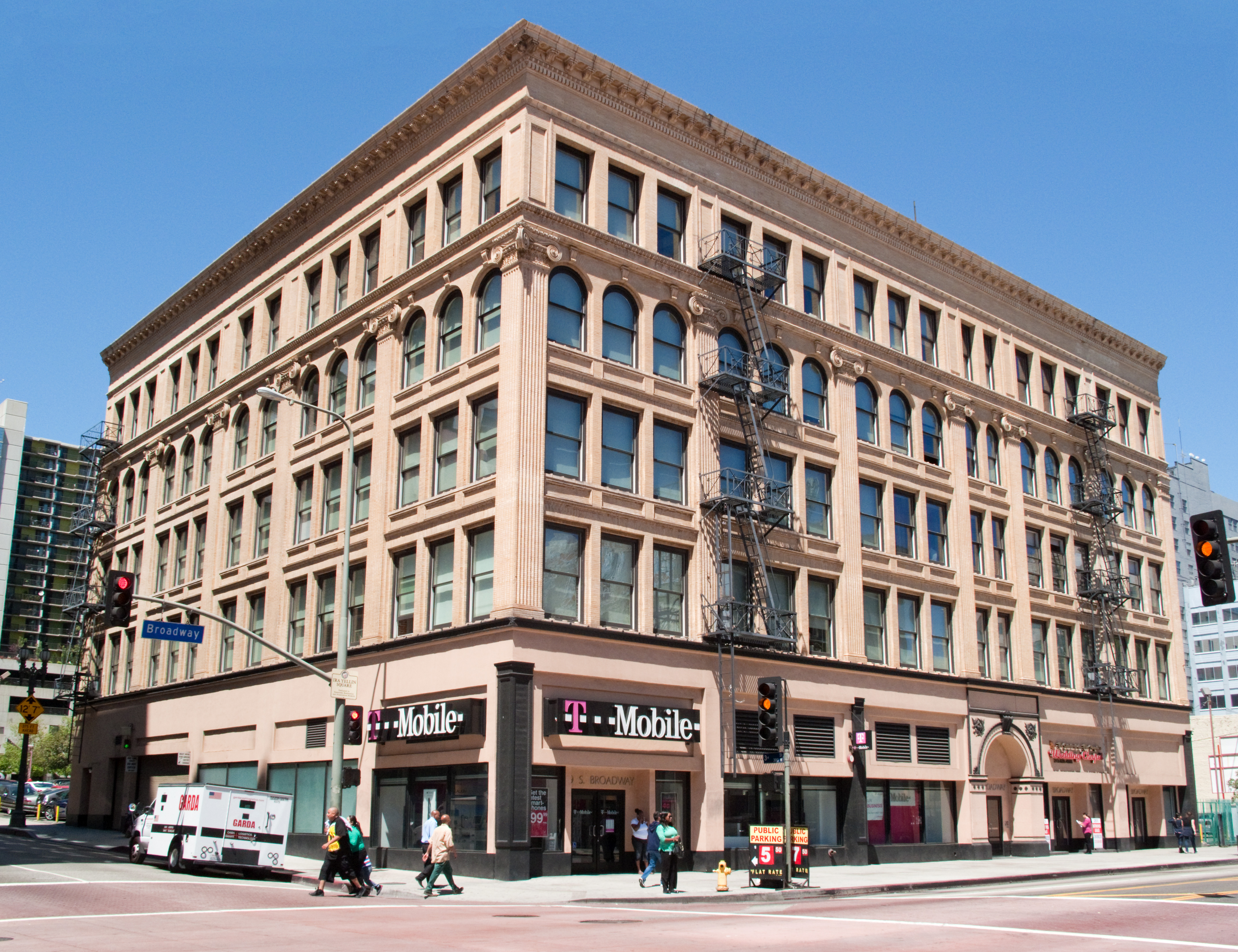
Pan American Building
The Pan American Building on the opposite corner. In the film it carries the name of a hotel that does not exist.
Five storeys of brick and terracotta on the opposite corner. In the film it is a hotel. The cinematographer, writing in 1982, has Deckard and Gaff searching Leon's hotel room here. The city's tourism board says the building carries the name Yukon Hotel on screen, and has Pris spying on Deckard from it as he goes across to Sebastian's.
It went up in the mid-1890s for Margaret Irvine of the Irvine Ranch, designed by Sumner Hunt with George Wyman supervising the work, which is to say the two Blade Runner buildings on this corner are the work of the same pair, at almost the same moment. This one is the second-oldest commercial building in the historic core, after the Bradbury. It has been the Irvine Block, the Byrne Building and, after the five-and-dime that held the ground floor, the Giant Penny Building. It holds flats now, under the name Pan American Lofts.
Se7en shot the sloth room in the penthouse, which was standing empty. Pigeons had been roosting in it, and the droppings were toxic enough that an asbestos abatement crew had to go in before anyone could work in it.
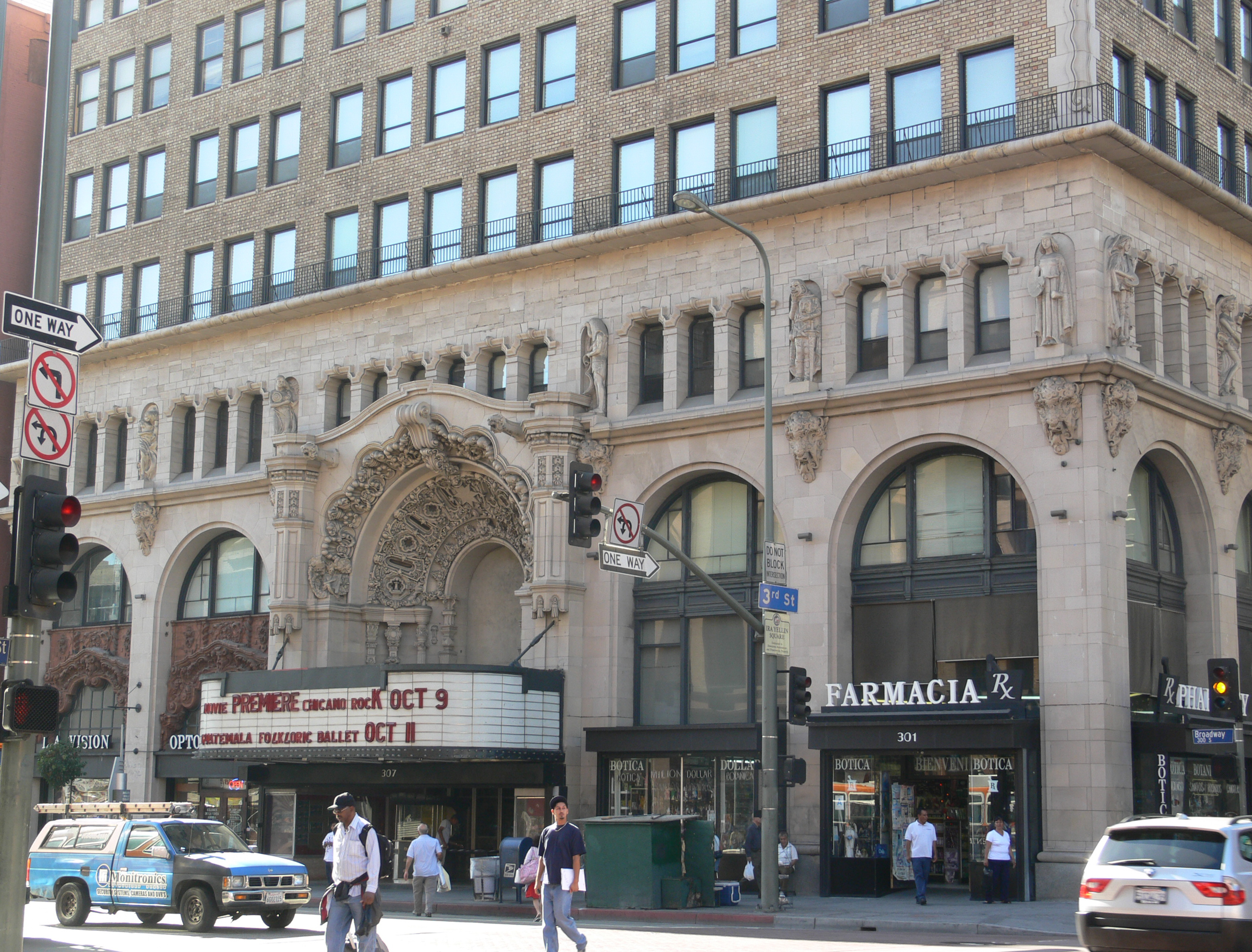
Million Dollar Theatre
The Million Dollar Theatre marquee, a few steps from the Bradbury.
The marquee is lit in the street shots, and it is playing itself. In 1981 the Million Dollar was a Spanish-language house, and the bill glowing on the front of it in the film's 2019 was genuinely booked on Broadway that year. The year of the shoot can be read off the front of the building.
Sid Grauman opened the theatre in 1917 with the premiere of William S. Hart's The Silent Man. It was the first movie house he built and the first grand picture palace in Los Angeles, before the Egyptian and the Chinese took him up to Hollywood Boulevard. From 1949 it ran Spanish-language film and live music under Frank Fouce. Mazacote, the bandleader on that marquee, was a regular draw here: in 1965 he opened for Celia Cruz's two-week run. It is on the National Register of Historic Places.
The tunnel and the police station
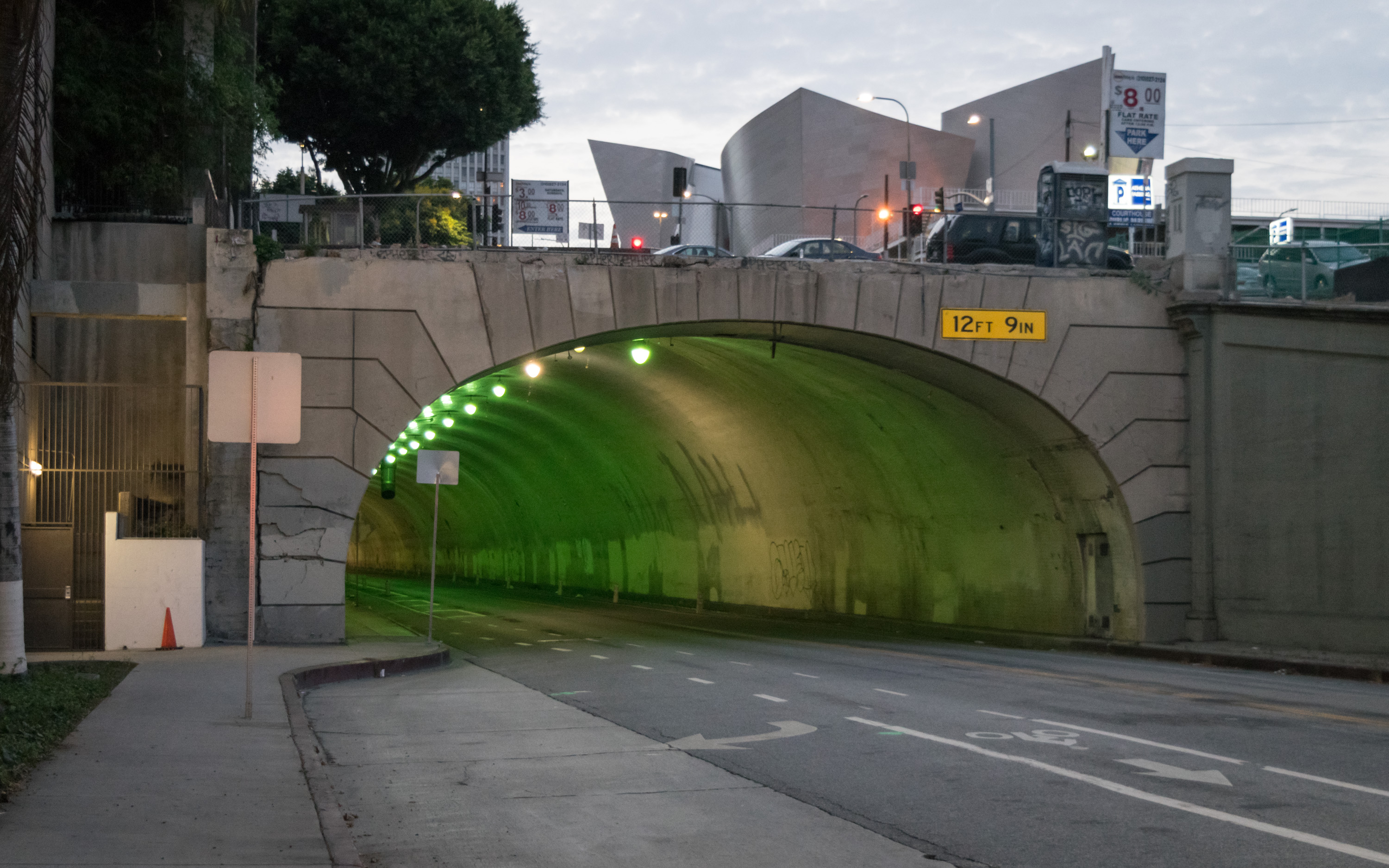
2nd Street Tunnel
The Hill Street portal at dusk, at the south-east end of the tunnel.
A spinner comes through a tube of white light. The tube is a road tunnel from 1924, driven under Bunker Hill and lined end to end in glazed white tile, and the tile is the point: headlights hit it, smear and come back from every direction at once.
Crews have kept coming back for it: The Terminator, Gattaca, Kill Bill and what looks like every car advertisement of the last thirty years.
Los Angeles Union Station
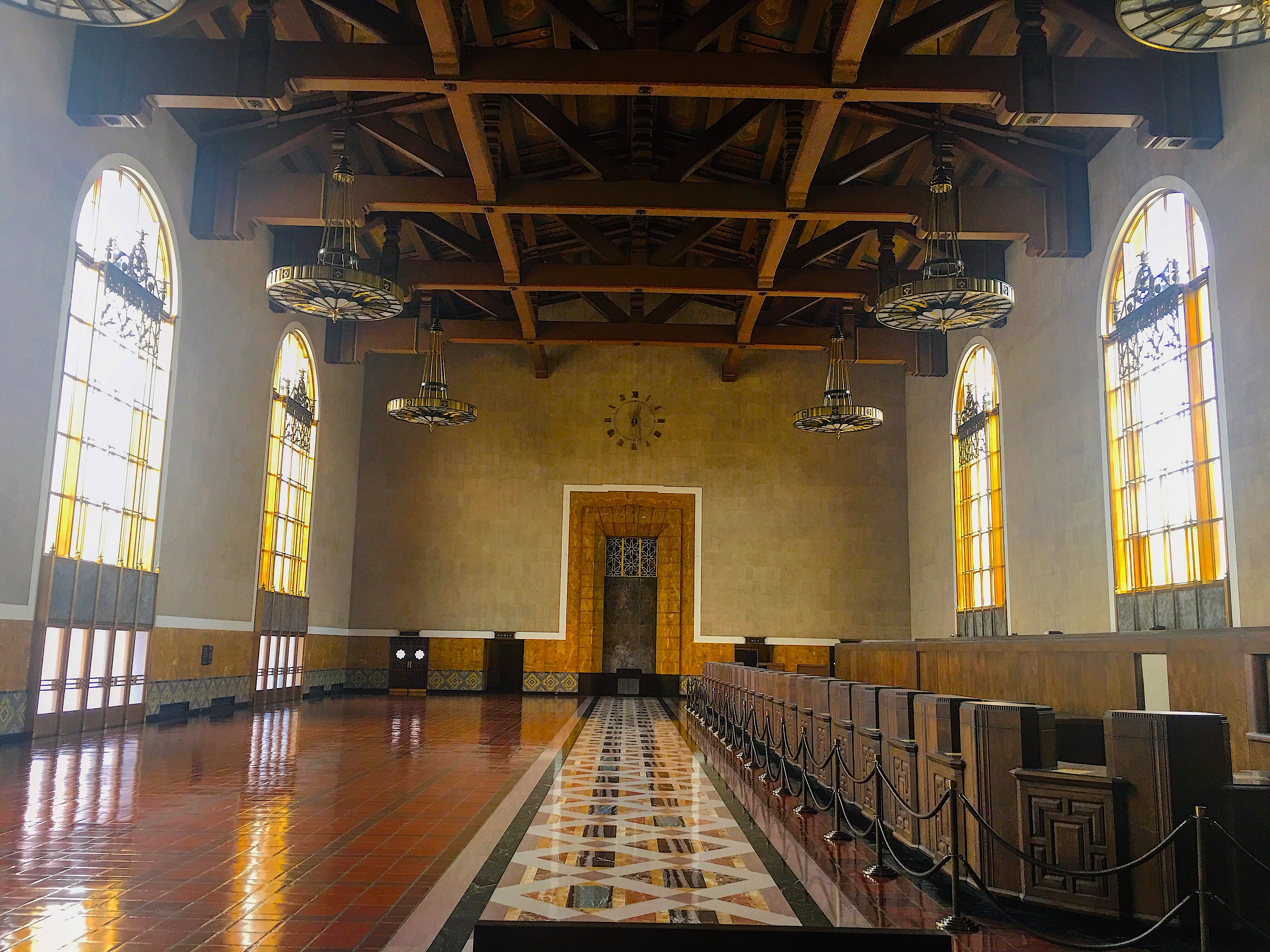
The ticket concourse. Office sets went in here and came out again when the shoot ended.
The Blade Runner police station is a working railway terminal on Alameda Street. Office sets went up inside the ticket concourse for the shoot and came out again when it ended, which leaves the room as it was before: wooden counters down one side, tall arched windows, marble inlay underfoot, chandeliers hanging off a beamed ceiling.
Union Station opened in May 1939, late enough to be nicknamed the last of the great American railway stations, and the trains still run: Metro, Metrolink, Amtrak. The Dark Knight Rises later came here for a Gotham courtroom. This film wanted a police department, set thirty-eight years after the cameras were in the room.
Deckard's apartment building
Ennis House
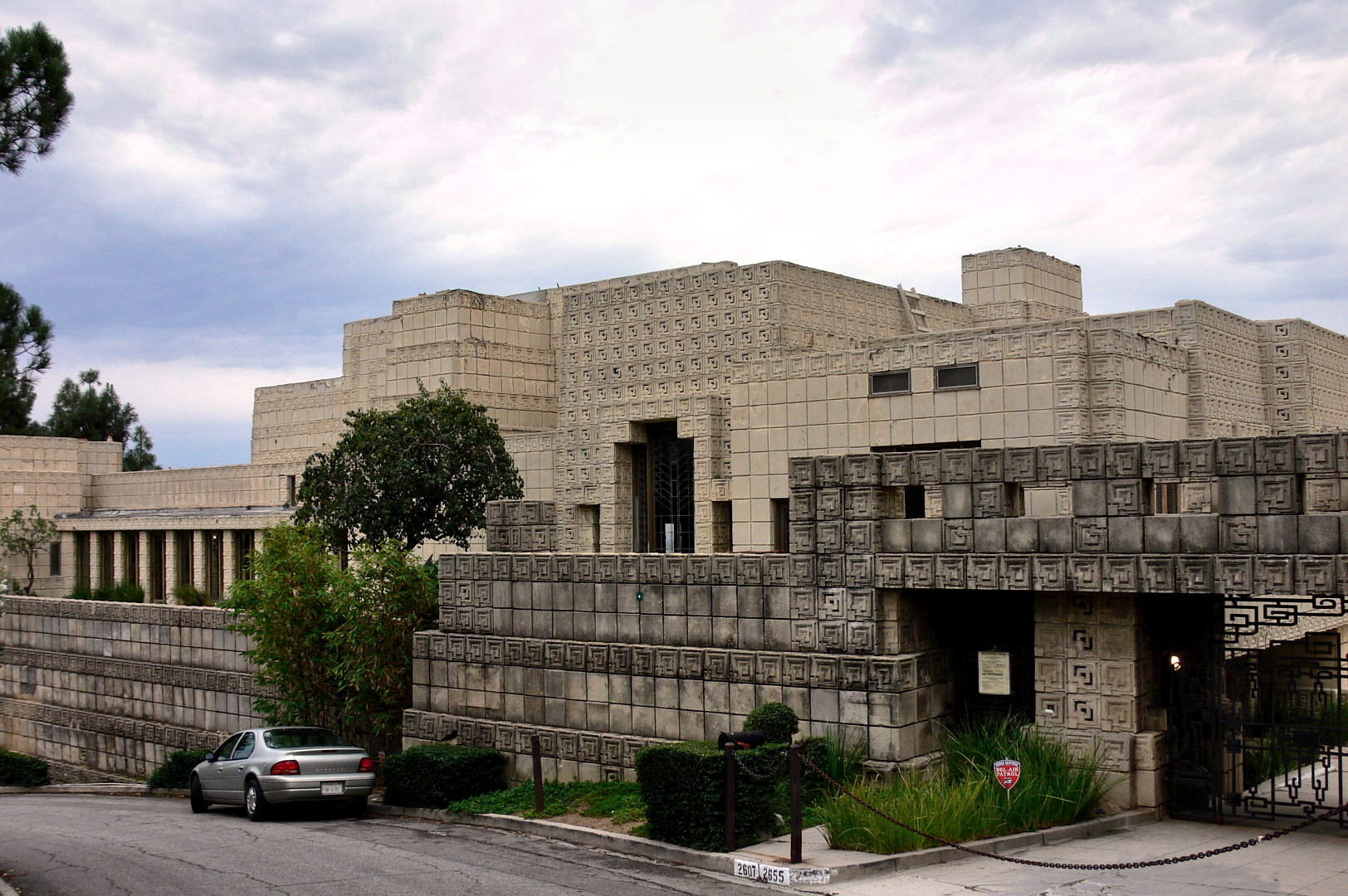
The Ennis House from Glendower Avenue, which is as close as anyone gets.
The Ennis House in Blade Runner is the outside of Deckard's apartment building. It is on screen for a moment, and it settles where he lives for the rest of the picture. A Toronto Star piece from 2007 has one of the bedrooms dressed with fibreglass tiles for the 1981 shoot.
Frank Lloyd Wright designed it for Charles and Mabel Ennis, it was finished in 1925, and it is the largest of the four textile block houses he put up around Los Angeles in the 1920s. The blocks were cast on site out of decomposed granite dug from the hillside, mixed with sand, gravel and water, poured into moulds, then knitted together with steel rods. The pattern is a stepped, perforated square, repeated until it stops reading as ornament and starts reading as a wall.
Glendower Avenue is the only way in: a narrow road that winds through Los Feliz and wraps the house on three sides. No tours are offered: you look at it from the road. Film crews have been coming since the 1950s, and the film left the house with a nickname, the Blade Runner house.
The last shot
The 1982 cut leaves the city altogether. Deckard and Rachael drive out into daylight, green hills, open sky — and none of that was shot for this film. Scott went to Stanley Kubrick and asked to use some of the surplus helicopter photography shot for The Shining. So the last minute of the picture is a real place, filmed from the air for somebody else's film. Nobody has published where it was flying.