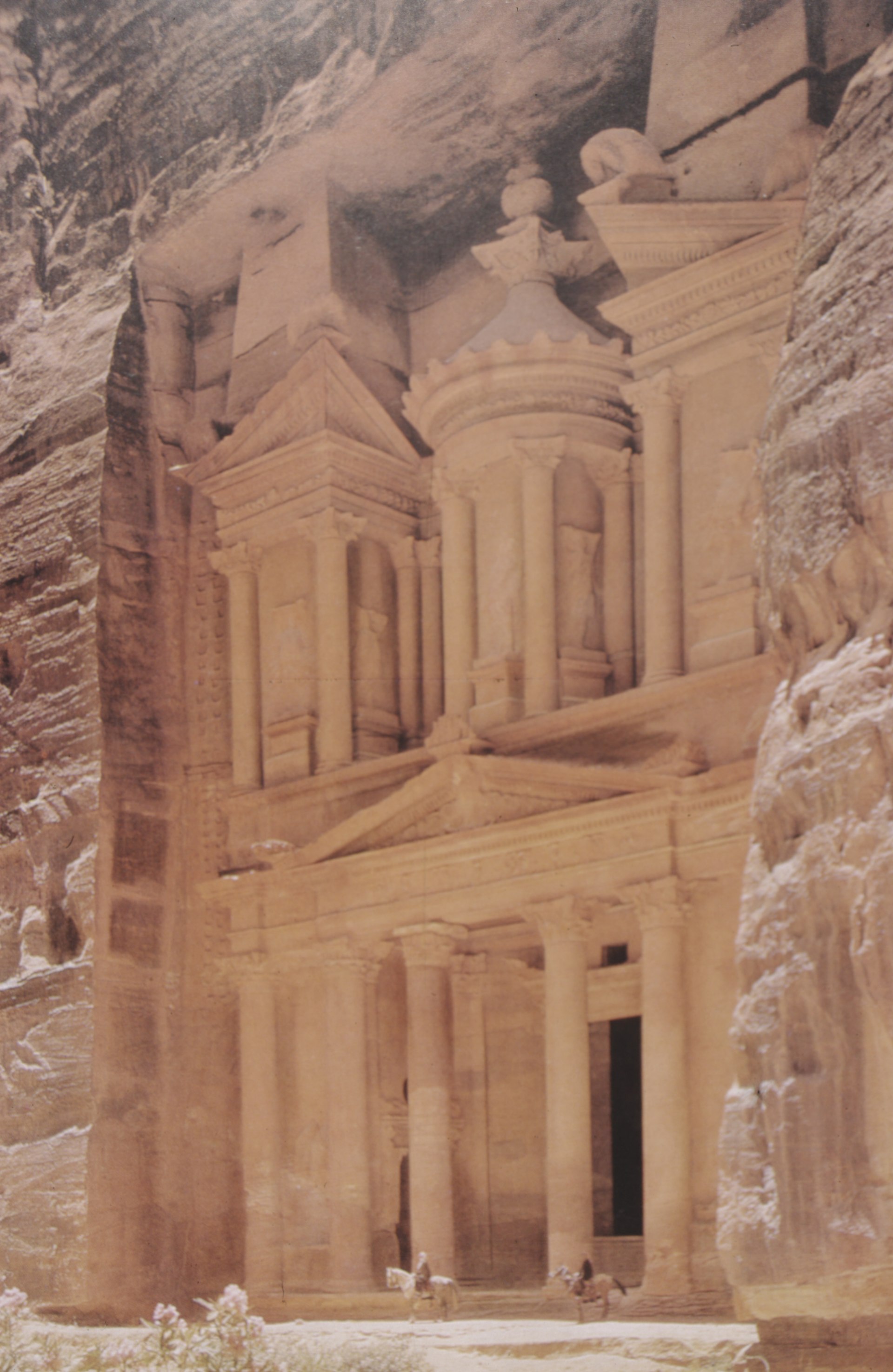
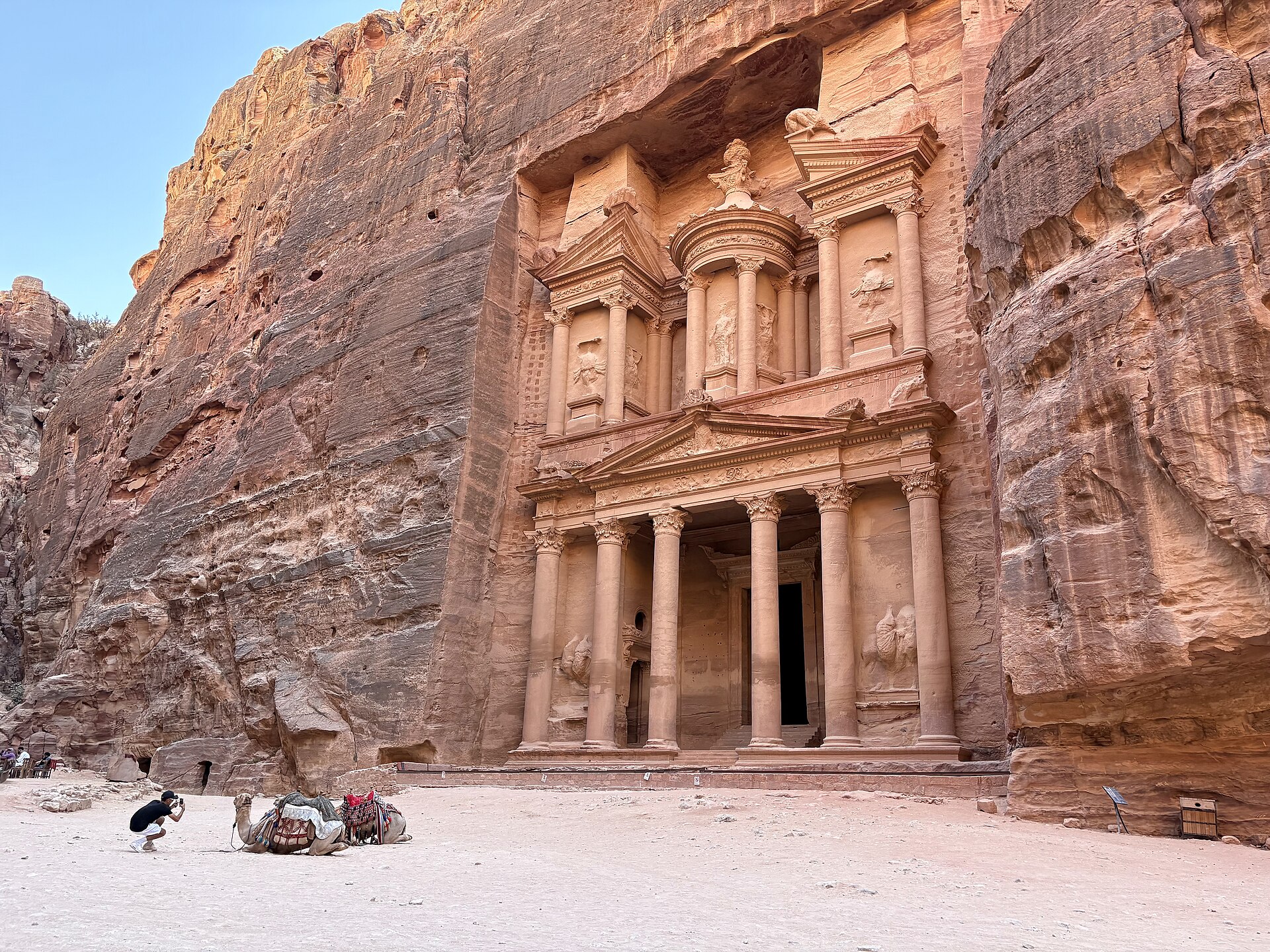
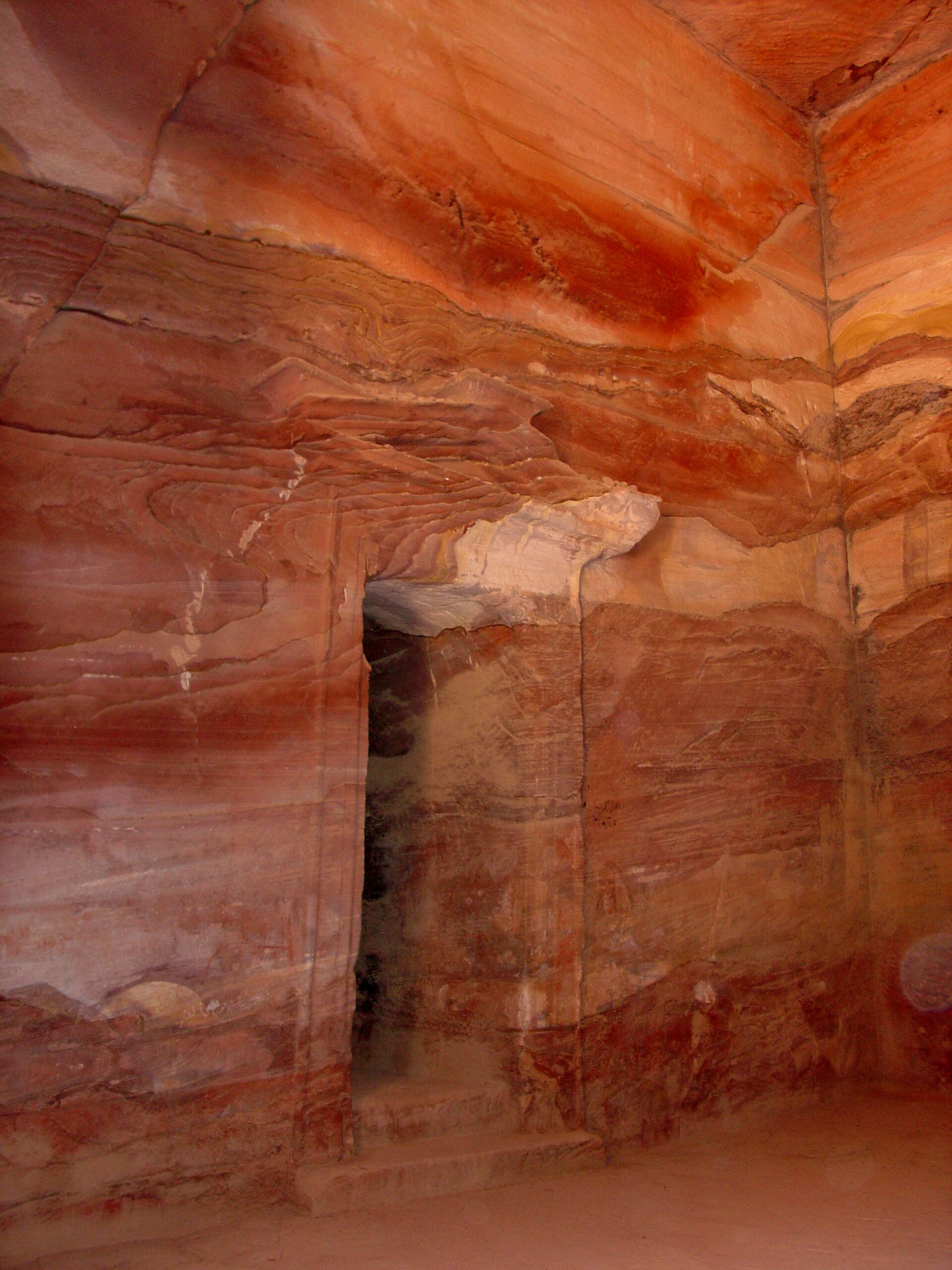
Behind the front of the Treasury at Petra there is one room. Banded sandstone, a doorway through to a second, smaller room, and nothing else. The trials, the knight and the cups that the film puts behind that facade were built at a studio in Borehamwood, north of London, and the rock face supplied the front.
22
places on the route
Eight places are in Almería alone; the rest run from Utah to Petra — switch with the buttons above. Click a point to jump to its entry.
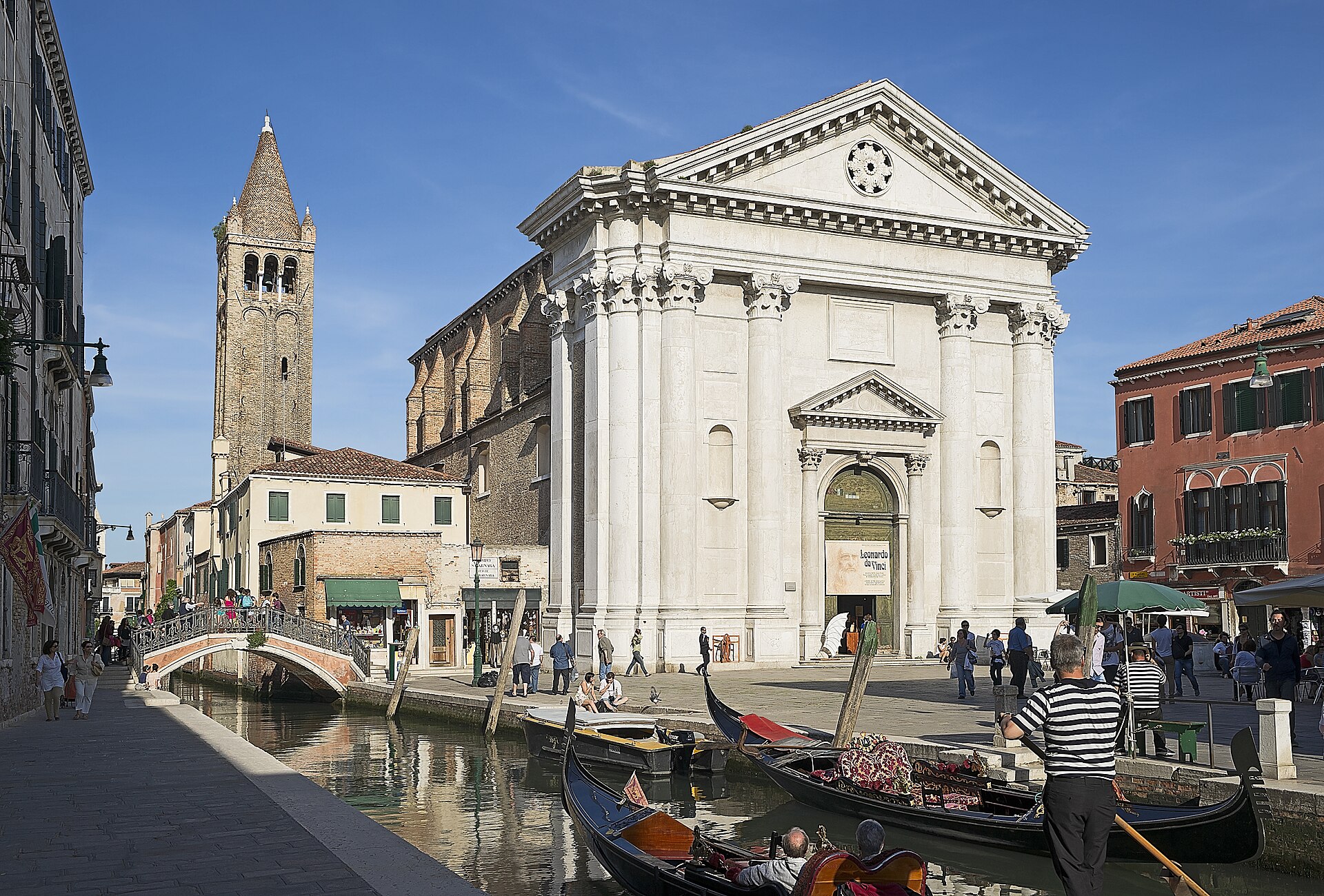
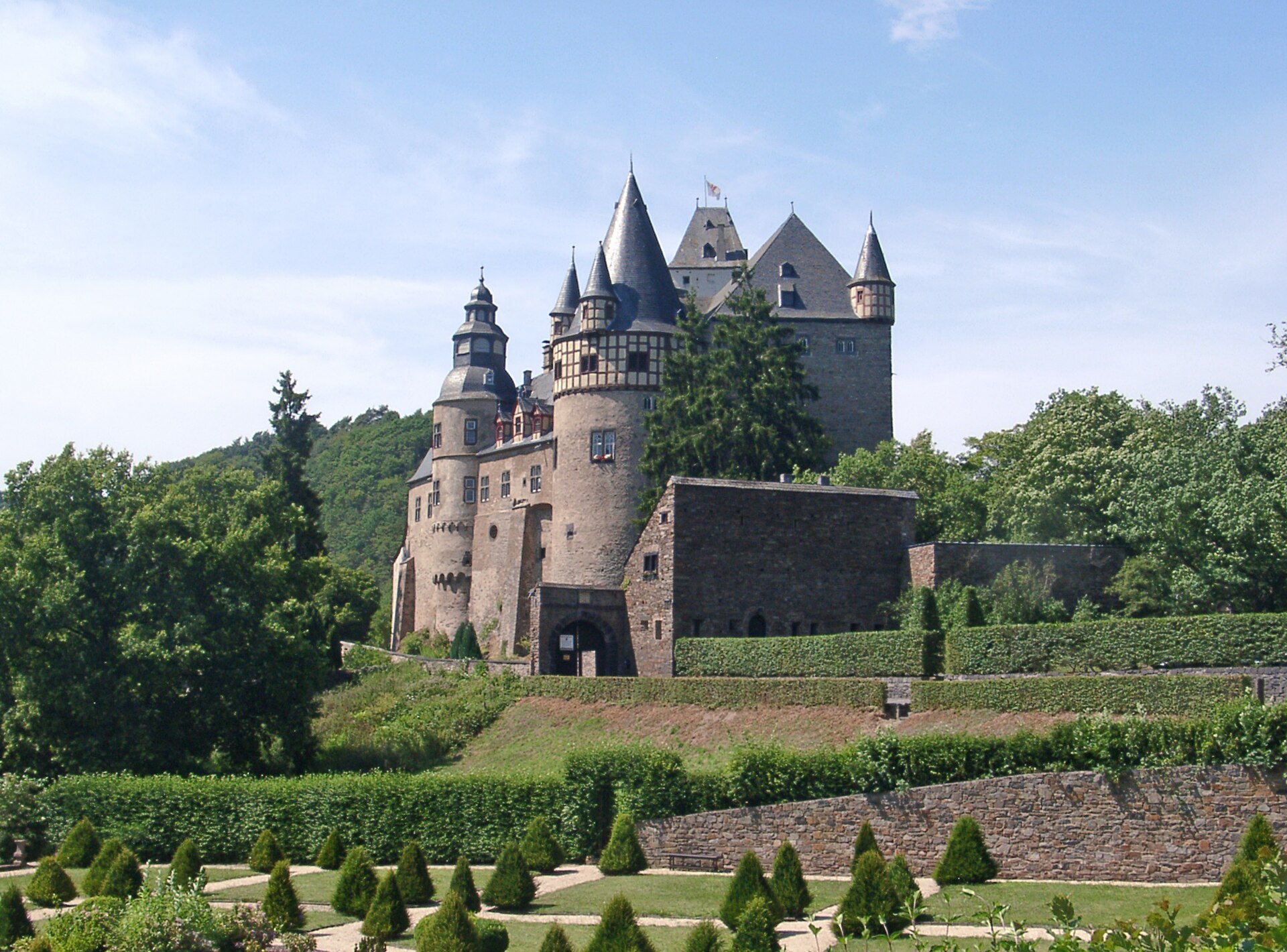
The arrangement repeats across this map. The library in Venice is the front of a church that lost its parish in 1810 and now holds an exhibition of Leonardo da Vinci's machines; the catacombs beneath it were a set. Brunwald Castle, which the story places in Austria, stands in the German Eifel, and on screen it is flipped left to right and widened with a matte painting that copies its right-hand facade onto the other side of the tower. The inside of Berlin Tempelhof is a flower hall in Westminster. Alexandretta is a working station in Granada province. Almost everything you can walk into is in Spain, Italy, Germany and Jordan; almost everything you remember from indoors was carpentry in Hertfordshire.
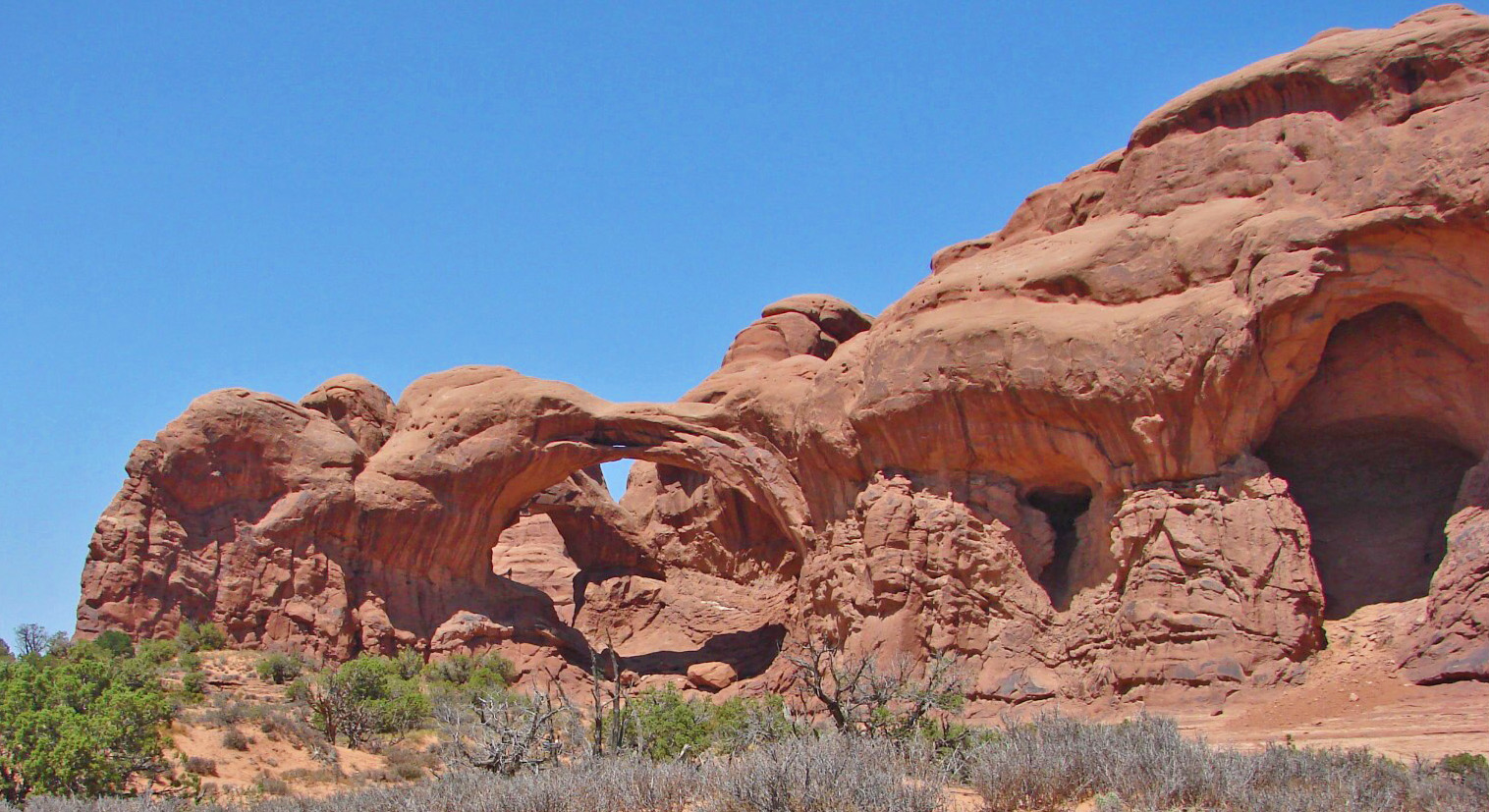
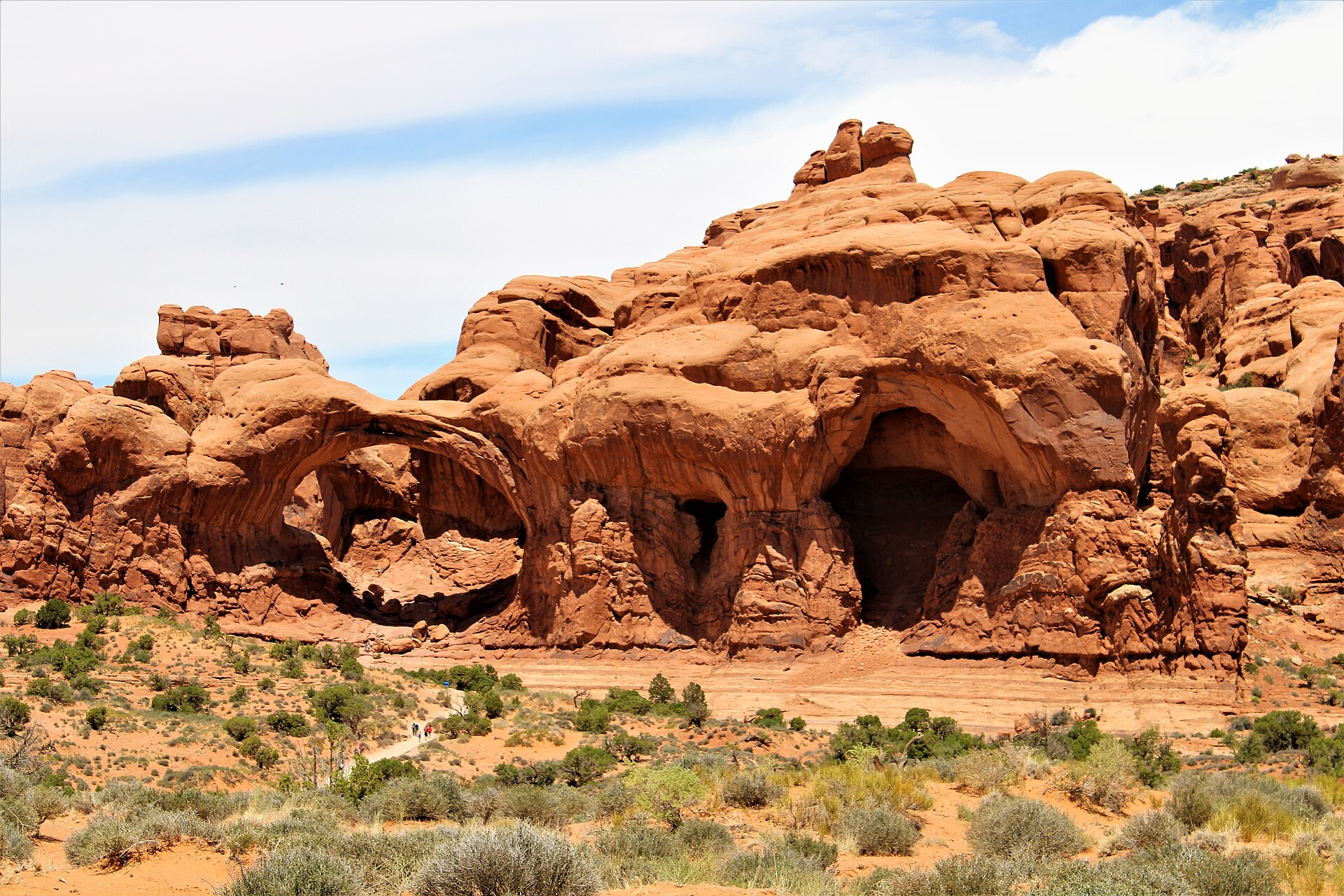
Double Arch on the left and, on the right, the alcove the film treats as the mouth of the cave. The photographer notes that most visitors come for the arch and never recognise the recess beside it.
The scouts ride up, dismount, and go into a cave under the arch. The arch is real and the cave is not. There is no cave in that rock at all.
Double Arch was cut from above, by water standing in a pothole, rather than from the side like most of the arches in the park. The larger of its two openings is 148 feet across and 104 feet high, the tallest opening in Arches. It is half a mile there and back from the Double Arch car park, and nothing is fenced off: people walk under both openings and through them. The park service's own history pages and its visitor questions never mention the film. The only place the film business turns up in the park's own account is a line saying that commercial filming needs a special use permit.
Lobato siding, Cumbres and Toltec Scenic Railroad, New Mexico
The circus train runs on a narrow-gauge steam line between Antonito in Colorado and Chama in New Mexico. The crew worked out of Alamosa. At Lobato, milepost 339.99, the first siding on the line, there stood a wooden water tank that had been built for a film in the 1980s and was used again by this one. It went over in 2006, old and in a high wind.
What is still at Lobato is the remains of a stock pen and the trestle, put up in 1883, the second-highest on the line and rated so light that a double-headed train has to uncouple, cross one engine at a time and join up again on the far side. A fire nearly destroyed it and it was rebuilt in 2011. Ten films are recorded on this railway between 1969 and 2021, from The Good Guys and the Bad Guys to The Harder They Fall, with Butch and Sundance: The Early Days, The Missouri Breaks and A Million Ways to Die in the West in between. Which of them used this particular siding, nobody we read says.
The Jones house, 502 Front Street, Antonito, Colorado
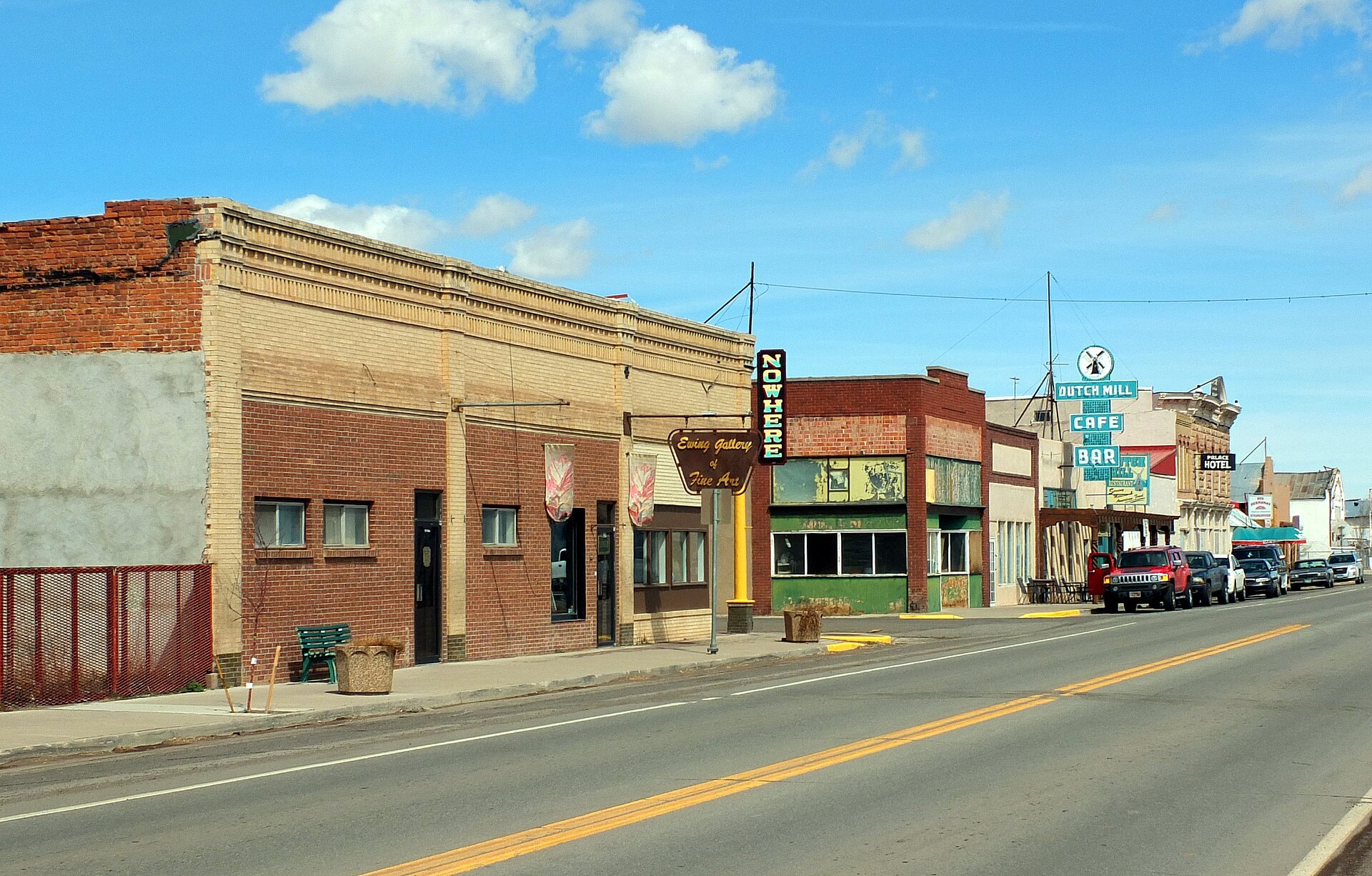
Main street in Antonito. This is the town, not the house — the Jones family home is on Front Street and is now a bed and breakfast.
Young Indy's home is at the Colorado end of the same railway, half a mile from Antonito station. It is a bed and breakfast now, run under the film's name, with a room of memorabilia in it. It is somebody's business and somebody's house rather than a place to look round.
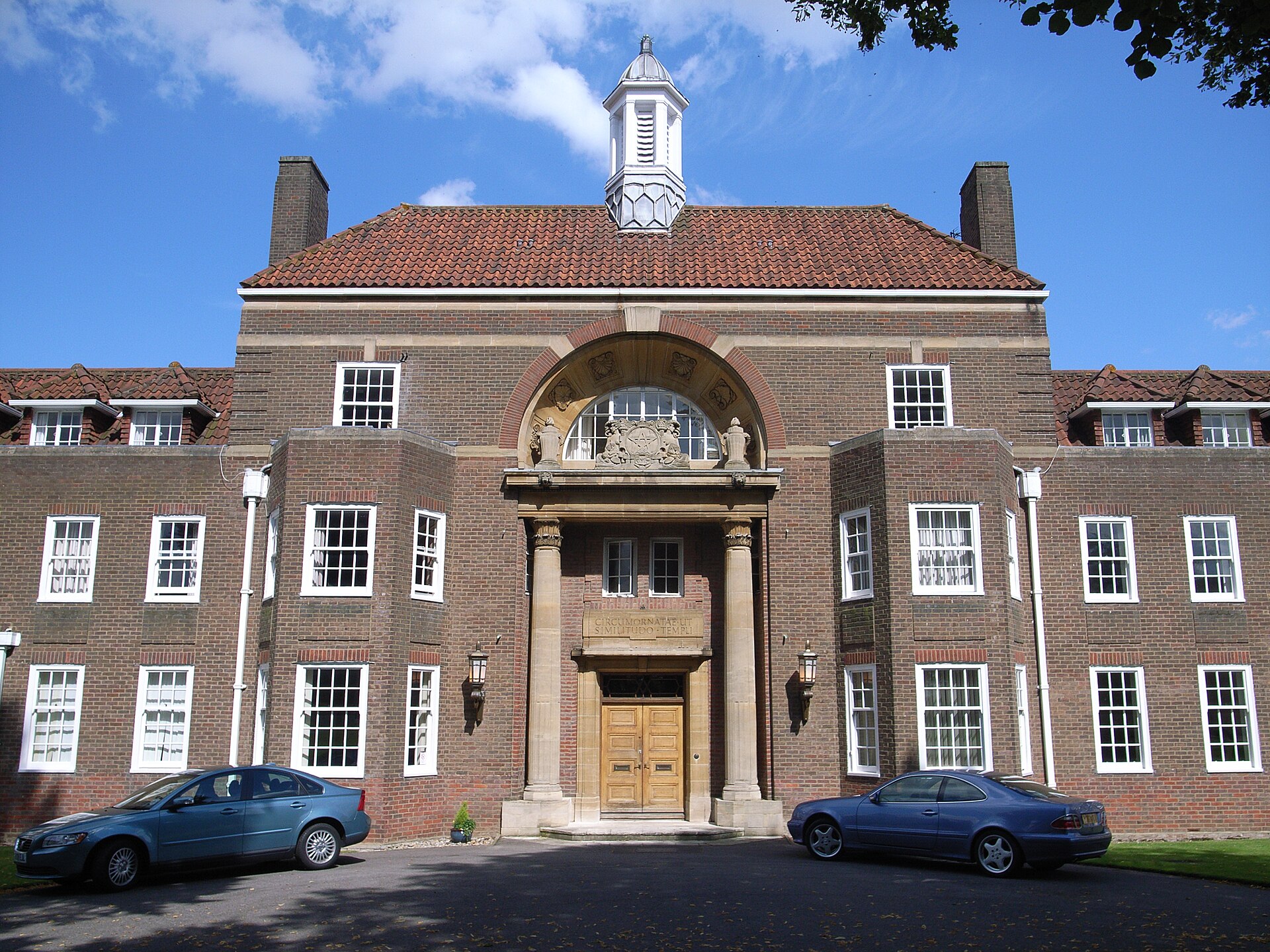
Indy's college is a girls' boarding school in Hertfordshire, and it had already played the same college eight years earlier in Raiders of the Lost Ark. The English part of the shoot finished here on 5 August 1988. The school is still a school and is not open to visitors.
One day, 29 June 1988, for Indy leaving for Venice. That is the entire record. The airfield's own account of its history does not mention the film, and nothing else we reached does either.
The front of San Barnaba, which plays the library. The banner hanging in the doorway advertises the Leonardo da Vinci machine exhibition that occupies the church today. The detached brick campanile behind is 11th-century.
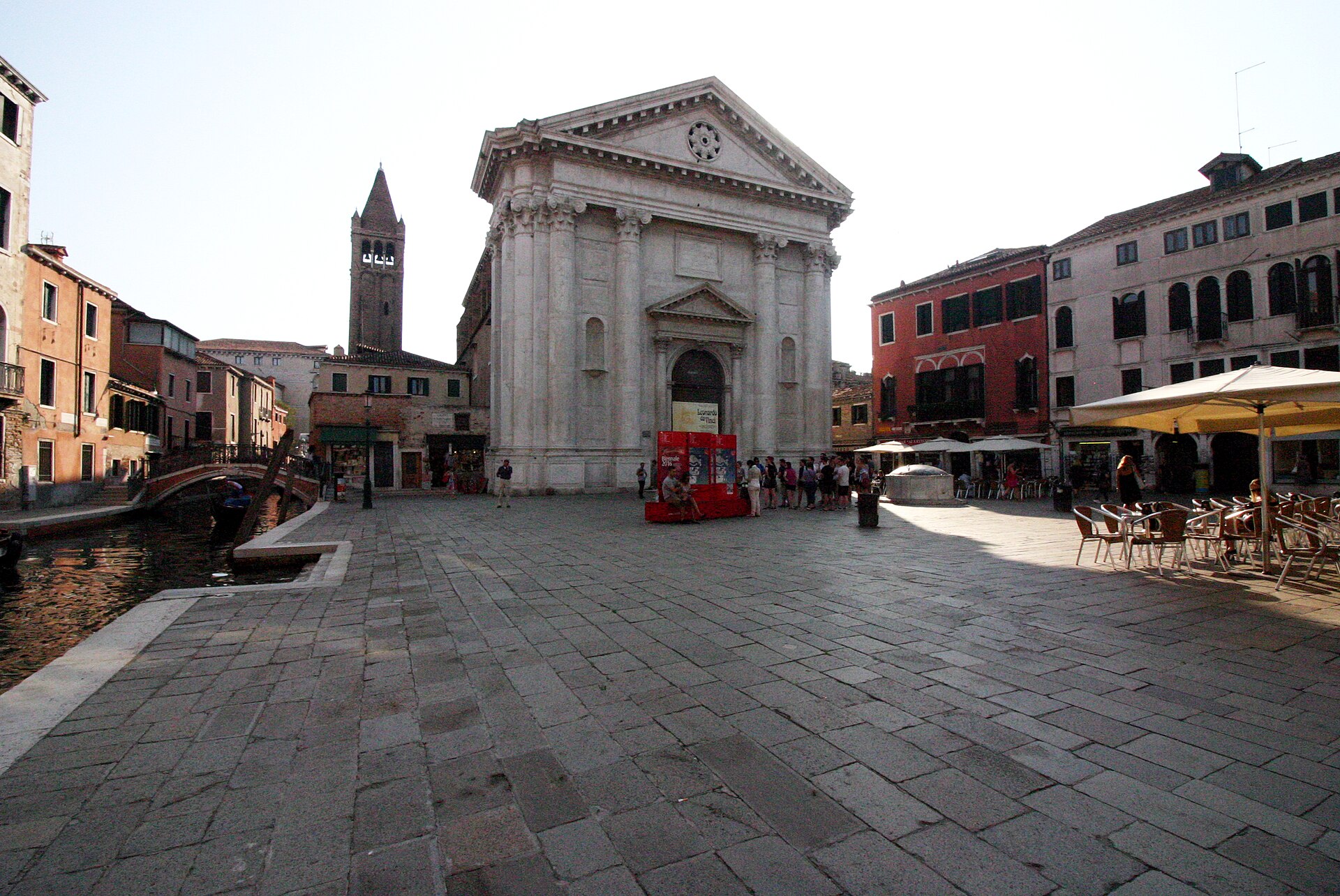
Campo San Barnaba, the square the church stands on. Indy comes up out of a manhole somewhere in this pavement. Café tables to the right, the canal and bridge to the left.
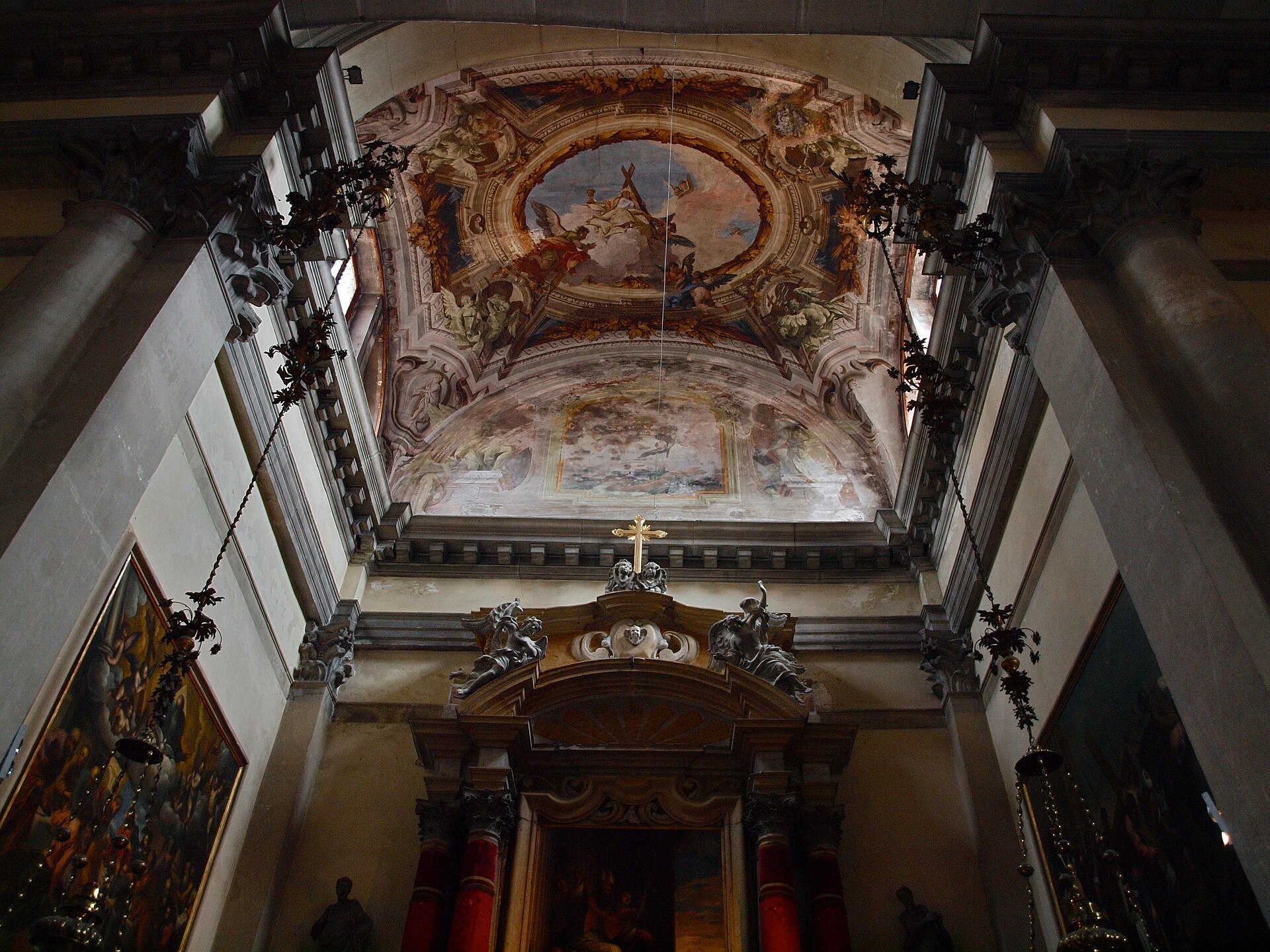
Inside San Barnaba: the 18th-century painted ceiling above the nave. The library the film puts behind this front was a set at Elstree.
Photo: Alejandro from Mexico City, MEXICO · CC BY 2.0 · Wikimedia Commons
The library. Only the outside of it: the church front is the library's front, and the manhole Indy climbs out of is in the middle of the square before it. The reading room and the catacombs under it were built in England.
The parish was suppressed under Napoleon in 1810 and the church became a dependency of the Carmini nearby. Late in the twentieth century it was turned into a permanent exhibition of models built from Leonardo da Vinci's drawings, which is what is inside it today: open daily from 10:00 to 19:00, nine euros, the whole show on the ground floor with two small steps at the door. The nearest vaporetto stop is Ca' Rezzonico on line 1, and it is a five-minute walk from Accademia or San Tomà. The brick campanile standing apart from the church is eleventh-century, with a spire shaped like a pine cone added in the 1300s.
Indy and Brody meeting Elsa, Kazim telling Indy where his father is, and pieces of the boat chase, all on 8 August 1988. Robert Watts had the canal to himself from seven in the morning until one, tourists sealed off for as long as that could be made to last, and Douglas Slocombe put the camera where no satellite dish would be in shot.
The canal is 3.8 km long and nothing we read names a stretch of it, so the point on our map is a label rather than a spot.
The rest of the boat chase is 1,100 km from Venice, in a commercial port on the Thames. Hacker Craft speedboats were run here on 4 August 1988, four days before the Venice day.
The shot of a boat passing between two ships was done by cabling the ships off for safety and then moving them together while the boats went through the gap. One boat scraped the sides. An empty speedboat loaded with dummies was launched from a floating platform between the hulls, with fire and smoke laid on partly to hide the platform, and the stunt had to be run twice because the first one landed short of the camera. Tilbury is a working port and closed to visitors. It has also stood in for John Wayne's smuggling investigation in Brannigan and appeared in the 2004 Alfie.
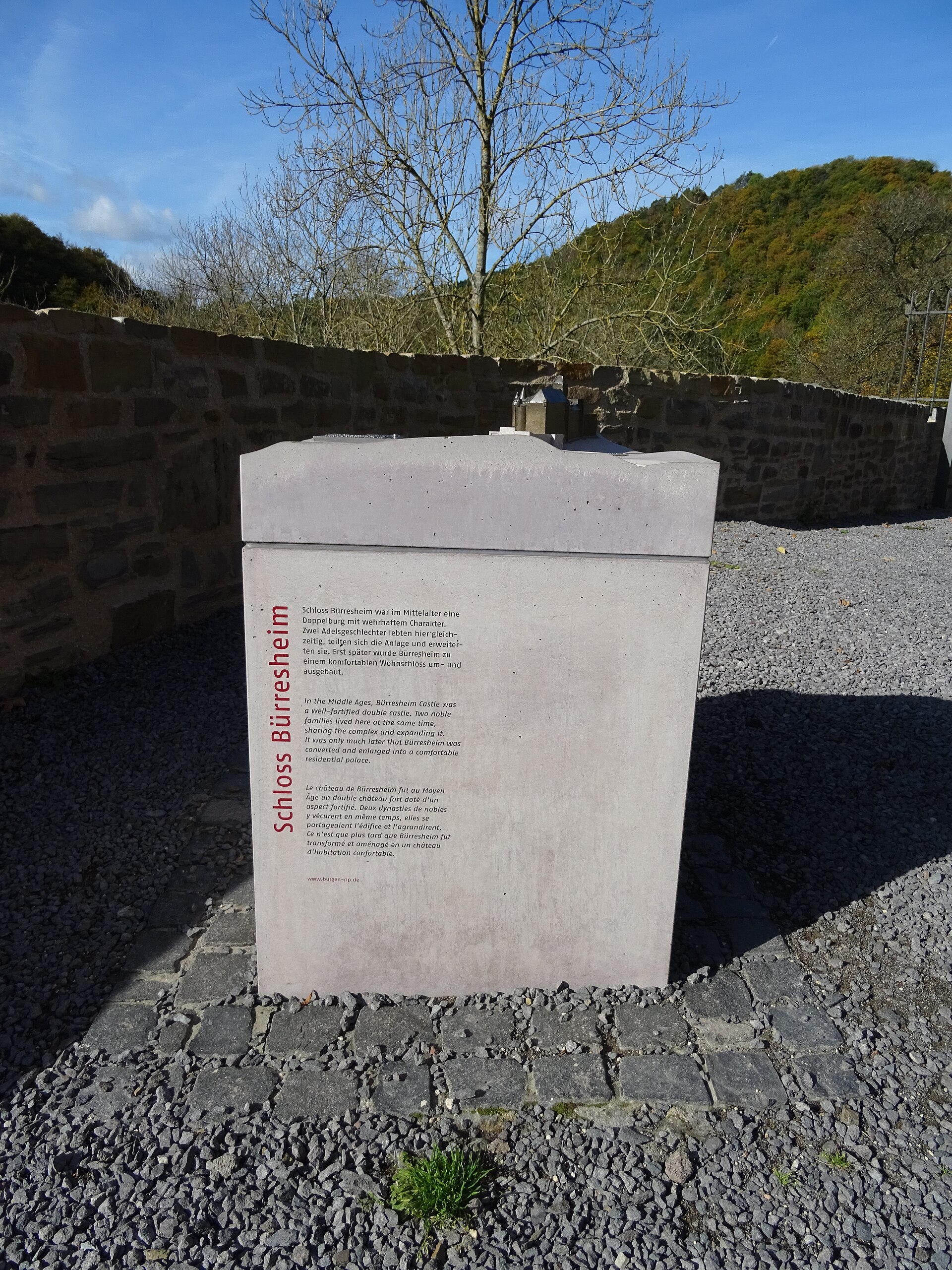
The interpretation stone at the entrance, in German, English and French, with a tactile model on top. It explains the double castle and says nothing about the film.
A short exterior, and the building on screen is not quite the building on the ground: the shot is flipped, and a matte painting adds a copy of the right-hand facade to the left of the main tower, so the castle reads wider than it is.
Bürresheim is one of three castles in the Eifel that were never destroyed, along with Eltz and Lissingen, which is why it has pointed roofs, oriels and painted half-timbering rather than a ruin's outline. It belongs to the state heritage directorate of Rhineland-Palatinate, whose welcome page names this film, with Ford and Connery in it, alongside the fairy-tale Rumpelstilzchen it also hosted. Six euros for adults, Thursday to Sunday and public holidays 10:00 to 18:00 from mid-March to the end of October, weekends only in February, early March and November, shut in December and January. The rooms can only be seen on the guided tours that run continuously and are included in the ticket. There is a car park at the entrance and the Förstersteig walking path goes past. The house cannot be made step-free, there is nowhere to eat on site, and dogs are not allowed in. Photography outdoors is allowed for private use; inside, it has to be applied for in writing.
The motorcycle chase was not part of the shoot at all. Spielberg and his editor Michael Kahn watched a rough cut late in 1988, decided the picture was short of action, and the sequence was shot afterwards during post-production on Mount Tamalpais and around Fairfax, near Skywalker Ranch. Marin County is across the bay from San Francisco, 9,000 km from the castle the chase is escaping.
What we have names a mountain and a town and no road, and the mountain's own record does not mention the film, so this pin marks the mountain.
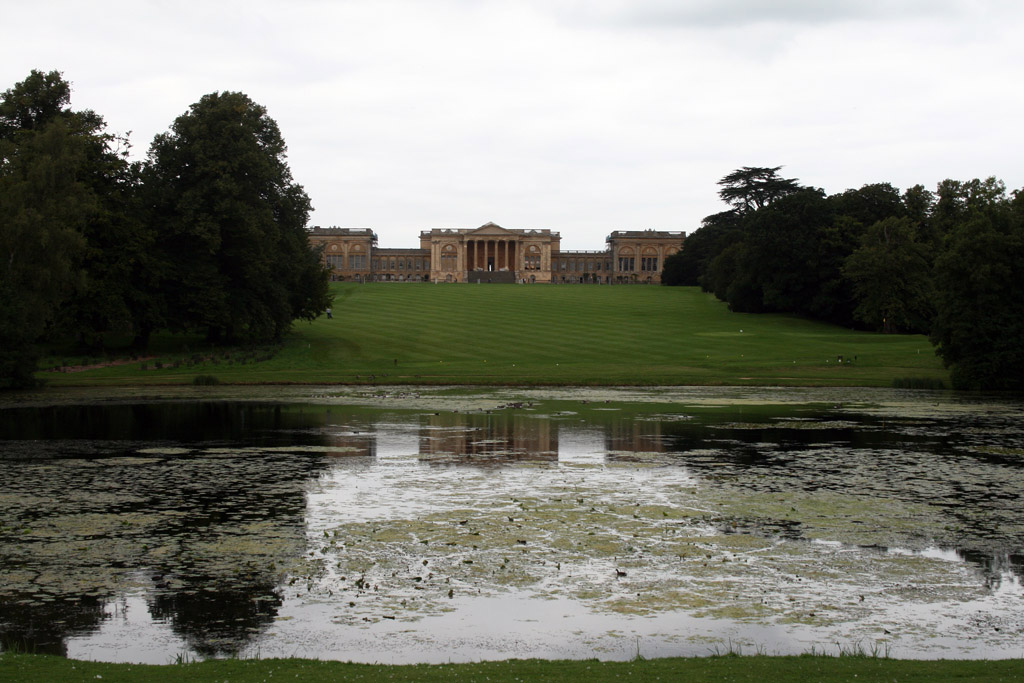
Two night shoots, 25 and 26 July 1988, for the book-burning rally. The house is an eighteenth-century one, seen in photographs across the Octagon Lake. Neither the school's own account nor anything else we found from the place's side mentions the rally; the connection comes from the production side alone. What the school and the National Trust gardens around it allow, we did not establish, so this page says nothing about getting in.
The interior of Berlin Tempelhof, where the diary is signed, filmed on 16 June 1988. The hall was built for the Royal Horticultural Society and used for flower shows. In December 2011 the society leased it to Westminster School for 999 years for eighteen million pounds, keeping the right to hold four flower shows a year in it, and the school converted the building into a sports centre. The inside of Tempelhof is a school sports hall that clears itself four times a year for the flowers.
Hatay is Almería
Spain is the one stretch of this map that a public body has documented itself. The Almería film office publishes a guide to what has been shot in the province, and its entry for this film lists thirteen places. Everything on this page outside Spain, day by day, rests on a single production diary that we have only as quoted by others; we have not held the book.
Escuela de Arte, Almería
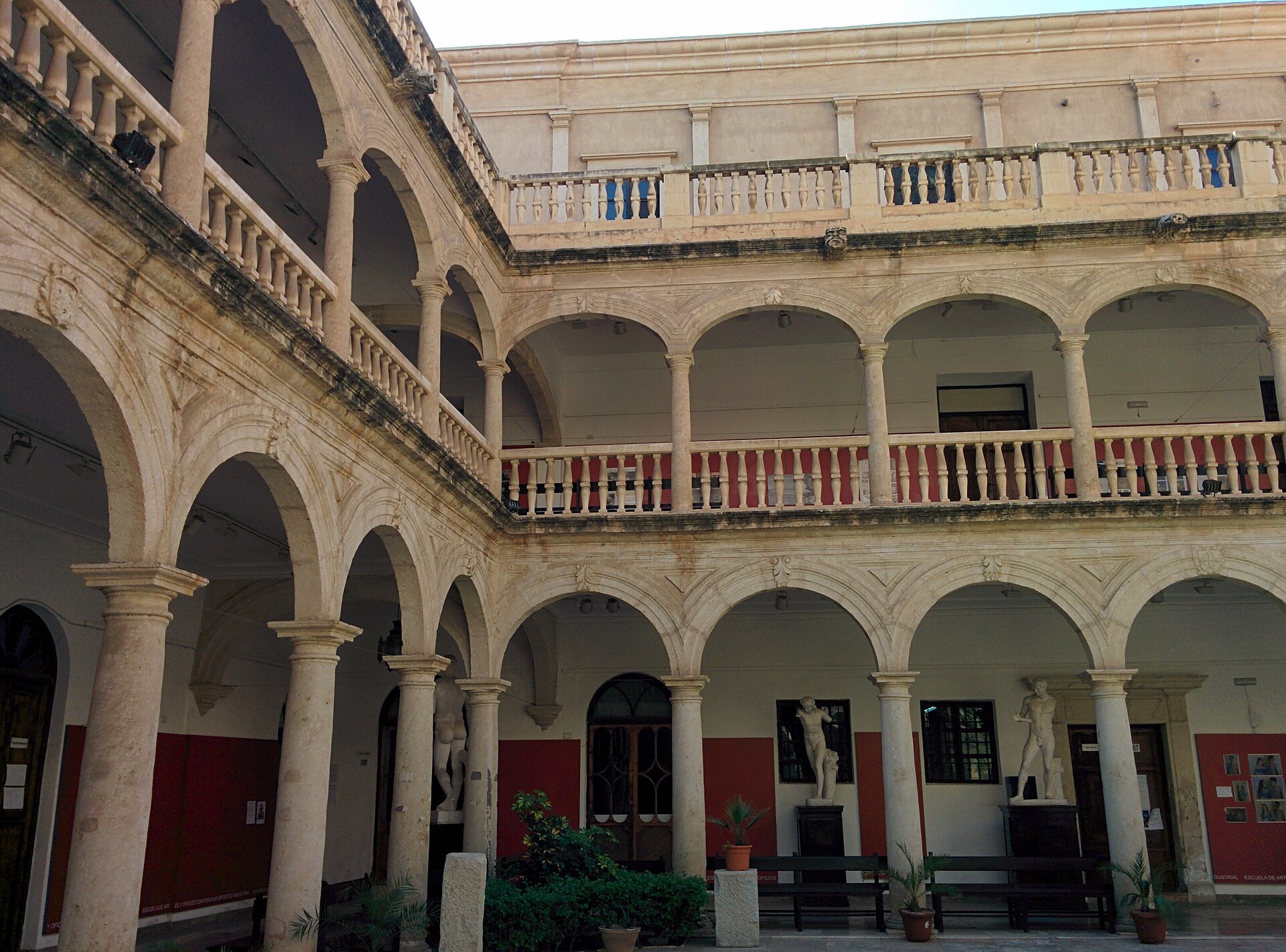
The courtyard of the Escuela de Arte in Almería, which played the Sultan of Hatay's palace. Plaster casts stand under the lower arcade.
The courtyard of the Sultan of Hatay's palace, where the Rolls-Royce is handed over, is the courtyard of an art and design school in the middle of Almería: two storeys of round arches, balustraded galleries, plaster casts standing under the lower arcade. The crew came here after about ten days in the desert. The film office lists one other title for this courtyard, El oro de nadie from 1968. It is a working school, and whether the courtyard can be visited we did not establish.
Alexandretta station, where Brody is taken, and the last day of Spanish filming, 2 June 1988. Rather than add one afterwards, the production built a mosque next to the station so that it would stand in the background.
Alexandretta is a real town: İskenderun, on the Turkish coast in Hatay province. Nothing we found puts this crew in Turkey at any point. Guadix is in Granada province and outside the Almería film office's territory, so the best Spanish source on this film has nothing to say about it.
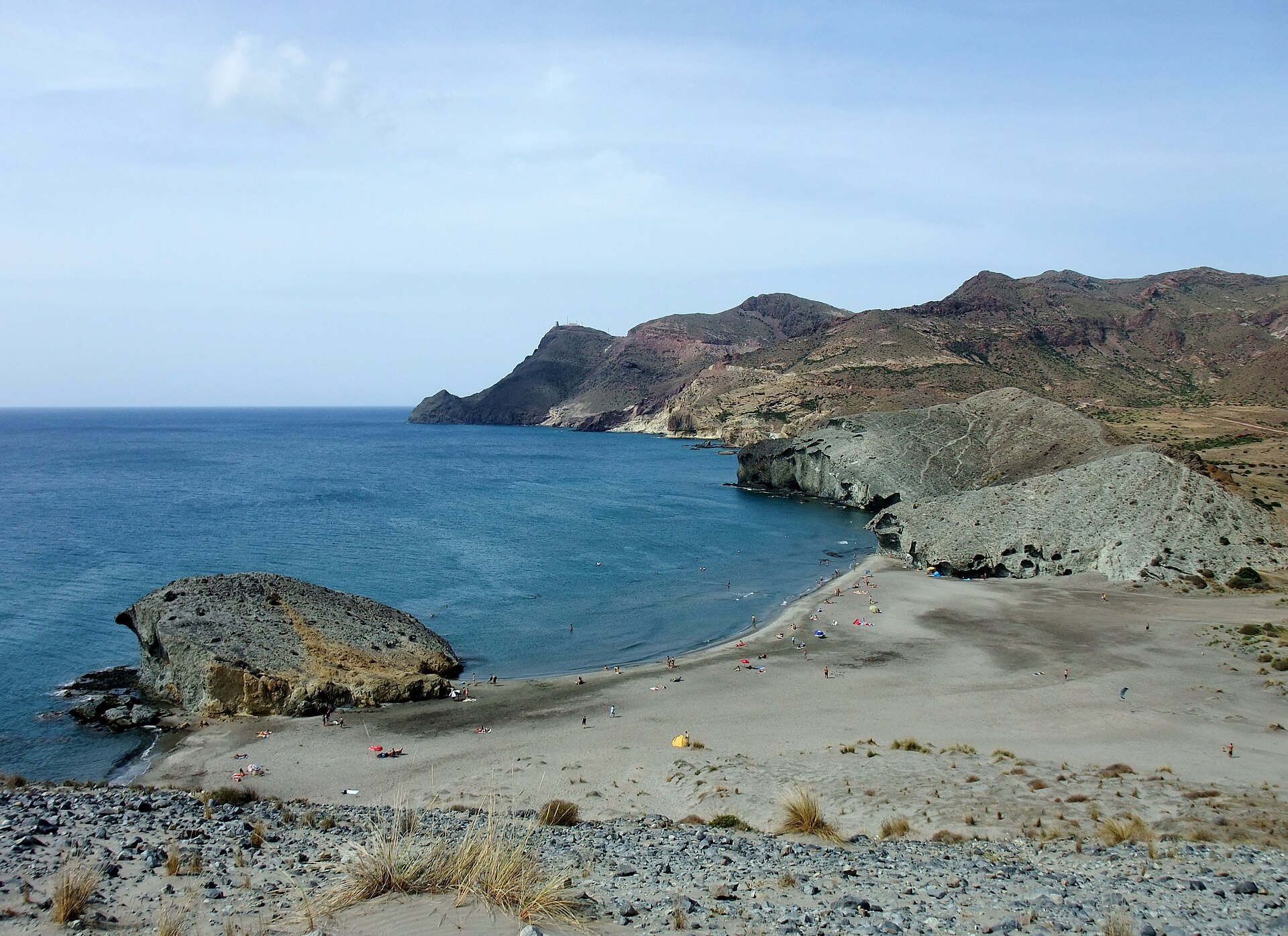
The beach where Henry Jones Sr. raises his umbrella at a flock of gulls and brings down a fighter. The rounded rock standing in the shallows at the end of the beach is the thing to recognise, and it has been recognised often: the film office's own walking route names it in The Adventures of Baron Munchausen, and points out that it is barely visible in The NeverEnding Story because of the retouching done when Atreyu calls the dragon. The same sand carries Antony and Cleopatra, Talk to Her, Sinbad and the Eye of the Tiger, The Wind and the Lion, Shalako and The Valley of Gwangi. It is inside the Cabo de Gata-Níjar natural park.
Minas de Rodalquilar, Níjar
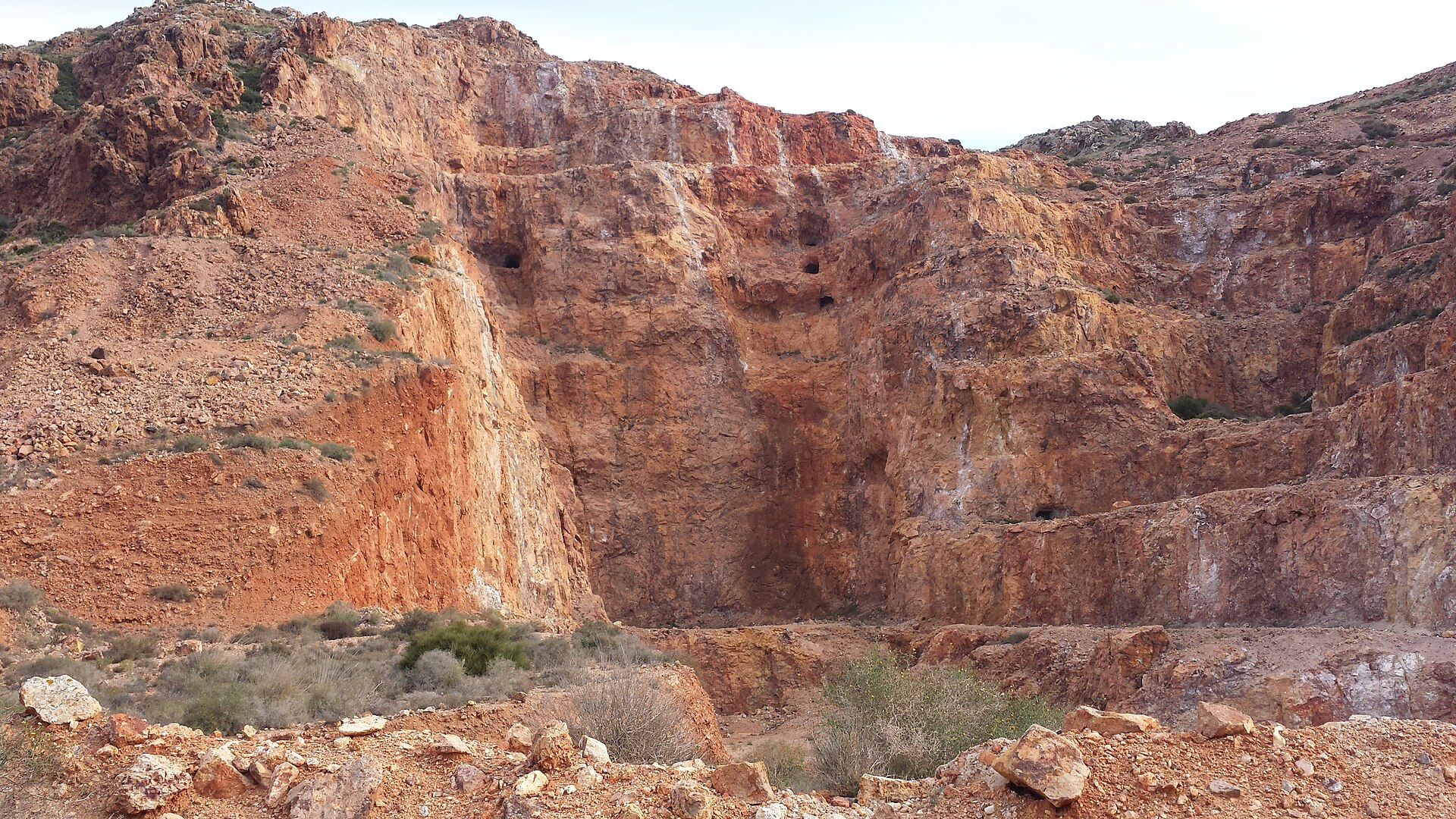
The Cerro del Cinto cut at Rodalquilar, with mine adits opening in the rock face. The film office puts parts of the car chase, and the aeroplane's tunnel, on the roads through this ground.
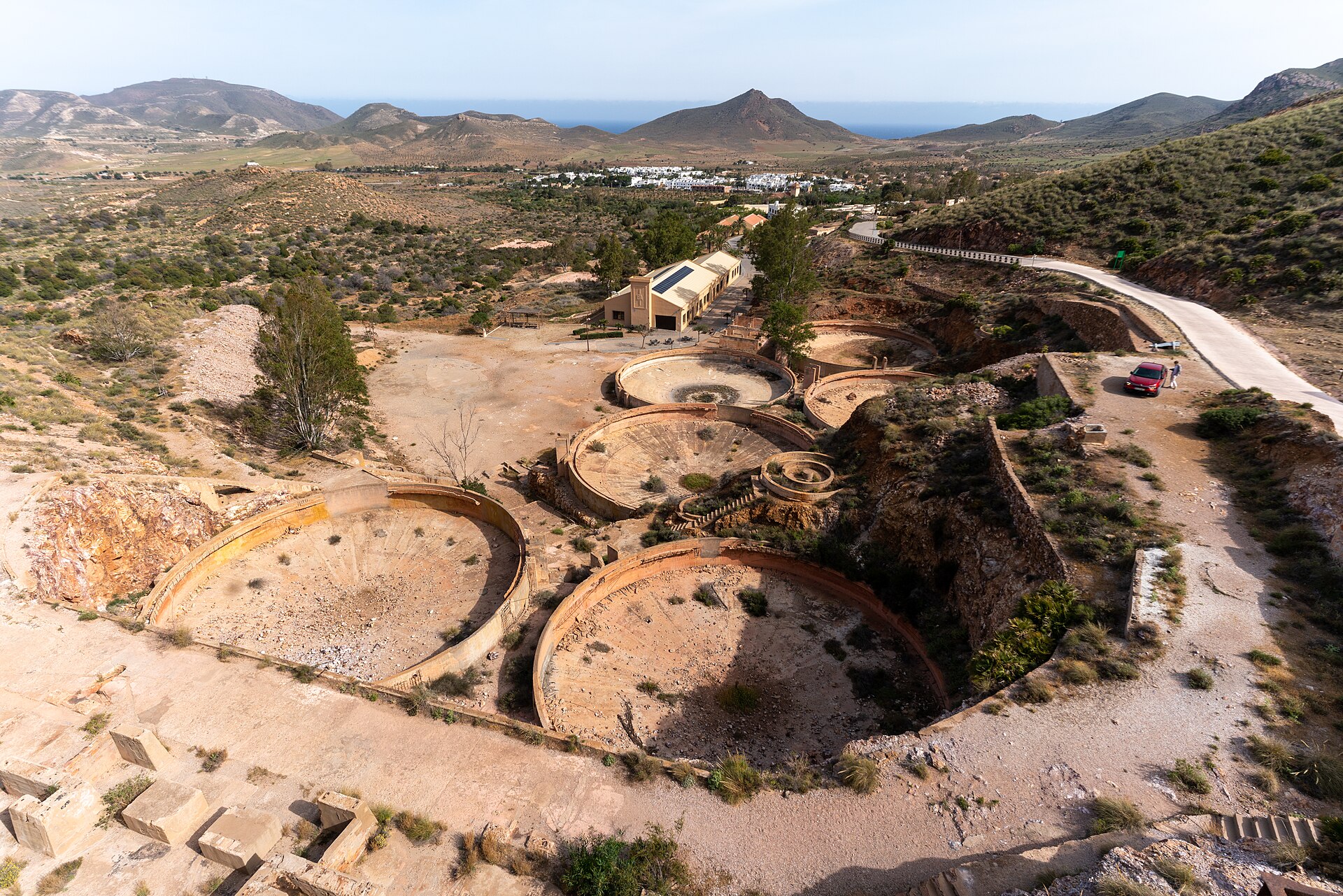
The abandoned gold works at Rodalquilar in 2026: circular leaching tanks, the road past them, the village and the sea beyond.
Photo: Paul Colin Hennig firstdorsal.eu · CC BY-SA 4.0 · Wikimedia Commons
Parts of the car chase run on the roads through the old gold-mining ground at Cerro del Cinto and Minas de Abellán, including the moment the fighter tears its wings off trying to fly through a tunnel in a mountain.
The mine is abandoned. Adits open straight out of a stepped orange cut in the hillside, and the leaching tanks of the processing works stand empty in the dry hills above the village. Duck, You Sucker!, The Condor, The Wind and the Lion and The Man from Marrakesh were all shot on the same ground. Nothing we have establishes whether you may walk into the workings.
Principal photography began on 16 May 1988 in the Tabernas desert. Spielberg had planned the chase around the tank as a short thing, two days of work, then storyboarded it into the centre of the film.
It was shot in the dry riverbeds here, and this is where our knowledge stops. The film office's entry for this film carries five ramblas, Búho, Indalecio, Trujillo, Otero and Viciana, plus Las Salinillas and a stretch at Alfaro whose name the guide itself spells two different ways. It does not say which shot belongs to which. Location sites do assign individual shots to individual ramblas, in confident detail, and every version of that we could trace ran back to aggregators rather than to anyone who was there. A rambla is kilometres long, so the pin is a point on a watercourse, not a filmed spot. Two of the unpinned ones carry Leone: Rambla de Otero has three entries in the whole guide and one of them is The Good, the Bad and the Ugly; Rambla Indalecio has all three Dollars westerns.
Named in the film office's list of this film's locations. Which scene, no source we reached says.
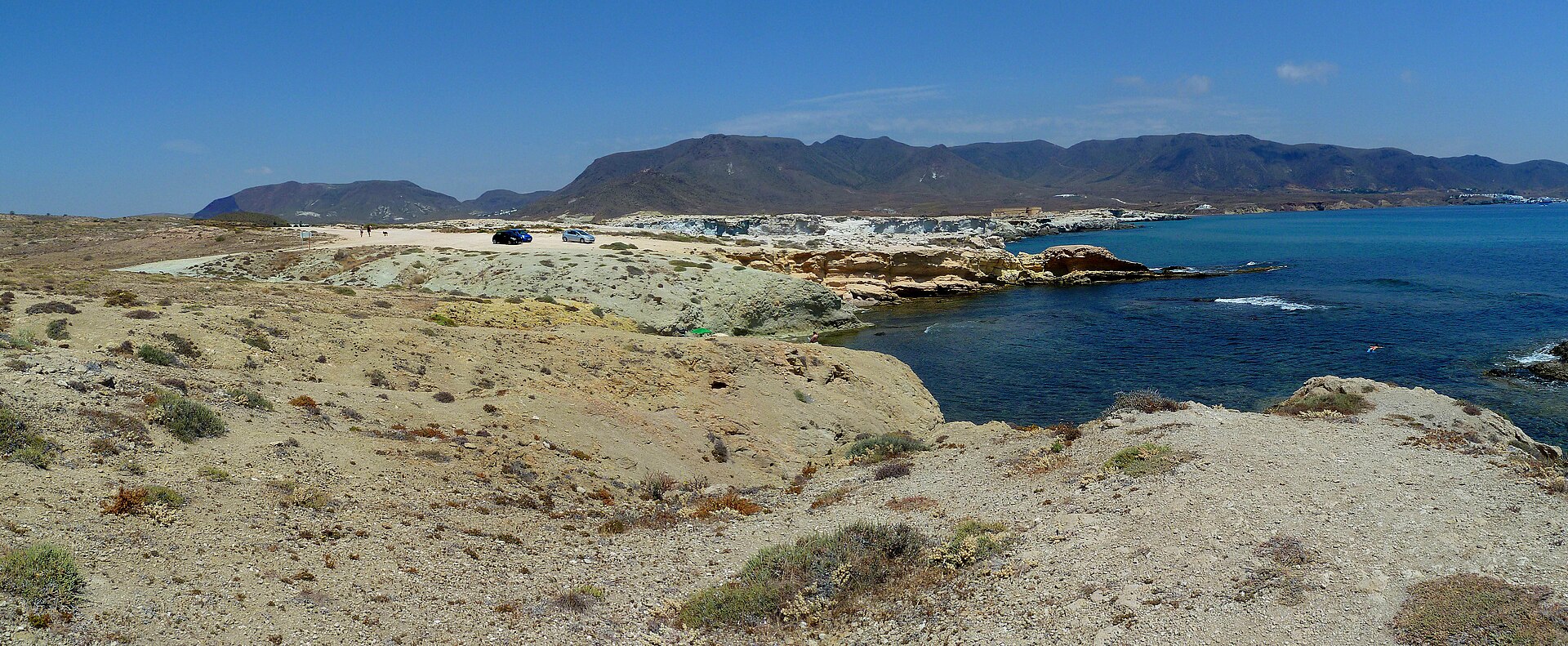
The place itself is a low coast of pale fossil dune stone with the Cabrera hills behind. The guide's walking route stops at the jetty here for a different film, and for the same actor: Connery diving into the sea in Never Say Never Again. The Wind and the Lion and Lucky Luke and the Daltons are on the list as well.
A street in the Almedina, the old quarter of the city, listed in the film office's index for this film and for no other film in the guide. That line is all the index says and all we found. There are three streets of that name in the province; this is the one in the city, because the index files it under the city.
The castle interiors went up first, 5 to 10 June 1988, and the escape from them on a motorcycle was shot here too. Then the library, the Portuguese freighter and the catacombs, one after another. The fight in front of a ship's propeller in Venice was done in a water tank here, with a long lens making the two men look closer to the blades than they were. The steamship brawl in the 1938 prologue took three days on a deck built on gimbals, with dump tanks of water coming down on it.
The Grail temple was filmed on 20, 21 and 22 July. The set had taken six weeks to build and sat on hydraulics so that it could come apart in the earthquake; between takes it took twenty minutes to put the hydraulics back to their starting positions and fill the cracks with plaster.
Elstree belongs to Hertsmere Borough Council and is a working studio, not somewhere to go. Its stages have carried Blackmail, the first British talkie, and Star Wars, and The Shining, and the largest of them is named after George Lucas.
Behind the facade: the main chamber is a bare room of banded sandstone with a doorway to a smaller one. Everything the film puts inside — the trials, the knight, the cups — was built at Elstree.
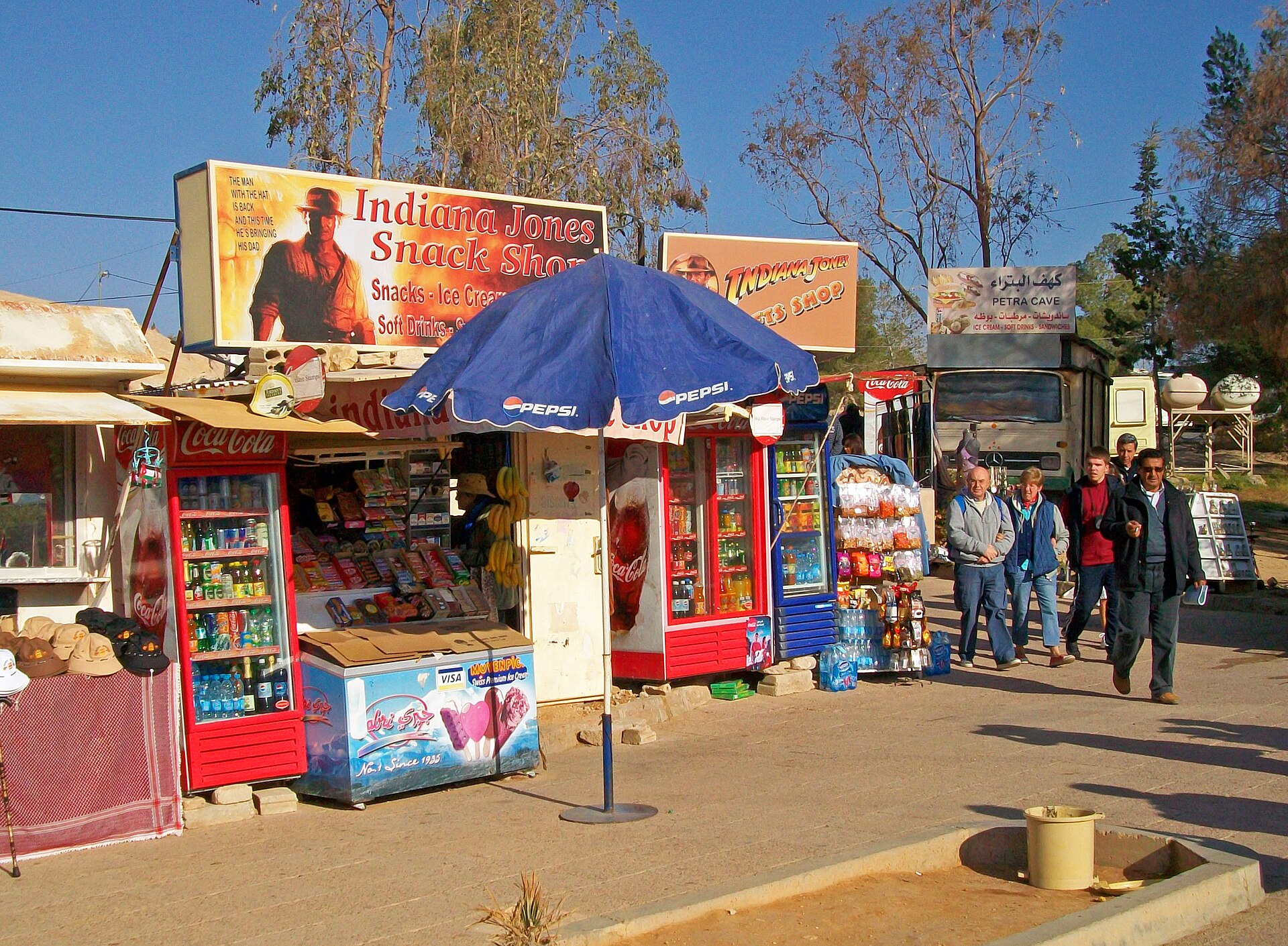
Outside the gate at Wadi Musa. The custodian's own pages never mention the film; the shops do. The board quotes the 1989 poster line about the man with the hat bringing his dad.
The temple of the Grail, filmed the day after Venice, with the crew as guests of King Hussein and Queen Noor. The main cast finished their work that week. Everything the film shows on the other side of that front was built on a stage.
Petra turns up on lists of films that have used it, worded as appearances rather than as shoots, which is a looser claim than the ones behind the Spanish and German entries here. The one that crosses this film's map twice is Sinbad and the Eye of the Tiger, at the Treasury and on the Almería coast in 1977.
The Treasury stands 39.5 metres high at the mouth of the Siq, the gorge just over a kilometre long that splits the rock in front of it; a triumphal arch spanned the entrance to that gorge until it fell in 1895. It is a mausoleum. Getting to it means four kilometres on foot from the visitor centre, or fifteen dinars for a club car. Entry is fifty dinars for a day if you are staying overnight in Jordan and ninety if you are not, one dinar if you are Jordanian. The gates open at six in summer and half past six in winter, everyone is expected out before sunset, and nobody sleeps inside the park. The stone is losing its surface to hands: white marks of stearic acid have come up on the walls and columns where people lean and touch, and the face has receded by 40 mm in under ten years.
Outside the gate at Wadi Musa there are kiosks with a fedora painted on the boards, an Indiana Jones Snack Shop, an Indiana Jones Gifts Shop, the 1989 poster line about the man with the hat bringing his dad. Inside the gate, the authority that runs Petra does not mention the film once on its pages for the Treasury or for the Siq. What it tells you instead is that the Nabataeans cut the thing, that the name comes from a bedouin story about a pharaoh's treasure hidden in the urn at the top, and that the bullet holes in the urn were made by people shooting at it to get the treasure out.