Two wooden churches carried this film and neither one is where you would look for it. One burned to the ground in 2006 and a new church took its place. The other still stands in a small town north-east of Chernihiv, and people are still arguing about what the camera got inside it.
4
places on the route
Click a point to jump to its entry.
Gogol set the story in Kyiv Oblast and the film keeps it there. The crew could not find the country it wanted anywhere near Kyiv and went looking outside the region: around Chernihiv first, then in the Carpathian foothills. One church in the story ended up needing three buildings, the wooden church in the Carpathians, the wooden church at Sedniv, and a copy of the Sedniv interior run up in a pavilion at Mosfilm. Much of what was filmed in the first two never reached the screen.
---
Chernihiv Oblast
Yelets Monastery, Chernihiv
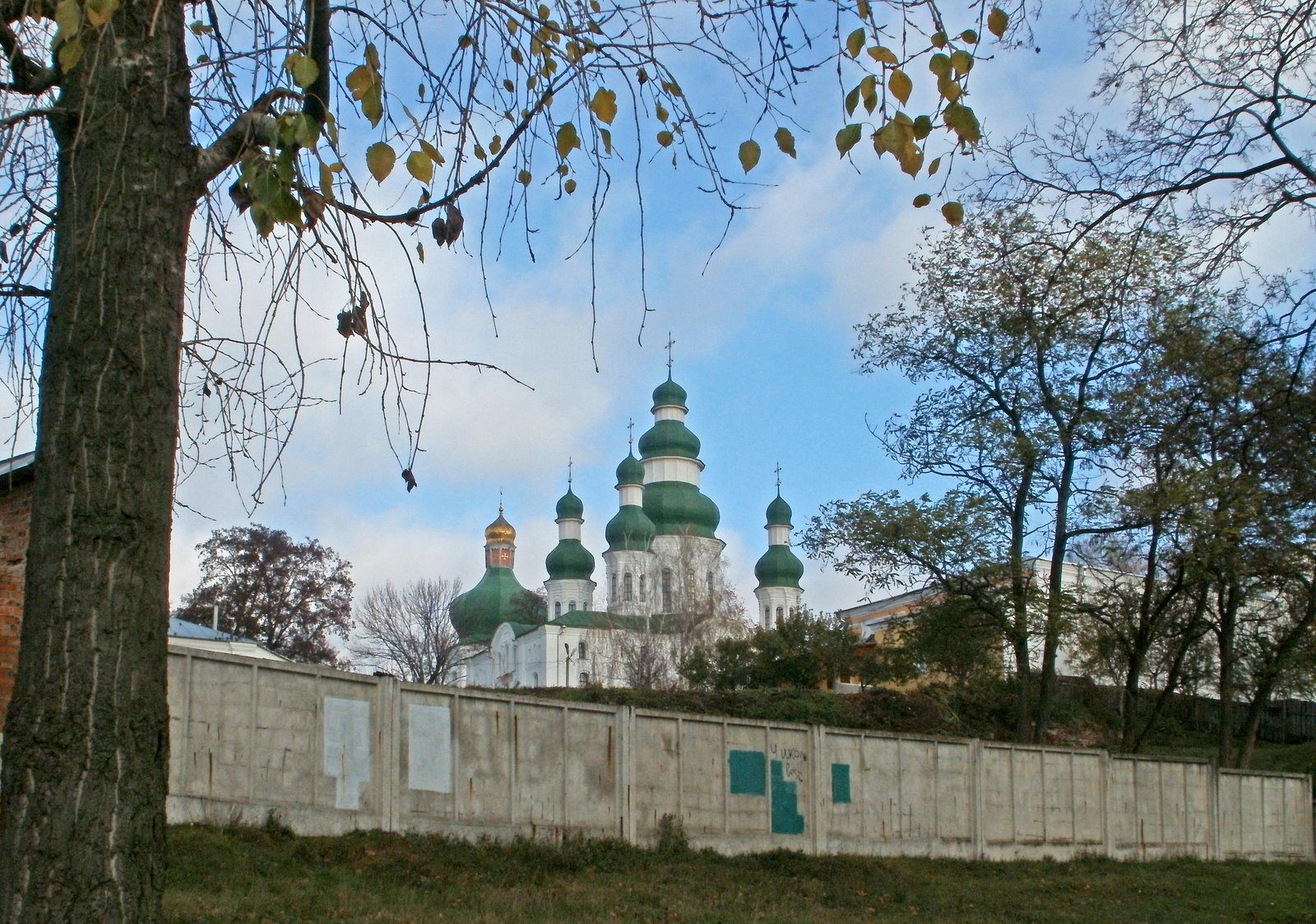
The Dormition Cathedral of the Yelets Monastery, Chernihiv, October 2013, seen over the concrete fence from the street below.
The film opens here. The Kyiv seminary that turns its students loose for the summer is the ground of the Yelets Monastery, and the windowsill Khoma Brut sits on belongs to it. The Dormition Cathedral is in shot.
The crew reached the Chernihiv region in July 1966 and found the monastery in no state to be photographed. After it was closed in 1921 the Soviet authorities moved their own institutions in: the Dynamo sports society, pharmacy warehouses, a library, a hostel for the philharmonic's performers. Before filming could start the crew had to fill in a huge puddle in front of the main entrance, patch and paint the domes and mend the doors.
The flying coffin was meant to be shot here as well. They began putting up a false church on the monastery ground and gave it up for want of scale, then looked at the old belltower nearby and found it cramped and full of rubbish. That is how the church at Sedniv got the scene.
The monastery was founded in 1060 on a slope of the Boldyni Hills, where legend puts an icon of the Mother of God found in a fir tree, and the name comes from the tree. Monastic life came back in the early 1990s and it is a convent now. One wooden building of the Cossack era is still standing on the ground, the house of Feodosiy Uhlytsky, late seventeenth century.
In 2012 Mosfilm sent Chernihiv working stills and footage of scenes that never reached the finished picture. The Chernihiv Ancient reserve, which holds the monastery among its monuments, took them into its collection.
St Catherine's Church, Chernihiv
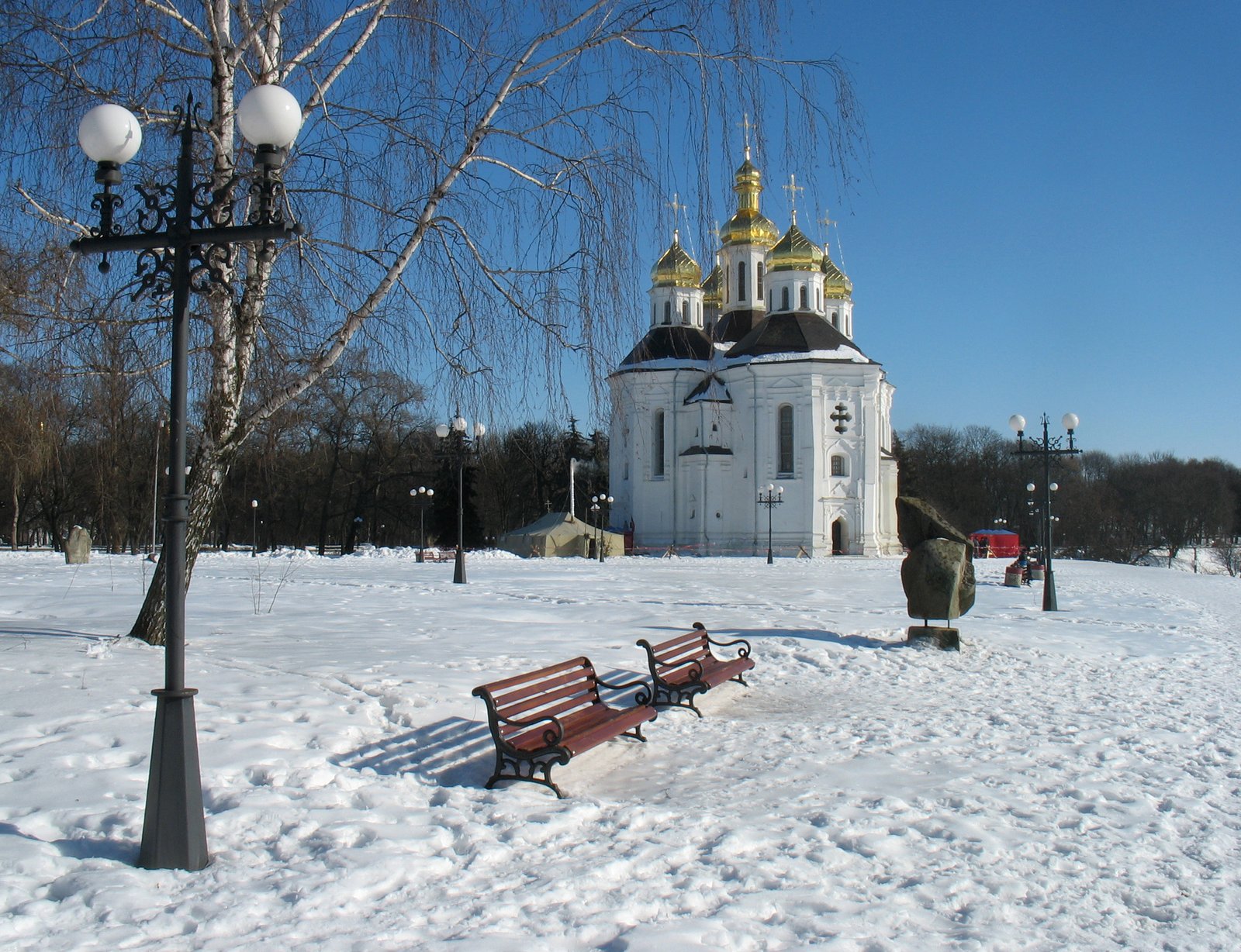
St Catherine s Church, Chernihiv, February 2007. It stands on a spur above the ravine at the edge of the old citadel.
Seven hundred and fifty metres east, five gilded domes over limewashed walls. The same send-off sequence was shot around the outside of this church, which sits on the way into Chernihiv from the Kyiv road.
It was consecrated in 1715, built for the Cossacks of the Chernihiv regiment who stormed the Turkish fortress of Azov in 1696 under their colonel, Yakiv Lyzohub. The brickwork copies a wooden church: five octagons, each under its own dome, the middle one raised above the rest. There is no principal facade, and the building reads the same from any side you approach it.
It was not a church in 1966 either. The last service before the film was held in 1933, the building was restored as a museum after the war, and it went back to parish use in 2006.
The Lyzohubs held Sedniv as well, twenty-five kilometres north-east, and the church of the three nights stands there.
St George's Church, Sedniv
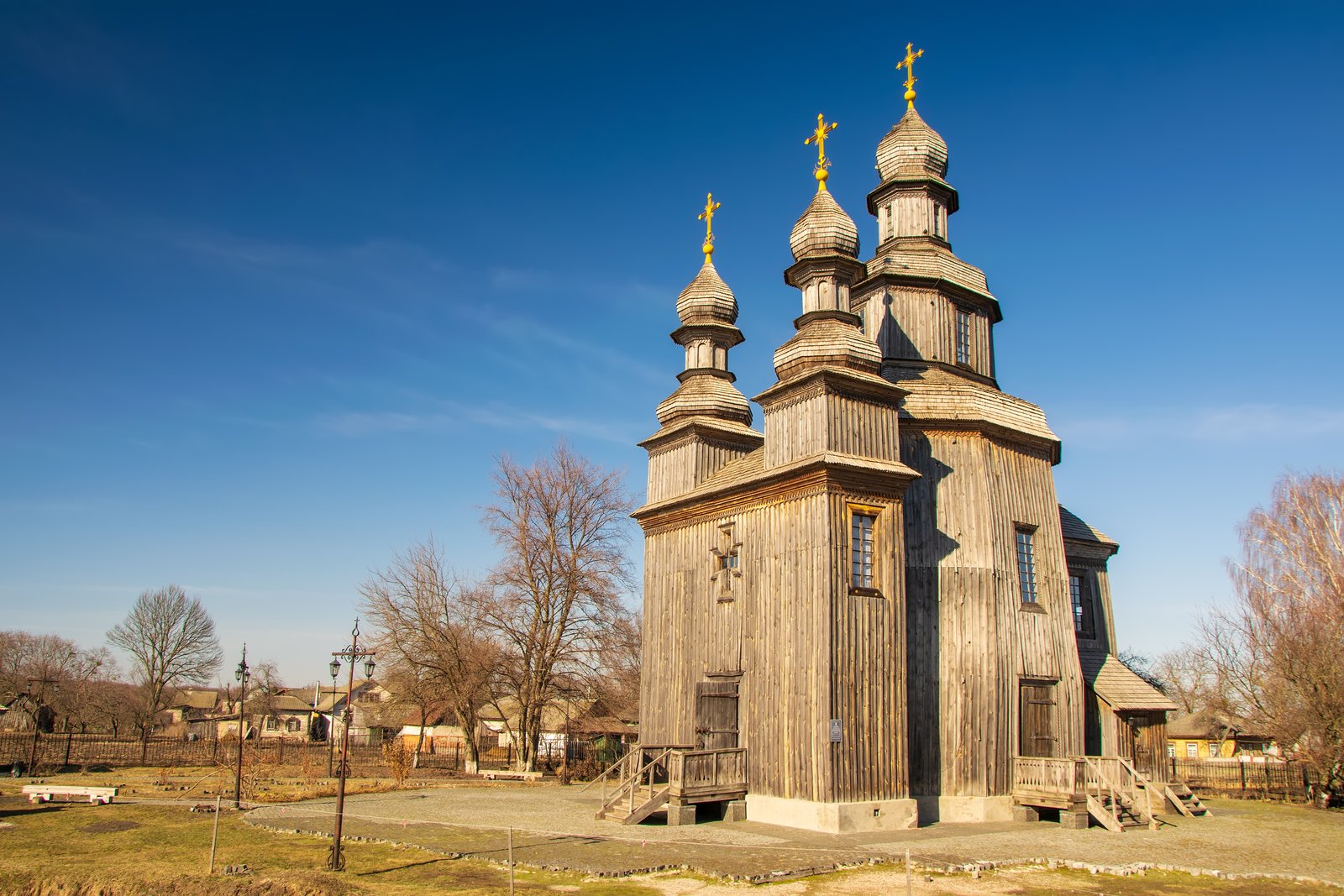
The wooden church of St George at Sedniv in April 2018, seen from the earthworks of the old hillfort it stands on.
Anatoliy Blynets, whose son is the priest, comes over with a bunch of keys, takes off the padlock and pushes the door, which groans. The floor creaks. Light comes in through cross-shaped windows and mixes with midges under the high dome.
The church stands apart from the houses on the high bank of the Snov, on an old hillfort with steep slopes on three sides. It is wooden, in three parts, put together without a single nail, with an octagonal tower over the middle and two tower-pillars at the west end. The walls lean as they go up, so the tower over the middle and the one over the altar each narrow by ten to twenty centimetres towards the top. Cossacks moved the whole building to this spot about three hundred years ago. A state protection plaque is screwed to the planking outside. It says between 1715 and 1747, monument number 1789.
This is the church of the three nights. Khoma reads over the dead girl and the coffin lifts and circles. How much of that happened in this building is the argument. Tamara Blynets, who was about ten at the time and whose grandfather worked on the shoot, remembers the crane jib the coffin was fixed to, turning while the cameramen filmed, and the pay: a rouble for children, three roubles for adults. The interior is theirs, she says. Andriy Kurdanov, a local historian, says the flights cannot have been done in here at all, because in 1966 the church had no dome and there was nothing to hang a coffin from.
By one version the Sedniv material was thrown out in Moscow and the coffin scene reshot at Mosfilm, where the interior of this church was reproduced exactly. The state Institute of National Remembrance puts the film's final scenes in this church and says nothing about anything being cut. What did survive from the Chernihiv leg is a windmill and a field with a cart going across it.
Kurdanov has one piece of evidence you can go and look at. The film crew painted the inside of the church for the camera, and Volodymyr Kasyanenko, the restorer who drew up the 2000 restoration plan, told him by telephone that the faint paintwork still showing on the walls is theirs, from 1966.
The building around it is largely new. The war took the belltower and the dome, a first restoration in 1975 to 1978 stopped for want of money, and from 2004 the church was practically built again. The restorers put the surviving face of Christ back on its board upside down. Blynets says they left the foundation without drip edges and blew foam into the gaps, and that every year is a struggle; the timber still leaks in rain and snow. Digital copies of pages from the Mosfilm shooting journal stand on boards in front of the church. Up to fifty thousand people a year come to Sedniv, and most of them come for this building.
Sedniv takes film crews. Ivan Kavaleridze's Grigory Skovoroda is from 1959. The Battalions Ask for Fire came in the mid-eighties. Marysia Nikitiuk's When the Trees Fall is from 2016. The Lyzohub kamenytsia and the Resurrection church went up at the end of the seventeenth century, the first masonry buildings in the town.
Wind back to the first reel, before the dead girl and the three nights. The students are let out for the summer and go tearing off home, and on the way they blow through a market and come out the far side of it with a stolen goose. That market is Brusyliv.
The name comes off paper. Oleksandr Lytovchenko, a researcher at the Chernihiv Ancient reserve working on Chernihiv in films, was sent to Moscow and read the shooting journal of Viy in the Mosfilm archive: not a word in it about Kyiv, a great deal about Chernihiv. One Chernihiv article puts Brusyliv among the places the journal names. Another, from the local historian Andriy Kurdanov, is the one that ties the goose to it.
There is a second Brusyliv in Ukraine, a town in Zhytomyr Oblast, and neither article says which of them it means. This one lies twelve kilometres south of Sedniv, inside the stretch of country the crew was already working in.
Ivano-Frankivsk Oblast
Horokholyn Lis
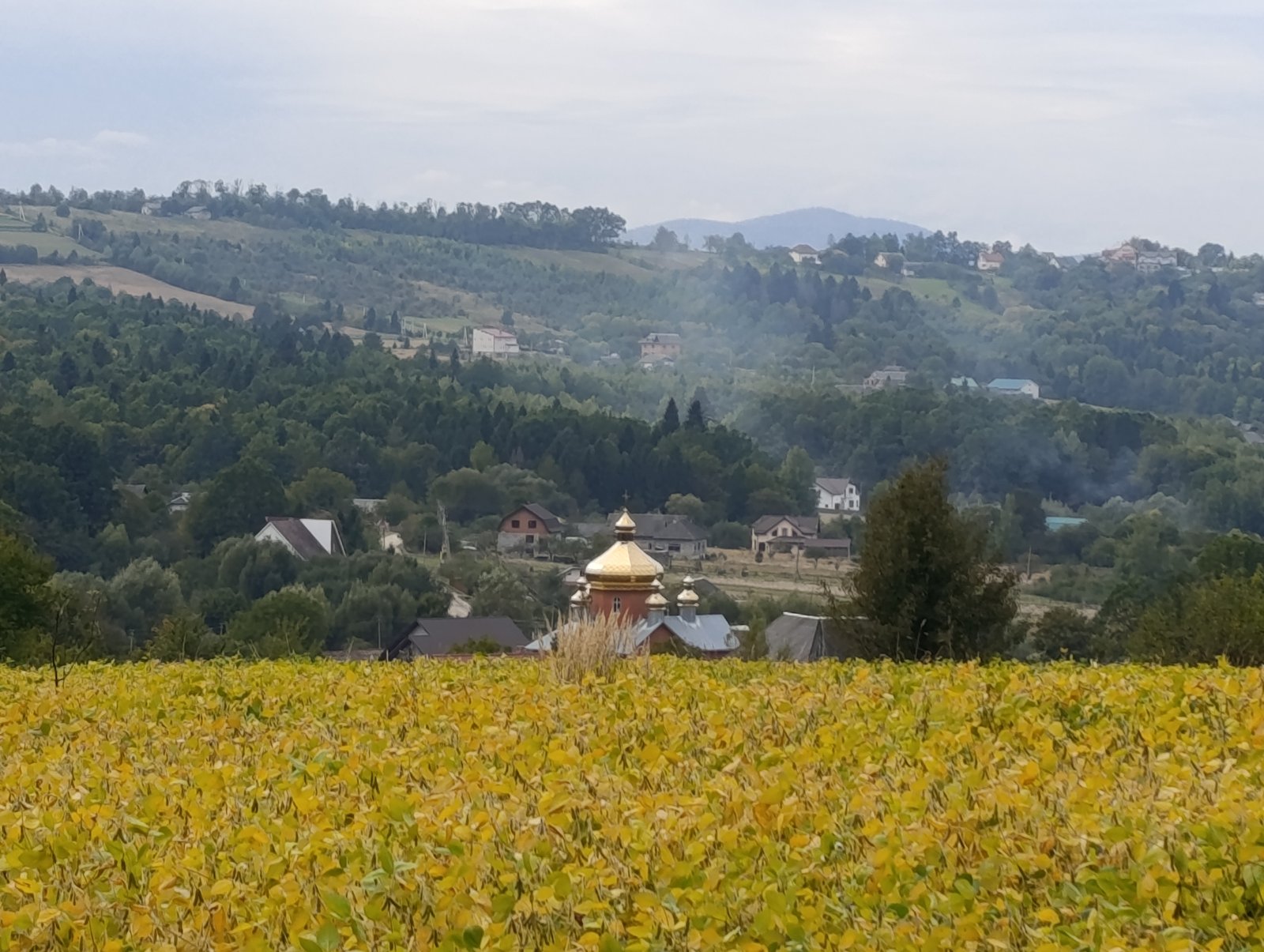
Horokholyn Lis in September 2025, looking across the fields towards the Carpathian foothills.
A hamlet of three hundred houses in the Carpathian foothills, lying in a hollow between low hills with the road winding down to it. Six hundred kilometres from Sedniv, far enough that the two ends of this shoot are not one journey.
The wooden church of the Blessed Virgin here is the farmstead church of the story, and the graveyard beside it was filmed too. The building was not old. A Pole left the village before the war, the villagers took his farmstead apart and built the church out of the timber in 1942, under German occupation. Under the Soviets the church was shut and the building was given a Museum of Atheism and Religion. Local people put the film crew's choice down to that.
For about a month the meadow by Hryhoriy Serediuk's old house was full of buses and cars, like a market day. Actors in torn greatcoats carried a coffin between the church and the graveyard; the coffin itself came in by plane. The crew went round the yards for jugs, kerchiefs, clothes and boots, bought pears and apples off the gardens, and put one village woman in shot with a rooster under her arm. Much of what was shot here was cut out, the fight between Khoma and the girl among it.
It burned to the ground in 2006 and the fire took the old icons with it. A new church stood on the same spot inside a year and a half, paid for by the community, the district and village councils and local businessmen. Its domes show from the far end of the hamlet, and that is what is standing when you get there.