A newsagent's stock is bouncing along the pavement of Princes Street, and Renton and Spud are running away from it with shop security on their heels. The chase goes up Hanover Street past the Royal Scottish Academy and ends on Calton Road, beneath the arch of Regent Bridge, where a car catches Renton and flips him over the bonnet. Those three streets sit within 900 metres of each other, and they are as much of Edinburgh as anybody has written down: going back over the ground in 2017, the BFI put the city's presence on screen at about three minutes.
14
places on the route
The three Edinburgh streets stand within 900 metres of each other — switch cities with the buttons above. Click a point to jump to its entry.
Everything else that reads as Edinburgh is Glasgow, and that was a budget decision rather than a scouting one. Danny Boyle told Empire that the Glasgow Film Fund had backed Shallow Grave, and that the money came with an obligation to shoot as much of the next film as possible in the same city; most of the best crews in Britain were living there anyway, he said. His producer, Andrew Macdonald, said they were carrying more than fifty locations on a small budget and could not afford to go east twice. So Spud's cafe is on Maryhill Road, Begbie's balcony belongs to a converted Baptist chapel in North Kelvinside, the Worst Toilet in Scotland was a set inside an empty cigarette factory, and the London hotel room at the end of the story is on Buchanan Street. Of those Glasgow locations, the cafe and the pub are still serving. The nightclub is rubble under a block of flats, and the hotel has been hollowed out behind its own front wall.
filmed herewhere it really happened
The Edinburgh filming locations: three streets, 900 metres
Princes Street
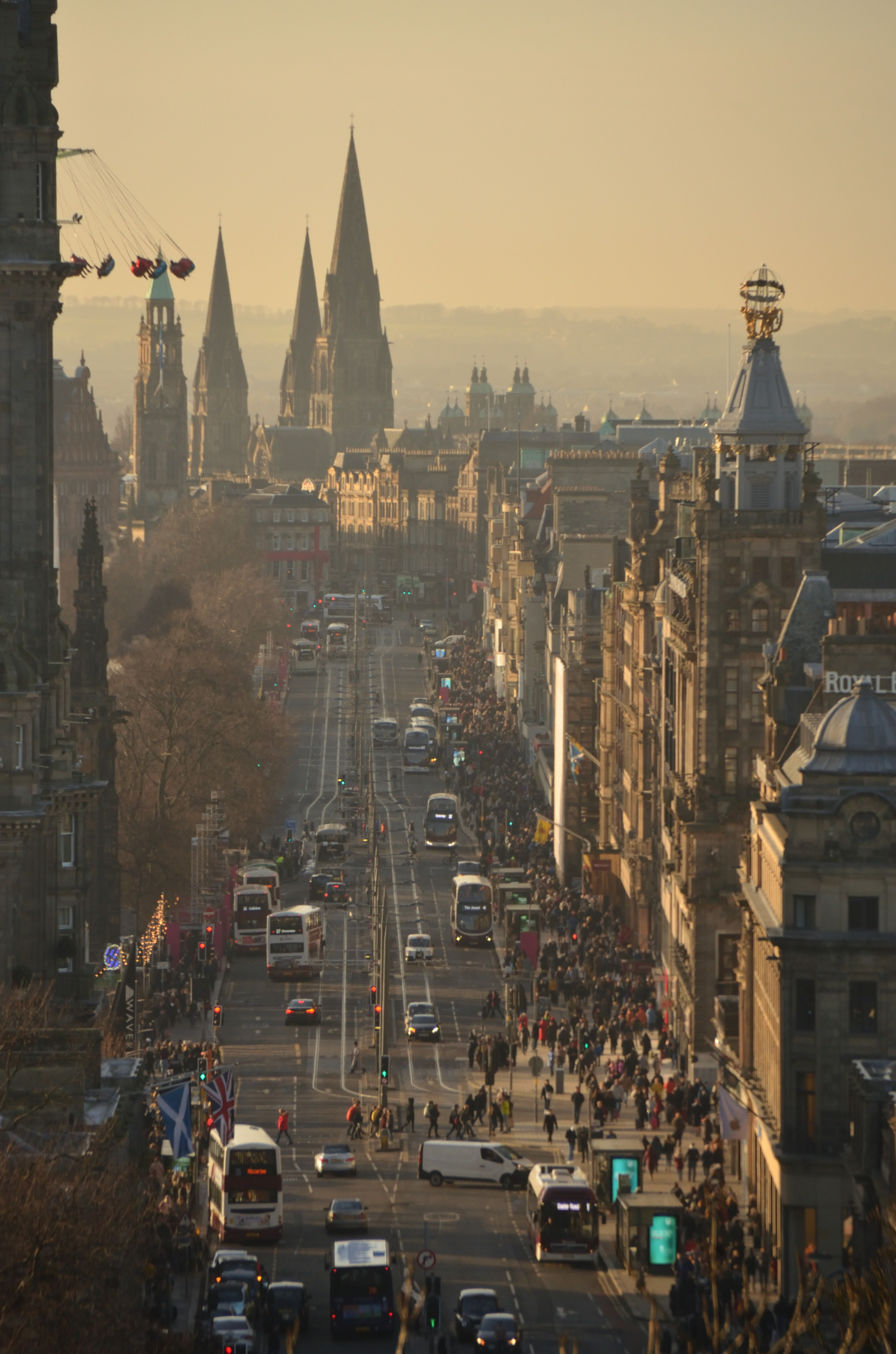
Princes Street looking east at dusk, with the spires of the Old Town beyond. The opening chase runs along this pavement.
The opening chase, cut to Iggy Pop with the Choose Life speech laid over the top of it. Princes Street runs about 1.2 km, and the accounts of the chase name shops rather than street numbers. Empire's reporter was on the street on the nineteenth day of the shoot, and he watched two actors sprint the same few yards most of the morning and strew the same stolen goods across them. The newsagent, John Menzies, closed in 1998, and a Zara was trading in its place by 2017; the Marks & Spencer visible behind the runners is still in business, its frontage cleaned up. The trams running down the centre of the road arrived in 2014; in 1995 there were none. The street has been used since by T2 Trainspotting, The Angels' Share and Clique.
Hanover Street
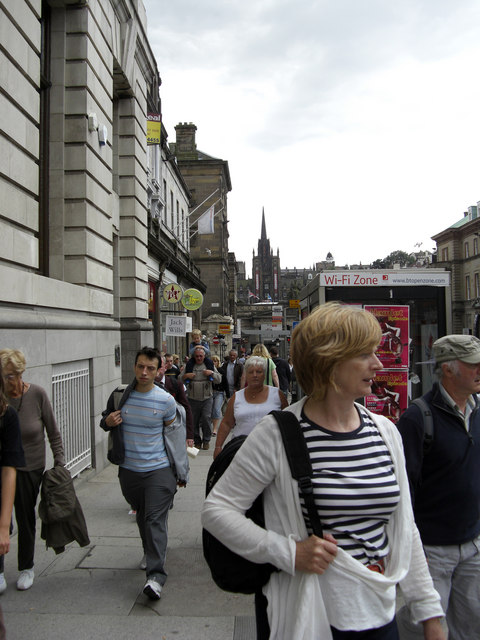
Hanover Street looking south towards Princes Street — the direction of the chase.
The middle third of the chase, 291 metres uphill from Princes Street. The two of them run past the portico of the Royal Scottish Academy and through a crowd of shoppers who, the BFI presumes, had not been told a thing and are in the film regardless. Above the Academy the street climbs to George Street between tall stone frontages. The Academy at the bottom of the hill is a gallery you can walk into.
Calton Road, under Regent Bridge
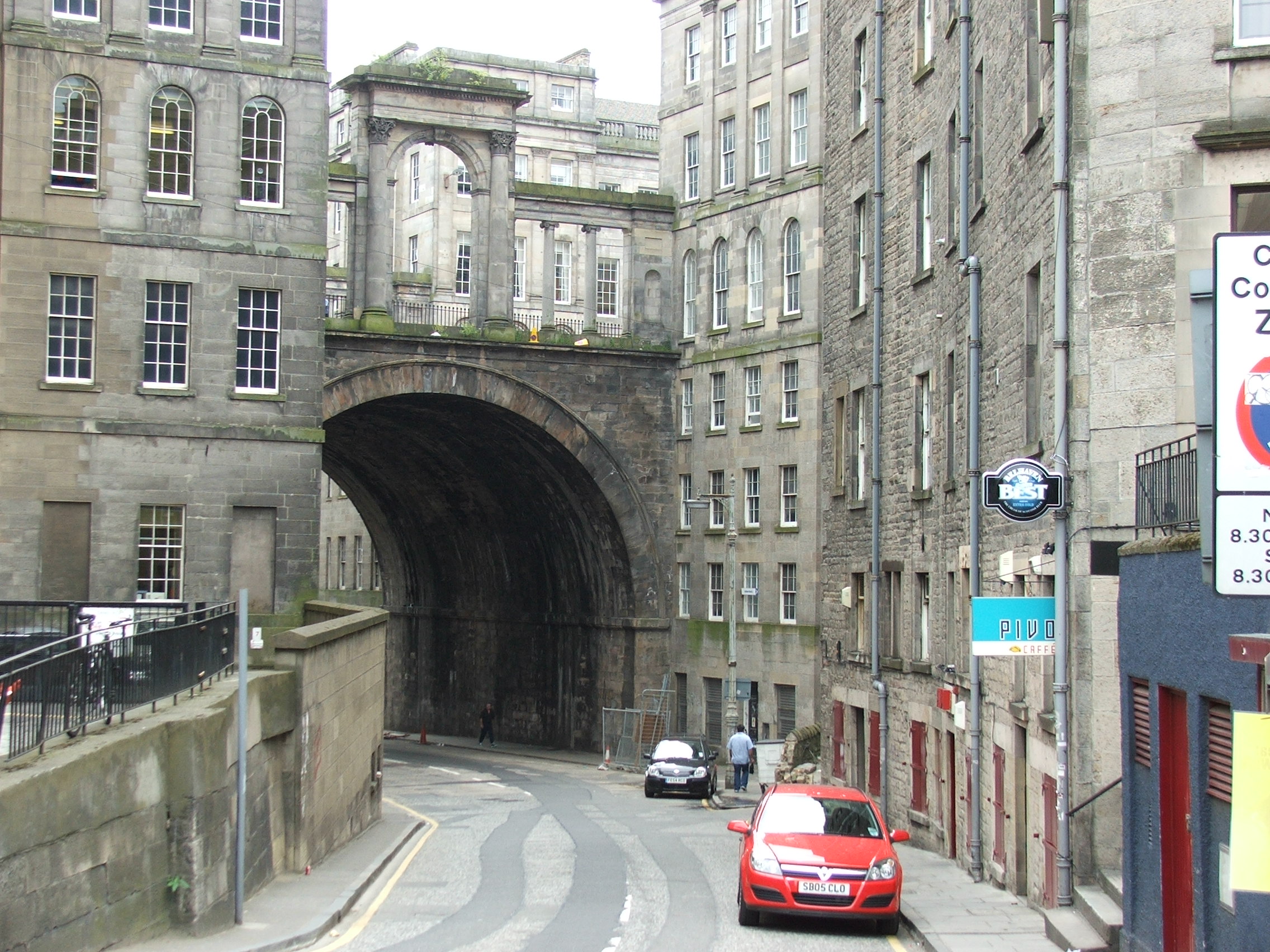
Calton Road from Leith Street in 2005, with the arch of Regent Bridge across it. The bar on the right is the one the chase runs past.
Where the chase finishes, and where Edinburgh finishes with it. A car pulls out of a side opening, Renton rolls across the bonnet and gets up laughing, Spud keeps going under the arch, and Waverley station sits in the background of the shot. The arch belongs to Regent Bridge, designed by Archibald Elliot in 1819, category A listed, carrying Waterloo Place over the road; the station's Calton Road entrance is a few steps east. The little bar the pair run past is Pivo now, done out on an eastern European theme. Empire's reporter watched them get it: under five seconds of screen time, two hours of work, McGregor knocked down about twenty times, with pauses while the nurse put him back together. Afterwards everyone went back to Princes Street and shot for another hour. Boyle had told Empire before the shoot that the Edinburgh days would take in pick-ups as well as the chase, wordless scene-setting shots to pad the action out.
Glasgow playing Edinburgh: half a mile of Maryhill
Firhill Complex, Hopehill Road
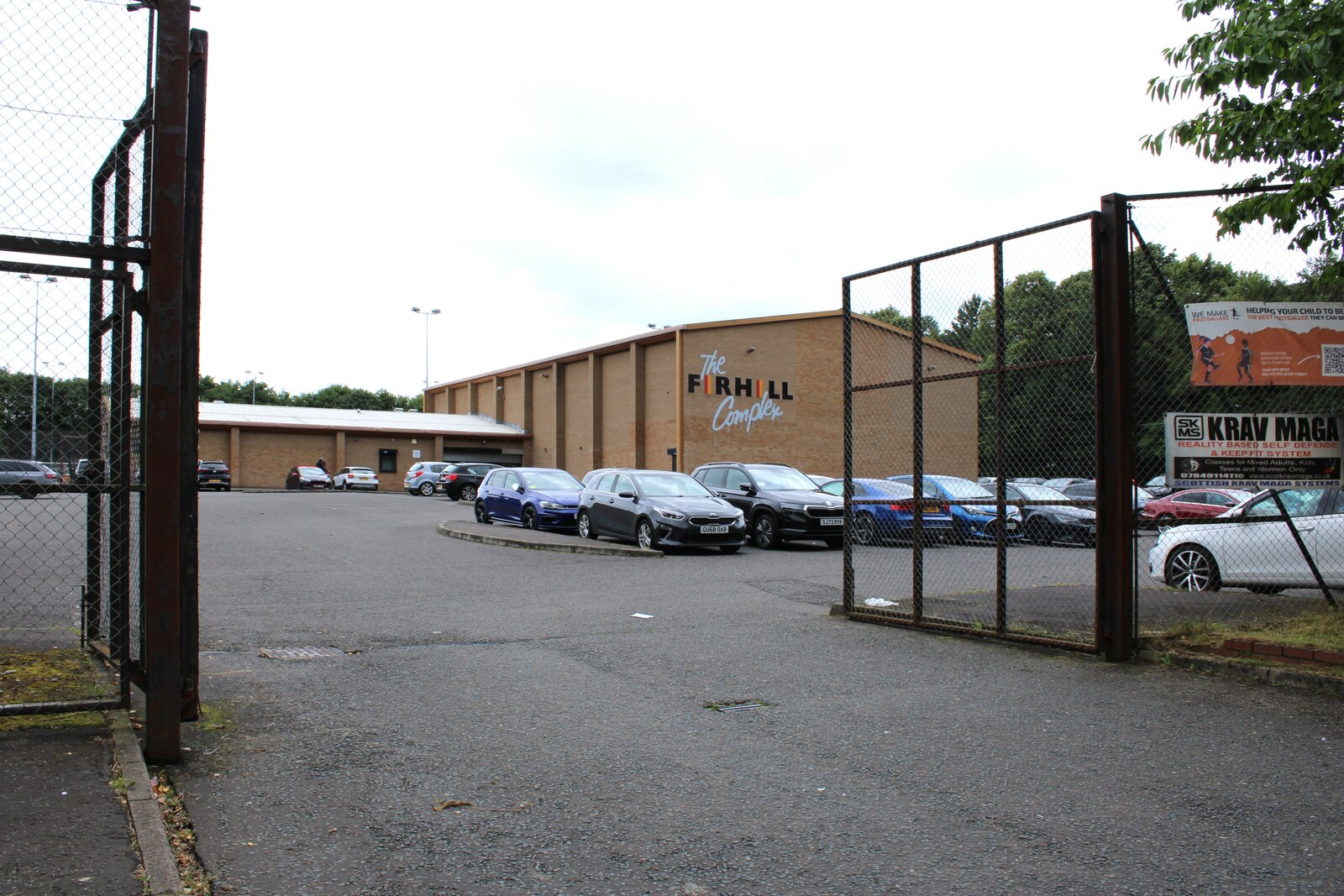
The Firhill Complex on Hopehill Road, where the five-a-side match of the opening titles was played.
Five-a-side football under the opening credits, the group introduced one player at a time as the match runs. The team on the other side of the ball is Calton Athletic, a recovery group for heroin addicts, started in Glasgow's East End in 1985 as a football team with a social club attached; Ewan McGregor went to meet them while he was working out the part, and they are the opposition on screen. The pitches are on Hopehill Road, 500 metres south of Firhill Stadium, where Partick Thistle play. A photograph from 2024 shows a low building behind steel mesh fencing, floodlight poles standing over the car park.
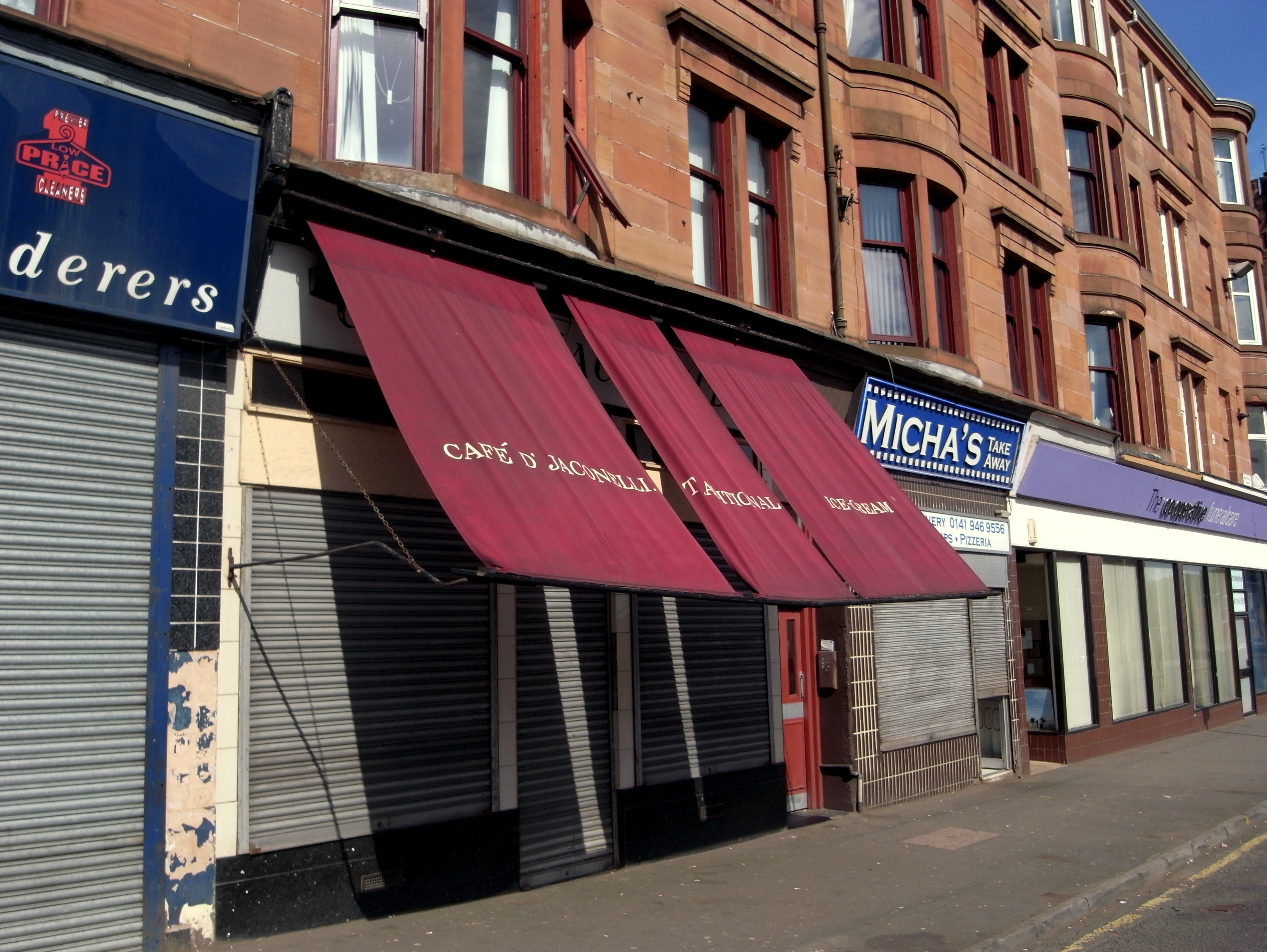
Café D'Jaconelli, 570 Maryhill Road
Café D'Jaconelli at 570 Maryhill Road, Glasgow, in 2011.
A milkshake, and Renton's advice about the job interview waiting for Spud. The cafe stands 457 metres from the Firhill pitches, wedged between The Codfather and a small launderette. It had been trading 93 years by 2017: blue fishtank, 1950s juke-box, booths with Formica tops, and an interior that two decades after the shoot had barely been touched. It is still open, and you can sit in the same booth.
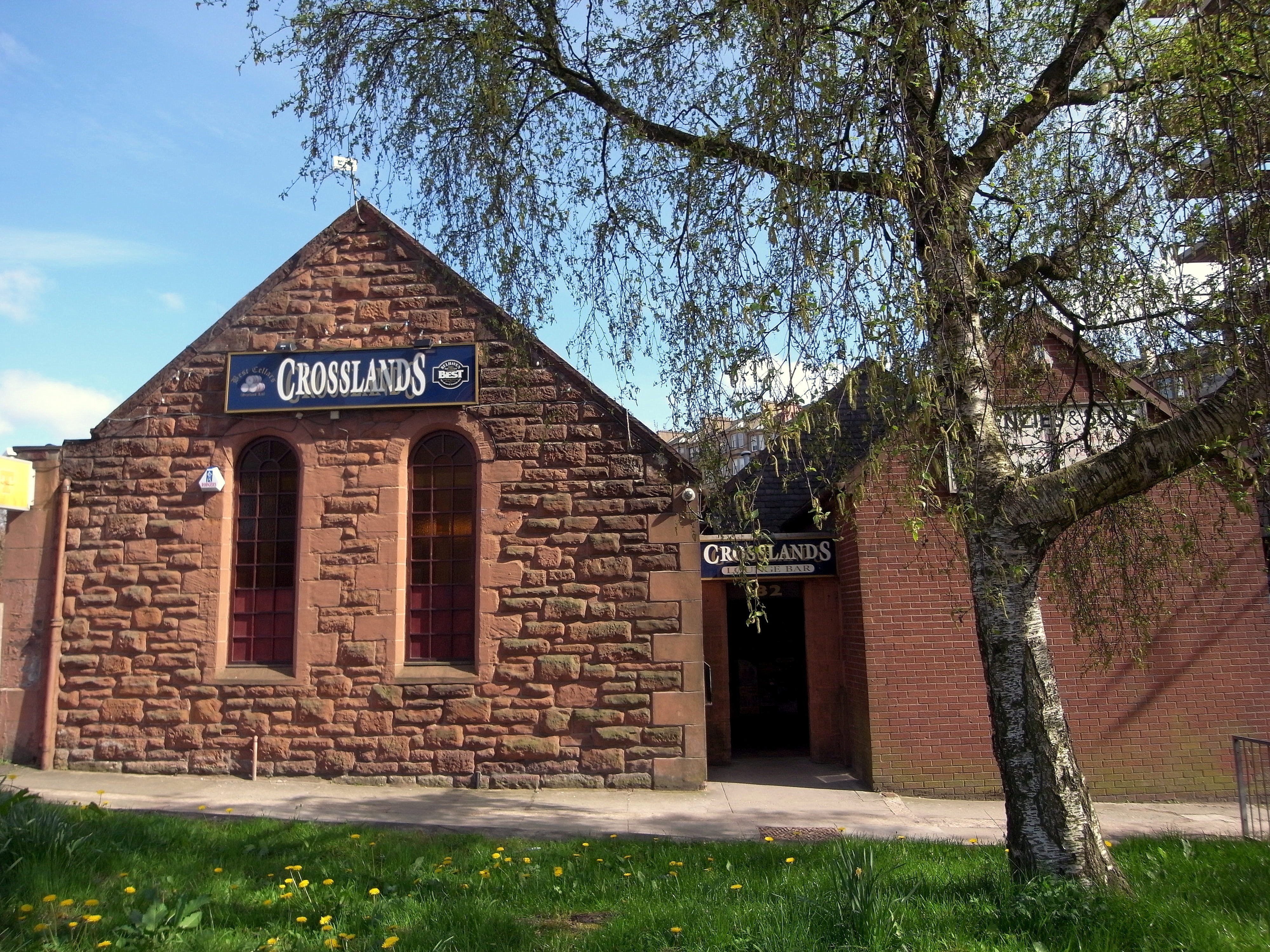
The Crosslands, Queen Margaret Drive
The Crosslands on Queen Margaret Drive in 2011, still under that name. The building began as a Baptist chapel.
Begbie on the couch under the wrought-iron balcony, telling the table how he gave a man a hiding over a game of pool, then lobbing his glass backwards over the rail into the bar below. The place was built as a Baptist chapel, and the balcony is the reason the production wanted it. Two days in the summer of 1995 cost 700 pounds to the owners, plus 20 pounds and free drink for every regular in the place. The sign has been repainted three times since: Franco's Bar; The Kelbourne Saint, in 2016, after 40,000 pounds went into the place; and BrewHaus, by 2022.
James Killen, the general manager in 2017, told the Guardian how to spot a visitor who has never been in before: they look up. Two young Finnish women had done it that week, one of them holding an iPad up under the balcony with a still from the scene on the screen while the other photographed her doing it.
One account will not sit with the others. Empire's reporter, riding along on the 1995 recce, names the pub for this scene as the Brewhouse, puts it in the town centre, and has Boyle saying that no other bar they could find had a balcony that would work. Queen Margaret Drive is 2.7 km out from the centre, and the pub there has carried the name BrewHaus only since about 2022. Either Empire wrote down a candidate that was later dropped, or it had the name and the district wrong. Everyone else, the manager included, says Crosslands.
Partick: the club that kept its own name
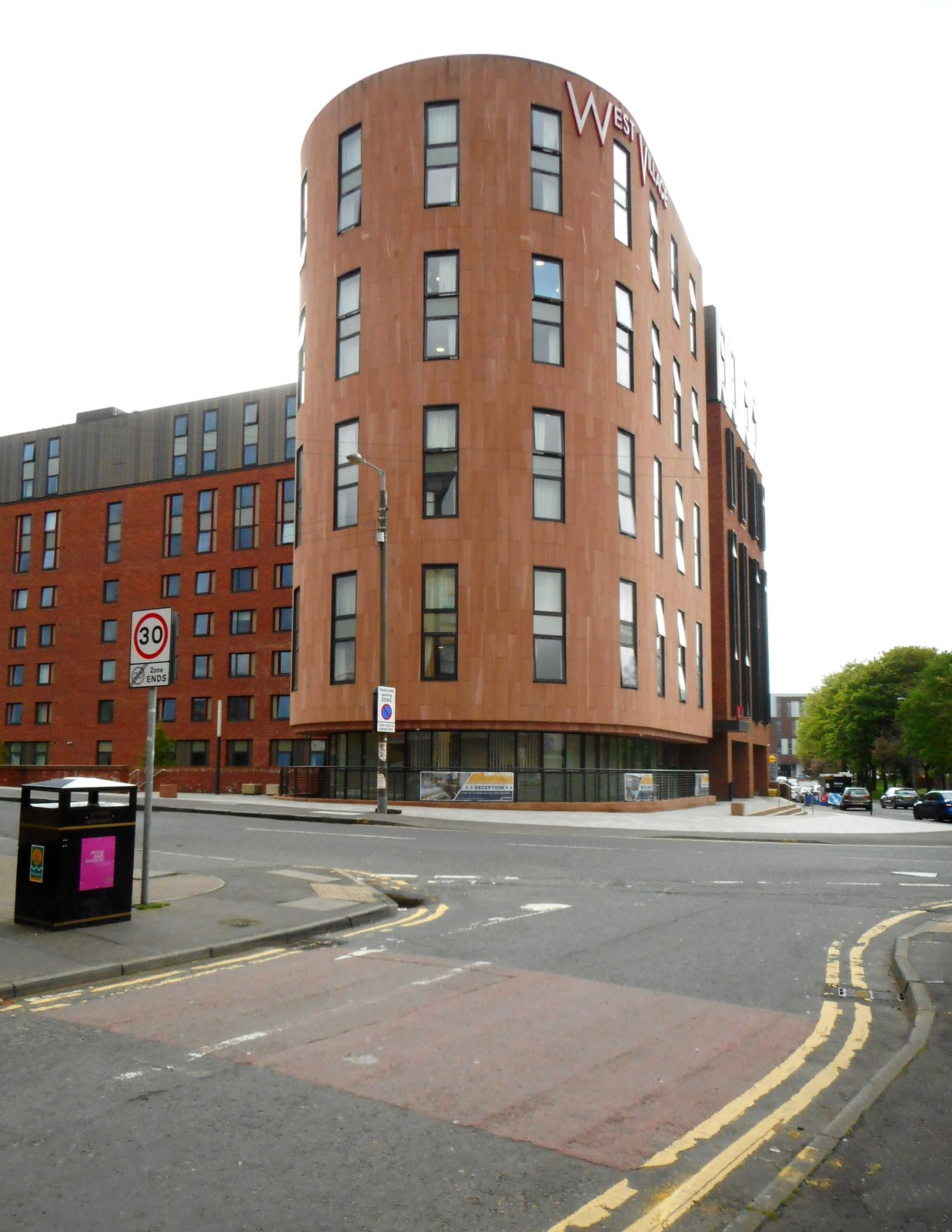
The Volcano, Benalder Street
The West Village flats on Benalder Street, on the ground the Volcano nightclub stood on.
Renton meets Diane in the car park. Inside, Tommy and Spud are talking about sex in a curtained-off corner while the girlfriends are having the same conversation in the toilets. The club plays itself, name and all: Volcano on the door and Volcano on screen. Before it was the Volcano it was Cinders Disco, and it stood where Byres Road comes down to Partick Cross; the Blondie and Heaven 17 on the soundtrack, by the BFI's account, is what the place played on an ordinary night. Empire's reporter went round with the location scouts and took down the booking: club and car park, Tuesday 30 May 1995. The building is gone. Flats called West Village occupy the ground, and 15 Benalder Street is not an address any more.
Tommy and Lizzy rent a tape here. Their own video goes missing, and Tommy's slide starts from that. The Glasgow magazine Glasgowist puts the shop at 312 Dumbarton Road, 388 metres from where the Volcano stood. There is a pharmacy at the number now.
Diane comes out of school and Renton is waiting at the railings. They walk the length of them to the gate, where she tells him she will go to the police unless he comes back. Jordanhill School stands on Chamberlain Road, in the West End. The railings and the gate at the end of them are still there. It is a working state school run by its own board of managers, and there is nothing there to visit.
Rouken Glen Park
Rouken Glen Park, opened to the public in 1906 and now run by East Renfrewshire Council.
Renton and Sick Boy lie on the grass doing Sean Connery voices, disagreeing about the Bonds and about The Name of the Rose, while Sick Boy puts air-rifle pellets into strangers across the park.
Boyle had used this wood before. Two years earlier, in the trees here, Ewan McGregor, Kerry Fox and Christopher Eccleston dug the hole that gives Shallow Grave its title. The body in the wood is Keith Allen, who turns up again in this film as the London dealer.
The park runs to 58 hectares, it has been open to the public since 1906 and East Renfrewshire Council looks after it.
Dennistoun: the cigarette factory where the interiors were filmed
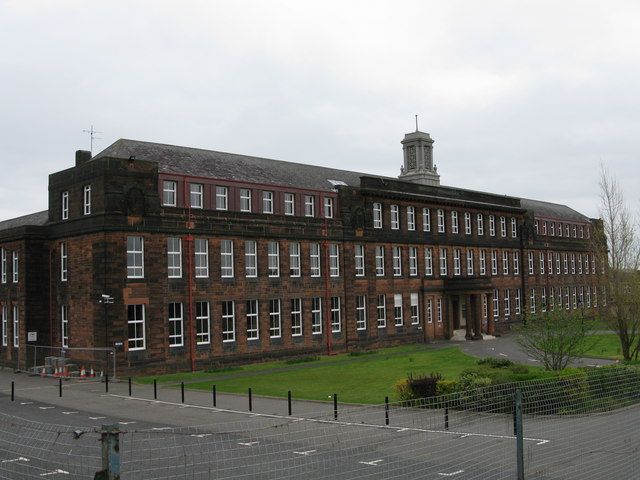
The former Wills factory, Alexandra Parade
City Park on Alexandra Parade in 2005 — the former W.D. & H.O. Wills cigarette factory, empty from 1990 until its office conversion in 2004, and the film's improvised sound stage in 1995.
You cannot visit the Worst Toilet in Scotland. It was a carpentry job, put up inside the disused W.D. & H.O. Wills factory in Dennistoun along with Renton's flat, his parents' front room, the squats, the tidier suburban rooms and some of the London interiors. The production office, the wardrobe and the art department worked out of the same building, and the sets took up 15,000 square feet of it for three weeks of interior filming. The factory stands just off the M8, the road that links Glasgow to Edinburgh. Thirty of the film's fifty locations were in Dennistoun, by GlasgowWorld's count, and nearly all fifty were in Glasgow.
Cigarettes stopped coming off the line in 1983, cigars in 1990, and the listing followed in 1992. What the crew took over in the summer of 1995 was a protected building with nothing in it. It stayed empty until the City Park offices were fitted into it in 2004. Alexandra Parade carried two tobacco blocks and enough factories and warehouses around them for the district to be called the Tobacco Lands; this is the big block, a 1953 quadrangle built round a courtyard.
The London scene that is half in Glasgow
Royal Eagle Hotel, Craven Road
Craven Road, Paddington. The Royal Eagle Hotel stands in this street, at numbers 26–30.
Four men come out onto Craven Road in Paddington and cross it in line abreast, the film doing the Abbey Road sleeve, then go indoors to sell two kilos of heroin. The hotel is at 26 to 30 Craven Road. The travel writer Caroline Allen told Time Out what the area had come to: by 1996 Paddington had fallen on hard times and had a drug trade of its own, and a budget hotel here came with the sort of guests the scene wanted. London took three and a half days at the end of a seven-week schedule. When Time Out telephoned the hotel in 2018, the manager did not want to discuss the film.
The George Hotel, Buchanan Street
235–245 Buchanan Street, the former George Hotel, listed category B.
They walk through a door in Paddington into a room 550 kilometres away in a straight line. The deal with Keith Allen's dealer was shot in the George Hotel, at the top end of Buchanan Street. The room was the circular one with the curved doors, according to a man who had first gone into it in 1990, to use its windows as a camera position for a BBC film about the new Concert Hall, and who lodged in the hotel on and off between 1995 and 1998. He brought a photographer in for its last month of business. In a film that spends its time turning Glasgow into Edinburgh, the London deal is Glasgow as well, and only the doorstep is where the story says it is.
The George is still standing. Historic Environment Scotland has had it listed at category B since December 1970, and in 1999 a commercial development went in behind the retained facade. The business died; the building did not. The front at 235 to 245 Buchanan Street, across from Buchanan Galleries, is the one Neil Cameron Duff drew in 1907, and a photograph from 2014 shows the hotel's stained glass still in the windows of the shop trading inside it, saltires and all. The same man puts two more productions in these rooms: The Big Man with Liam Neeson, and Taggart, which used the lounge bar with the sprung dance floor.
The one place that plays itself, and the one you cannot drive to
Corrour railway station
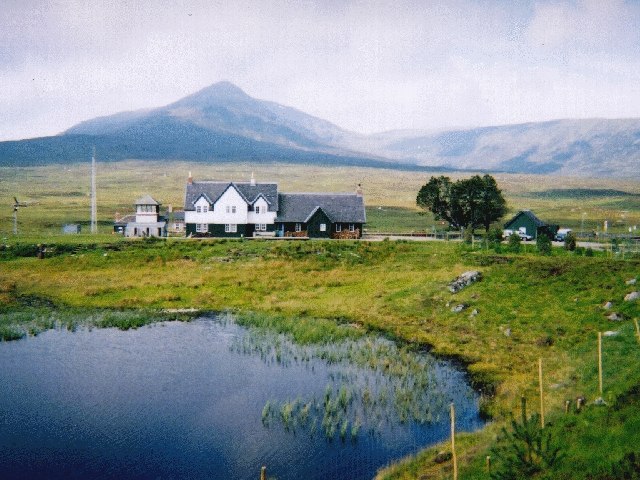
Corrour station on Rannoch Moor with Leum Uilleim behind it.
Tommy gets the other three down onto this platform to go walking, and what he gets back from Renton is the speech about how shite it is to be Scottish. The mountain behind the platform is Leum Uilleim. No public road reaches Corrour, the highest station in the UK and the most remote: it sits on the West Highland Line from Glasgow to Fort William, at the top end of Loch Ossian on Rannoch Moor, and you arrive by train or you walk in across the moor. Corrour Station House, on the platform itself, is a restaurant with rooms, run by the estate. The spot where four men get off in the middle of nowhere has a dinner service and beds for the night, and it is 128 kilometres from Princes Street with no road to it.
Television has come back for documentary since: the BBC's Secret Britain in 2010, and Paul Merton's Secret Stations for Channel 4. Neither shot a story here; in both the presenter simply turns up on the platform. A photograph taken at this spot in June 1996, four months after the film opened, catches a train unloading walkers and rucksacks onto an empty platform.
The station that gave the film its name
Leith Central railway station, foot of Leith Walk
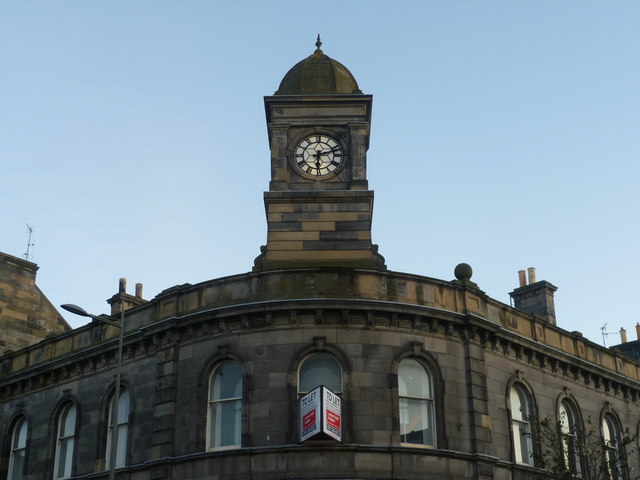
The clock tower of Leith Central station, which gave the film its title and never appeared in it.
In Irvine Welsh's novel, Begbie and Renton use the derelict Leith Central as a toilet, and a drunk in the dark asks them whether they are trainspotting. The drunk is Begbie's father. That exchange is where the title comes from, and Boyle's film does not contain it. The name stayed on the picture anyway. The sequel restored it: T2 Trainspotting, 2017, as a flashback.
Passenger trains ran here from 1 July 1903 until 7 April 1952 and then stopped. Diesels used the place as a depot until 1972, and after that it stood empty right through the 1980s, which is how it became the ruin the book describes. It is 2.8 km north of the streets the chase used.
The trainshed came down long ago. What still stands where Leith Walk runs out is the frontage, the clock tower and the row of shops beneath them, with the Central Bar pulling pints in the ground floor. Behind that front, on the ground the platforms used to cover, there is a supermarket and a children's soft-play centre.
The two locations nobody has placed
While the film was still being scouted, Boyle told Empire which rooms were giving him trouble: a crematorium, and above all a courtroom, because courts tend not to let crews in at all. The morning Empire's reporter spent riding around Glasgow with the scouts started at a crematorium.
A production that had secured a working nightclub, a cigarette factory standing empty under a preservation order and a platform on Rannoch Moor with no road to it found a courtroom harder than any of them. Where it found one, nobody wrote down.