A blind dancer runs through a leaf forest, soldiers ride her down across a field of small white flowers, and the last fight of the film happens in a blizzard. Almost none of that is China. It was shot inside a nature park in the Ukrainian Carpathians, in a circle thirty kilometres across around a town called Kosiv, over seventy days in September and October 2003.
4
places on the route
Switch regions with the buttons above; click a point to jump to its entry.
Two people who were there have described it in detail. Yurii Stefurak, deputy director of Hutsulshchyna National Nature Park, and Nadiia Kostiuk, who runs recreation and environmental education for the park and stayed with the Chinese unit for all seventy days.
Kostiuk counted twelve filming sites and said every one of them sat inside that circle. The circle is why Ukraine got the job. Zhang Yimou had looked at Russia, Switzerland and New Zealand first, and in Russia the sites had been hundreds of kilometres apart.
She also gave the split. The plan had been to shoot a third of the film in the Carpathians, then half of it. It came out at more than three quarters. What is genuinely Chinese, she said, is the interiors and the bamboo.
---
Ukraine
Hutsulshchyna National Nature Park
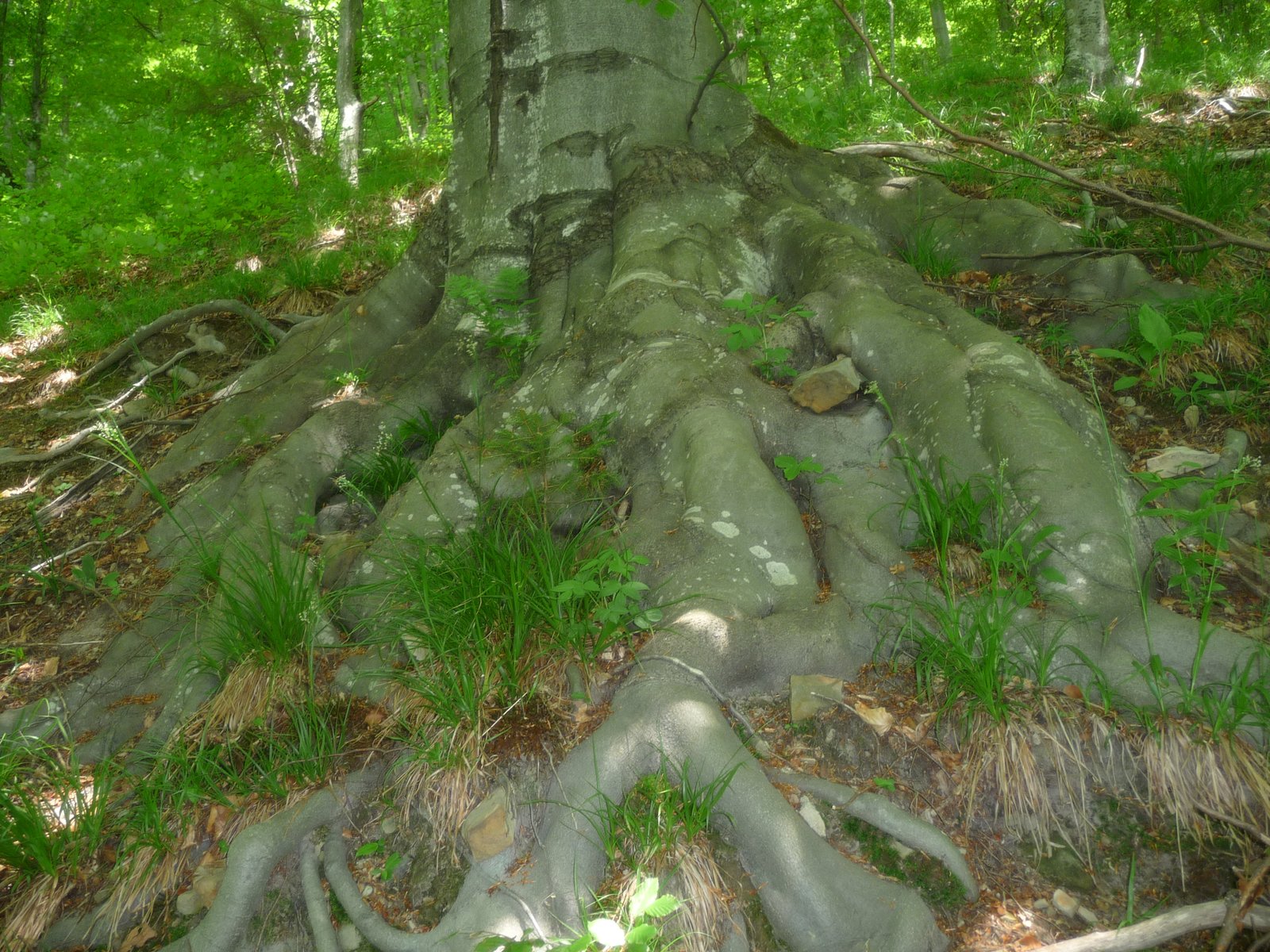
A beech in the Puhachivka tract inside the park, May 2011. Beech woods are the first thing park staff list when they describe what the crew filmed.
The park covers 32,248 hectares of hill country around Kosiv, and most of the film is made out of it: beech woods, mown fields, high meadows, horses. Kostiuk said the scouts were also after something the flatter parts of Europe cannot offer, mountains that stack in three tiers, one ridge behind another behind another, the way she said China itself used to look.
The horses are Hutsuls, the local mountain breed, and they are in most of the action. They came from sport stables in Ivano-Frankivsk and Sniatyn and worked with stunt riders from Kyiv. One stunt defeated all of them, a fall in which the horse turns almost a full double somersault.
The sport horses could not do it. It was done by an ordinary working horse belonging to a man named Vasyl from near Yabluniv, and the crew applauded.
The park lists two other features shot on its ground, both directed by Oles Yanchuk: Neskorenyi and Zalizna Sotnia. Those films are also how the Chinese production found the place. Park director Vasyl Prorochuk had worked with the Kyiv company Paradigma on them, and the approach came through him.
Kosiv
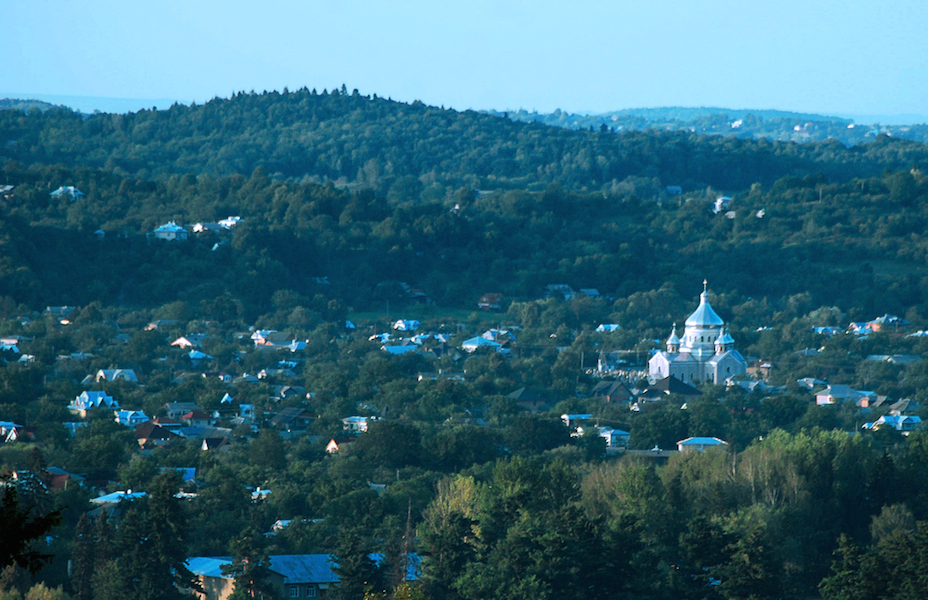
Kosiv from above, August 2012. The unit was based here for 70 days.
Eighty people came from the Chinese side and forty from the Ukrainian one, and they stayed seventy days. The Chinese were put up in two guest complexes above the town, Baika and Karpatski Zori. By the end almost nobody was translating; Kostiuk said they had got down to gestures.
The film needed a flowering meadow in late autumn, so the park grew one. The order arrived with percentages: this much yellow, this much red, this much blue, in bloom by the end of October, tall enough to move in the wind, because the blind heroine has to walk into a flower.
Then it stopped raining. The plot was kept alive with twenty tonnes of water a day poured over a hundred thousand seedlings, and it failed anyway. How it failed depends on who is telling it.
Stefurak remembers a shoot called for three in the afternoon and snow coming down instead; they went out and found an uncut meadow elsewhere. The Chinese account, taken from the making-of documentary, has Zhang Yimou spotting a patch of small white wild chrysanthemums from a car on the way back from a scout, two days before the first day of shooting, a patch several times bigger than the one he had ordered planted and with about two weeks of flowering left in it.
The two versions agree on the ending. The meadow the park grew is not in the picture. The meadow that is in it grew by itself.
Then the snow came, in October, and it did not go. Zhang Yimou has described getting up one morning to find everything outside the window white, being told by locals it would be gone within a day, waiting the day, and working out that ten days of melting would leave him with ruined leaves and no autumn to shoot either. So he rewrote the ending and put the last fight in the blizzard.
Moving was not available to him. One of the leads was contracted to be in Kosiv for a single week, and Kostiuk says there was no time to shift a unit that size from the Carpathian foothills down to Crimea or across to Transcarpathia, where the season was still holding. Then the sun came out and the snow began to go. The final episodes were finished in one shaded corner of the park where some of it was still lying.
Of Kostiuk's twelve sites, one has a name attached to it in print, and the park is what attaches it. In the route it publishes from Kosiv to its Zdvyzhyn education centre, the paragraph on the Dubyna tract adds that the film was shot there. It does not say which scene.
Dubyna is an oak and birch wood in the Pokuttia Carpathians, at 380 to 400 metres, in the park's Stari Kuty division. The villages around it use it for picnics, and district and regional hiking rallies are held there.
The park's own trail through it runs 4.37 kilometres. It starts at the nursery where the park raises over a hundred thousand saplings, passes the St Nicholas apiary and its fifty-odd hives built as chapels, a Hutsul cottage, a bear, a bee and a windmill, and goes on through birch. Then the Tsukhaniv tract, a protected stand of oak and hazel in the valley of the Tsukhaniv, a tributary of the Cheremosh. Then Try Kruli, oak mixed with spruce and hornbeam, with jays, hazel grouse and woodpeckers in it. Then the ponds, which hold pike, carp and grass carp and have Carpathian newts round the edges. It ends at the edge of the wood.
Driving to it, the park's route leaves Kosiv on the Kuty road, turns left at the far end of Smodna village for the airfield where the Yavson aeroclub flies, and takes the village road on to Kobaky, past the ponds and the nursery. Fourteen kilometres in all.
Lake Lebedyn
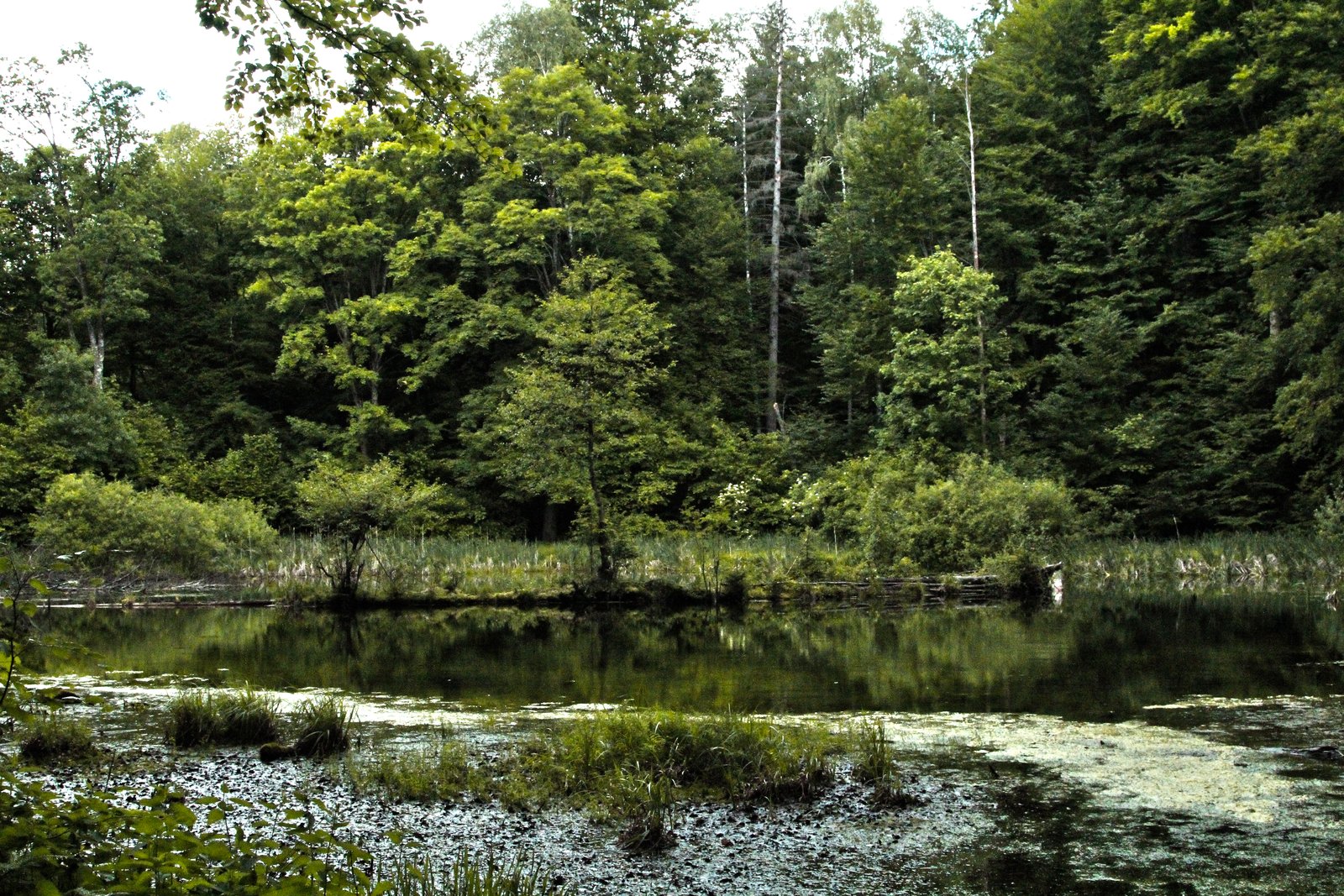
Lake Lebedyn, May 2014. The road up to it was rebuilt while the production was in the area.
The production spent money in Kosiv and some of it stayed on the ground. The road up to Lake Lebedyn, a small mountain lake northwest of the town, was rebuilt while the crew was in the area, and the park's account puts that repair down to the film, along with fifteen mobile phones, a field kitchen and army tents that afterwards went to children's camps.
Whether the lake itself is in the film is a separate question and the same account does not answer it. It describes a scene of the heroine bathing at a lake at the end of October, and the trouble around it: the park drew clean spring water and heated it, the actress refused it in case of infection, and bottled water was driven in from Ivano-Frankivsk. It does not say which lake.
China
Chashan Zhuhai
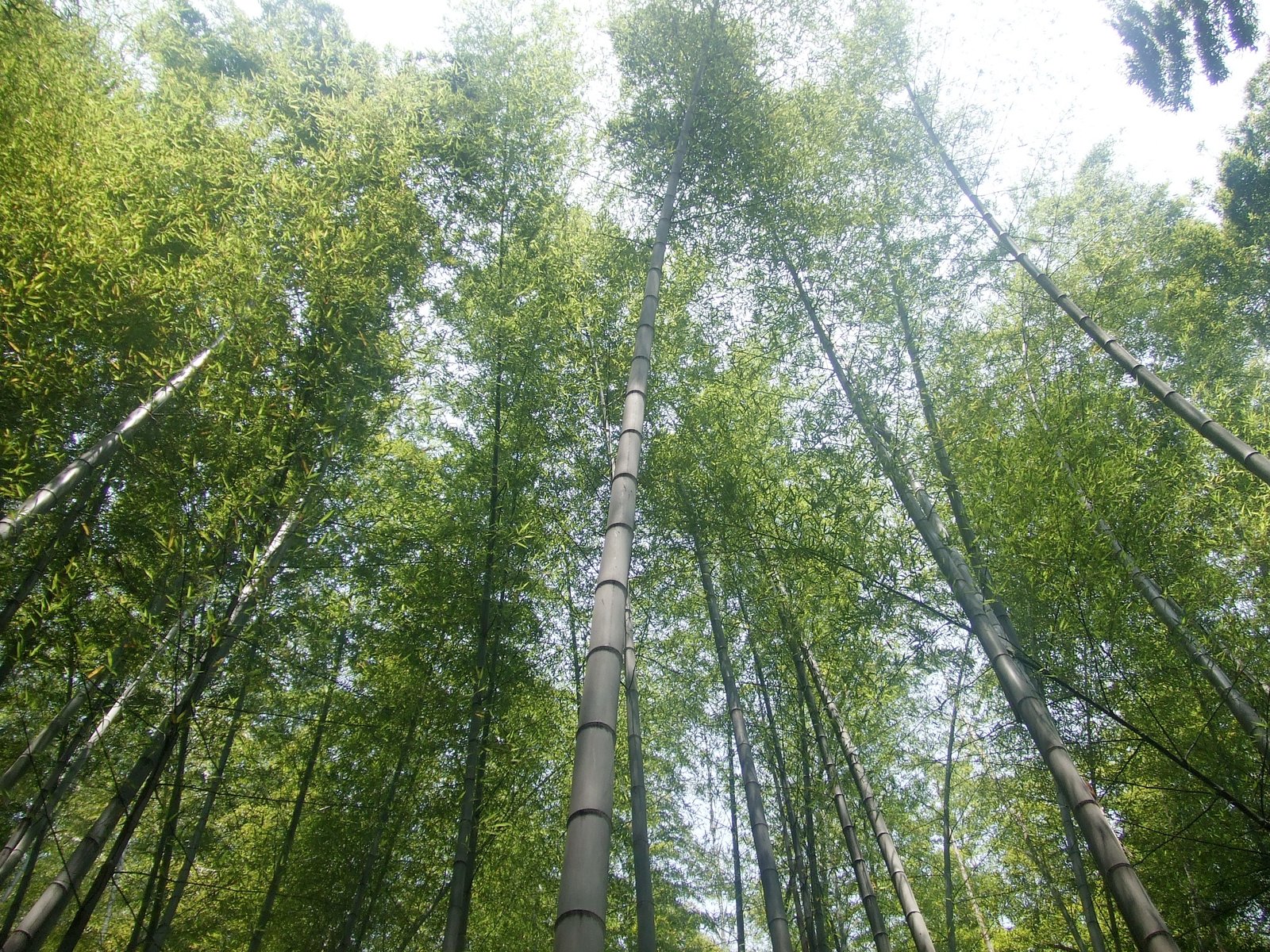
Looking up inside the bamboo at Chashan Zhuhai, April 2011.
The bamboo is the part that really is China, and it was shot last.
By 7 January 2004 the crew had been twenty days inside the Yongchuan bamboo sea on a closed set, based at the tea-house resort in the forest park. The location was Shanziwan, one bay of it. A second spot in the park, where a thatched hut had been built, was still standing unused.
Nearly everything they took there was fighting. Andy Lau worked seven and a half hours at Shanziwan on 7 January and had no dialogue in any of it. Two days before that the production borrowed two hundred armed police as extras, made them up as Tang constables with swords and long knives, and sent them after Zhang Ziyi through the densest part of the bay. The figures running along the tops of the bamboo were doubles on two cranes.
Takeshi Kaneshiro finished his last scene and left on 5 January. The ending of the film had been shot three months earlier, in snow, in another country.